














Cultivating Turmeric, Harvesting Gold
The northern region of Thai Nguyen boasts ideal soil and climate conditions for turmeric cultivation, particularly in hilly areas with moderate slopes and well-drained, moisture-retaining soil. According to scientific evaluations, turmeric grown here yields exceptionally high levels of Curcumin.
Tests conducted by the Center for Technical Standards, Measurement, and Quality (under the General Department of Standards, Metrology, and Quality) reveal that 1kg of Bac Kan turmeric starch contains up to 78.13g of Curcumin, four times higher than turmeric from other regions. This makes northern mountain turmeric highly valued and sought after by businesses.
Thai Nguyen province currently cultivates approximately 250 hectares of turmeric, primarily in communes such as Na Ri, Bach Thong, Cho Don, and Phong Quang. The main varieties grown are yellow turmeric and red sticky turmeric, favored for pharmaceuticals, health supplements, and premium spices.
In Phong Quang commune, Thai Nguyen, Ms. Ban Thi Nuong of Ban Chieng village shares, “I utilize vacant land between forests to grow turmeric. It’s easy to cultivate, with minimal pests and diseases. After preparing the soil once, the plants thrive on their own until harvest.”
Many local households have switched to turmeric, replacing less profitable crops.
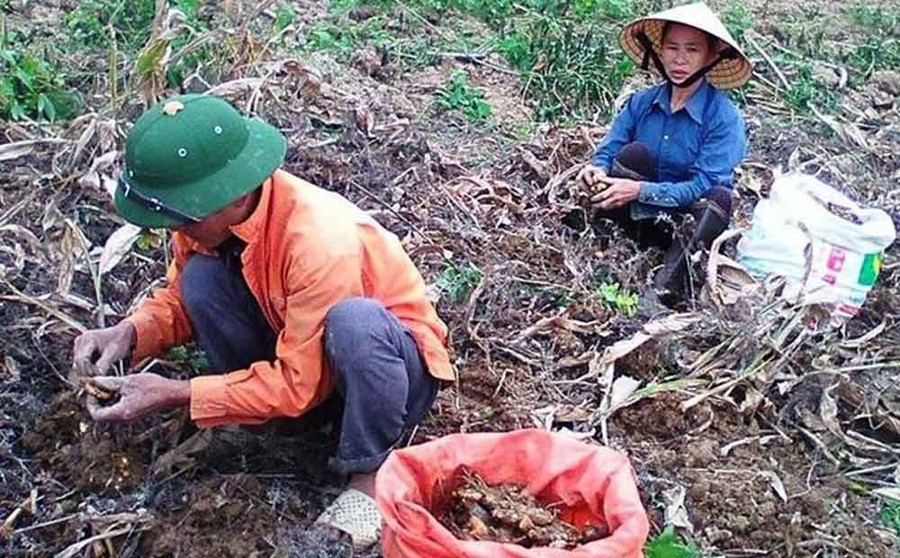
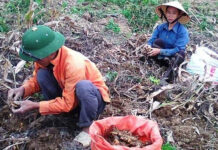
Turmeric harvest in Cao Bang. Photo: T.L
In Cao Bang province, turmeric is cultivated across approximately 50 hectares in communes like Thong Nong, Can Yen, and Thanh Long.
Mr. Hoang Trung Dung, Chairman of Can Yen Commune People’s Committee, notes, “Turmeric is primarily grown in areas with dry, infertile soil suitable for only one corn crop annually. Compared to corn, turmeric yields 1.5 times higher economic returns per hectare.”
Each hectare of turmeric produces around 20 tons of tubers at harvest. With prices ranging from 5,000 to 7,000 VND/kg, farmers can earn 100–140 million VND/ha/crop. This stable income has led locals to dub turmeric the “mountain gold.”
Enhancing Turmeric’s Market Value
Leveraging abundant raw materials, several value chain models have emerged, with businesses and cooperatives providing seeds, techniques, and product purchase guarantees to farmers.
This collaboration ensures farmers’ production stability, secures raw material supplies for businesses, and delivers traceable products to markets.
Through agricultural extension projects, industrial promotion programs, and the OCOP initiative, some businesses and cooperatives have invested in advanced processing lines, brand development, and market expansion. This elevates turmeric’s value beyond fresh tubers to high-value processed products.

Large-scale concentrated turmeric farming areas established in Thai Nguyen and Cao Bang.
Businesses and cooperatives now offer diverse turmeric products, including black sticky turmeric extract, red sticky turmeric extract, honey-turmeric capsules, and turmeric powder. These products support cancer treatment, stomach ailments, skin brightening, blood nourishment, inflammation reduction, and overall health and beauty enhancement.
The high purity and exceptional Curcumin content have solidified northern mountain turmeric’s market position.
Mr. Nguyen Anh Xuan, Chairman of Phong Quang Commune People’s Committee, states, “Many turmeric products have achieved 5-star OCOP ratings and national recognition as outstanding rural industrial products, marking a significant milestone for export market expansion.”
Bac Kan turmeric starch from Thai Nguyen is now available nationwide and exported to international markets, including India, Ukraine, Taiwan (China), France, and notably, the stringent markets of the U.S. and Japan.
Transforming seemingly barren hills into sustainable livelihoods, turmeric has charted a new course for mountainous agriculture.
By linking production with markets and fostering farmer-business partnerships, the “mountain gold” will continue enhancing incomes and driving new rural development in upland areas.