




















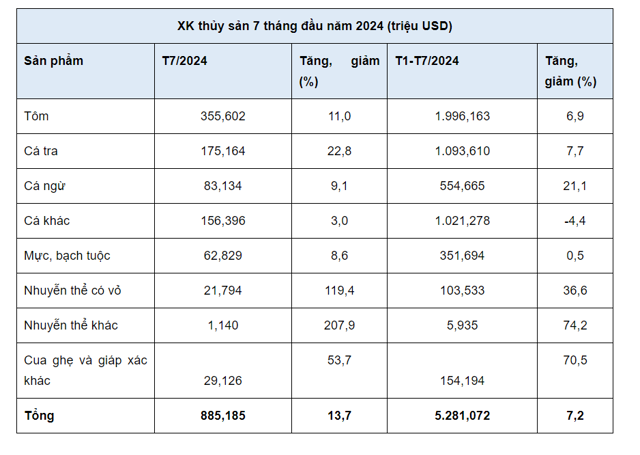
According to the Vietnam Association of Seafood Exporters and Producers (VASEP), the export of all key seafood products experienced more robust growth in July 2024.
Notably, shrimp exports increased by 11%, the highest growth rate in the past seven months. Specifically, shrimp exports to China and the EU surged by 24% and 32%, respectively, while exports to the US and Japan rose by 9% and 4%, respectively. However, exports to South Korea decreased by 21%.
EXPORT TURNOVER IN THE FIRST SEVEN MONTHS REACHED NEARLY USD 5.3 BILLION
In the first seven months of 2024, shrimp exports reached nearly USD 2 billion, up 7% compared to the same period last year. White-legged shrimp accounted for USD 1.45 billion, up 4%, while black tiger shrimp reached USD 246 million, down 10%. Notably, exports of spiny lobster increased nearly threefold to USD 145 million.
“In the first seven months of 2024, the export turnover of Vietnam’s seafood industry reached USD 5.28 billion, up 7% compared to the same period in 2023”
According to the Vietnam Association of Seafood Exporters and Producers (VASEP)
Tra fish exports showed brighter signs with a 23% increase in July 2024. Notably, exports to all major markets, including the US, Japan, China, and the EU, recorded double-digit growth ranging from 20% to 40%, except for a slight increase of 5% in the EU market.
In the first seven months of 2024, tra fish exports reached nearly USD 1.09 billion, up 7.7% compared to the same period last year. China remains the primary market for Vietnamese tra fish, with a value of USD 317 million, down 2.3% compared to the same period in 2023. This market mainly consumes large-sized tra fish (>1.2 kg/fish) in the form of whole fish or fillets. It is also a potential market for by-products such as tra fish swim bladders. In the first seven months of this year, exports of tra fish swim bladders reached approximately USD 50 million, with USD 40 million worth exported to China, accounting for 80%.
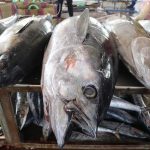
After continuously achieving double-digit growth rates ranging from 16% to 32%, the export of tuna slowed down in July 2024, increasing by only 9% compared to the same period last year. Cumulative exports of tuna in the first seven months reached USD 555 million, up 21% compared to the same period last year. The two main export products are canned/pouched tuna and frozen tuna loins/fillets (raw material for canned tuna production).
Since Decree 37/2024 took effect (from May 19, 2024), tuna processing and exporting enterprises have faced challenges in sourcing raw materials that comply with the new regulations, which require a minimum size of 0.5 meters for caught yellowfin tuna.
VASEP has sent an official dispatch to Prime Minister Pham Minh Chinh, Deputy Prime Minister Tran Luu Quang, and the Minister of Agriculture and Rural Development, reporting and proposing amendments to Decree 37 to align with international practices and reality, including the provision related to the minimum size of yellowfin tuna.
Simultaneously, VASEP also sent a document to its member companies, requesting their compliance with the IUU regulations and Decree 37 while awaiting the Government’s consideration and revision.
In the past two months since Decree 37 took effect, some tuna enterprises have completely stopped purchasing domestic raw materials from fishermen due to the inability to meet the 100% requirement of the 0.5-meter size rule. Most ports currently do not provide raw material certification (S/C form) for yellowfin tuna lots that do not meet the size requirements stipulated in Decree 37. This period coincides with the peak season (July, August, and September) for yellowfin tuna fishing by Vietnamese fishermen.
In addition to tuna, other seafood products such as squid, octopus, and other marine fish also face raw material shortages for export and lack the necessary catch certification for exports to the EU.
Exports of other marine fish (excluding tuna) decreased by over 4% in the first seven months of 2024. Meanwhile, squid and octopus exports remained stagnant, reaching approximately USD 351 million.
FROZEN SEAFOOD EXPORTS TO THE US AND EU, FRESH SEAFOOD TO CHINA
The top four markets for Vietnamese seafood showed significant demand recovery in July 2024: China (+30%), the US (+14%), Japan (+11%), and the EU (+14%). In the first seven months, seafood exports to the US and China both grew by 10% and accounted for similar proportions.
While exports to the US and the EU mainly comprise frozen products, the picture is different for China. In the first half of this year, seafood exports to China reached nearly USD 690 million, up 8.4%. Tra fish remained the largest export item, accounting for 35% with over USD 243 million, despite a 7.4% decrease compared to the same period last year.
“In the first seven months of 2024, seafood export turnover to the US and China both surpassed USD 930 million, each accounting for nearly 18% of Vietnam’s total seafood export turnover. Meanwhile, seafood exports to the EU also increased by 10%, reaching over USD 600 million”
According to VASEP
The second-largest export item to China in the first half of this year was spiny lobster, with nearly USD 122 million, up 174% and accounting for nearly 18% of seafood export value to this market. Exports of white-legged shrimp to China decreased by 10%, reaching USD 117 million. Exports of black tiger shrimp also declined by nearly 30%, reaching USD 38.5 million.
Meanwhile, exports of live crab to China increased twelvefold to USD 49 million. Frozen seafood exports to China in the first half of the year mostly decreased due to lower prices, while fresh seafood performed better. In addition to spiny lobster and live crab, live clams (mainly carpet clams and flower clams) and live abalone also witnessed strong growth, increasing by 280% and 282%, respectively, compared to the same period last year.
The Chinese market for frozen shrimp is currently in a state of oversupply due to the influx of products from Ecuador and high domestic harvests. In contrast, demand for salmon and spiny lobster in China is expected to continue rising.
As the global leader in seafood consumption, Chinese consumers are increasingly favoring high-quality, value-added seafood products. This shift in preference has led to a transition from purchasing seafood at traditional markets to buying fresh seafood through e-commerce channels. Shrimp is the most popular seafood item purchased online by Chinese consumers.
VASEP assesses that regarding frozen products, the US and EU markets are expected to perform well in the second half of the year due to positive signals such as economic recovery, decreasing inflation, and lower interest rates, which could stimulate demand in these markets.
Meanwhile, exports of frozen products to China have yet to break through, with relatively low prices. On the other hand, China is the number one destination for fresh seafood, catering to the hospitality and tourism industries. Therefore, Vietnam’s fresh seafood products, such as spiny lobster, crab, clams, and abalone, will likely remain attractive to Chinese consumers in the coming period.
Vietnam’s $800 million product captivates the US and Russia: Over 100 countries import it for consumption
This product is exported to over 100 countries worldwide and has helped Vietnam earn hundreds of millions of dollars.
China triples imports of Vietnamese seafood

According to the Vietnam Association of Seafood Exporters and Producers (VASEP), Vietnam’s seafood exports reached nearly $750 million in January, a 64% increase compared to the same period last year. Notably, exports to many markets have surged.
Seafood stocks surge simultaneously
On February 26, the VN-Index started trading with a rebound as stocks in the securities, steel, fertilizer, and chemical sectors showed positive signs. The export sector also received good news, with the seafood group recording a series of stocks reaching the maximum price increase.