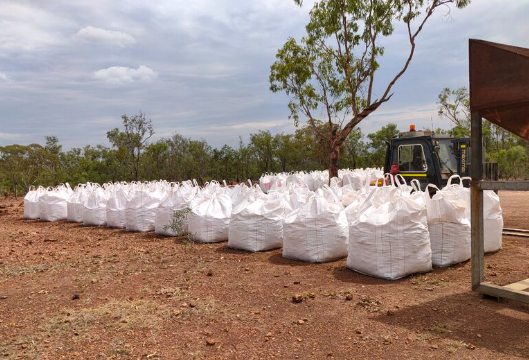
Illustrative Image
Preliminary statistics from the Customs Department reveal that Vietnam’s cashew nut imports in July reached over 296,000 tons, valued at more than $436 million, up 5.4% in volume and 4.2% in value compared to June. In the first seven months of 2025, the country imported over 1.89 million tons of cashew nuts worth more than $2.9 billion, an increase of 6.2% in volume and a significant surge of 36.1% in value compared to the same period in 2024.
Vietnam has consistently maintained its position as the world’s top exporter of cashew kernels for many years, capturing a significant share of the global cashew kernel export market. This achievement is a testament to the Vietnamese cashew industry’s unwavering commitment to establishing its reputation in the international arena. While domestic supply plays a crucial role, the country also invests significantly in imports to reinforce its global leadership.
In terms of market sources, Cambodia stands as Vietnam’s largest cashew nut supplier, contributing over 915,000 tons valued at over $1.38 billion. This marks a substantial increase of 16% in volume and an impressive 37% in value compared to the previous year. The average price reached $1,517 per ton, reflecting an 18% jump from the price in the first seven months of 2024.
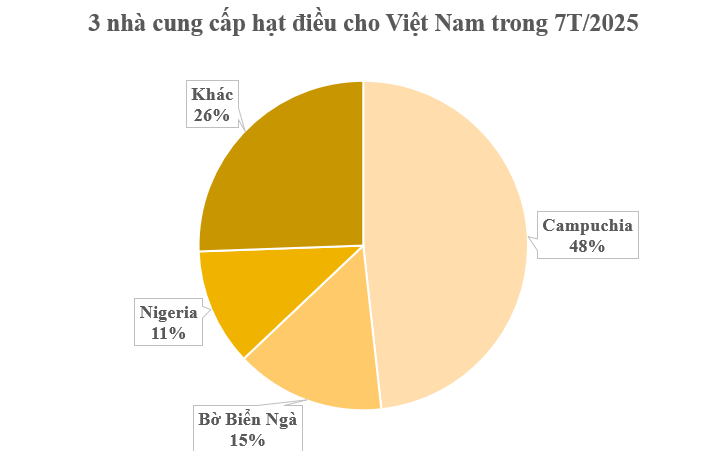
Côte d’Ivoire ranks second, with over 278,000 tons worth more than $433 million. While there was a 14% decline in volume, the value surged by a notable 17% compared to the same period in 2024. Import prices witnessed a significant increase of 37%, corresponding to $1,555 per ton.
Nigeria, Vietnam’s third-largest cashew nut supplier, provided over 218,000 tons valued at more than $319 million. This represents a substantial increase of 24% in volume and an impressive 61% surge in value compared to 2024. The average price stood at $1,462 per ton, reflecting a significant 31% increase.
For Vietnam’s neighboring supplier, cashew nuts hold strategic importance and possess high commercial value, playing a pivotal role in their national economy, alongside rice and rubber. Cambodia has been diligently working to solidify its standing as one of the world’s foremost producers and exporters of cashew nuts, boasting substantial production volumes and considerable export earnings, with Vietnam as its primary export destination.
The Ministry of Finance issued Circular No. 40/2014/TT-BTC to guide special preferential import tax rates for goods originating from the Kingdom of Cambodia. Accordingly, the Circular stipulates a 0% special preferential import tax rate for various goods imported into Vietnam from Cambodia, specifically targeting the following:
Coconuts, Brazil nuts, and cashew nuts, fresh or dried, whether or not shelled or peeled; Dates, figs, pineapples, avocados, mangoes, and mangosteens, fresh or dried; Melons (including watermelons) and papayas, fresh;
Rice; Molasses resulting from the extraction or refining of sugar; Products made from cassava starch and substitutes prepared from starch, in the form of flakes, grains, pearls, siftings, or similar forms;
Thus, cashew nuts imported from Cambodia and other ASEAN countries benefit from a 0% import tax rate, whereas imports from non-ASEAN markets are subject to a 5% tax rate.
The Vietnam Cashew Association (VINACAS) has set an ambitious target of achieving a cashew export turnover of $4.5 billion in 2025. To materialize this goal, the industry must focus on three pivotal pillars: enhancing product quality, diversifying markets, and intensifying trade promotion. Amidst the ongoing complexities of global trade tensions, proactively staying abreast of market intelligence, adjusting business strategies, and investing in deep processing will be pivotal for survival and success.
China’s Urgent Pursuit of Vietnamese Cashews: Unveiling the Strategy

In the first seven months of the year, Vietnam exported 412,000 tons of cashew nuts, raking in a impressive $2.8 billion. In recent months, China has surpassed the US as Vietnam’s largest cashew nut importer, showcasing a shift in the global market for this sought-after commodity.
“Transforming Intellectual Property into a National Strength: A Policy Refinement”

“Speaking at the forum ‘Refining Intellectual Property Policies – A Driving Force for Innovative Enterprises’, organized by the VCCI, a representative from the Department of Domestic Market Management and Development (Ministry of Industry and Trade) emphasized the critical role of intellectual property. They highlighted that intellectual property serves as a protective tool for creations and a foundation for innovation. Additionally, they outlined the challenges and provided policy directions to enhance the legal framework surrounding intellectual property rights in the country.”
A United Front: The Political Resolution for a Standardized National Curriculum

“The Political Bureau directs a thorough review and evaluation of the implementation of the National General Education Program. This includes a unified approach to providing a single set of textbooks across the nation. The ambitious goal is to ensure free access to these textbooks for all students by the year 2030.”
Resolution 68: Transforming Perceptions and Mindsets About the Private Sector

“Professor Dang Viet Anh highlights the ambitious goals set by Resolution 68, which envisions a significant boost in private enterprises in Vietnam by 2030. The resolution aims for a substantial increase, targeting at least 1 million additional private businesses in the country by the end of the decade.”
The Power Trio: BSH, VIG & TAPTAP’s Strategic Alliance for Sustainable Growth

As insurance needs become increasingly intertwined with life experiences, consumers demand swift and transparent solutions. The collaboration between BSH Insurance, VI Group, and TAPTAP does not merely bring insurance closer to digital-savvy consumers but also forges a multifaceted ecosystem where both customers and businesses thrive.