








The 80th anniversary of the August Revolution and National Day on September 2nd featured a impressive parade, with many spectators praising the stunning footage, especially the camera work of Le Bao Han.
Le Bao Han is a renowned cinematographer and director of photography in the film industry. He possesses extensive experience in cinematography, TVC advertising, and is an expert in steadicam operation – a device that facilitates smooth and stable shots.
Han revealed that he was tasked with capturing the dynamic scenes at the main grandstand using the steadicam, while the rest of the footage was handled by teams from VTV and the Vietnam Film Center (VFC).
A Billion-dong Setup
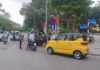
To accomplish his task, Han donned a steadicam setup weighing over 20 kg and worth billions of dong. During the live broadcast, viewers might have spotted him riding an electric scooter, donning an exoskeleton, and maneuvering the steadicam with both hands.
The steadicam is an image stabilization system used to capture smooth and controlled tracking shots. It isolates the cameraman’s movements, ensuring stable footage even when the camera is bumped or moved across uneven surfaces. Steadicam combines the stability of a tripod with the flexibility of a dolly and the agility of handheld shooting.
Directors and cinematographers commonly use steadicams for:
Tracking shots: Following characters as they move through a scene or space, giving viewers a tour of their surroundings.
POV shots: Reflecting the mindset of a character and showing how they perceive the world through their perspective and mental state.
Confined space shots: Capturing fast-paced action sequences or shooting in tight locations like narrow staircases where larger dollies won’t fit.
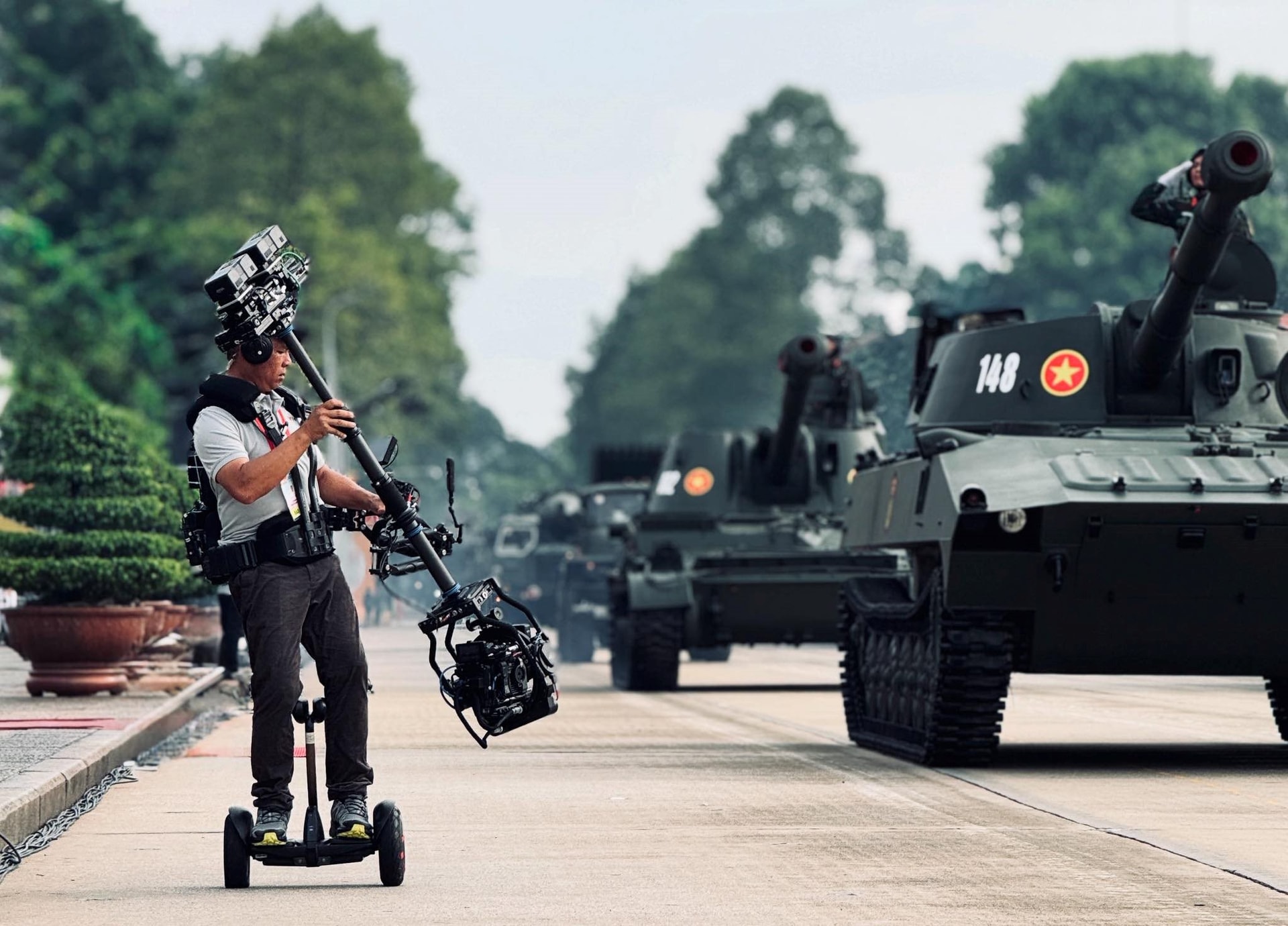
Photo: Le Bao Han
And There’s More…
To achieve these breathtaking shots, Le Bao Han and his team utilized the Trinity system.
Vietnam has caught up with the world by acquiring the Trinity – a hybrid between traditional steadicams and gimbals. Trinity is the first hybrid image stabilization system that combines classical mechanical image stabilization technology with advanced active electronic image stabilization technology, made possible by 32-bit ARM gimbal technology. This fusion results in five control axes, enabling smooth, versatile, and precisely controlled movements, unlimited filming experiences, and complete creative freedom.
Trinity employs a 5-axis electronic gimbal system, a step up from the traditional steadicam’s 3-axis mechanical system.
Trinity offers new shooting angles and storytelling options for directors and cinematographers. The camera can transition from low to high mode during shooting by inverting the axis; it can also utilize a fully stabilized tilt axis controlled by a joystick, allowing for smooth transitions from low-angle to over-the-shoulder shots.
By maintaining the axis at a 45-degree angle and panning left or right, the camera can even peek around corners, regardless of the mode. The additional stabilization on the roll axis enables the use of telephoto lenses. Unconventional shots, angles, and movements are achievable when Trinity is used in full stabilization mode. For situations that demand a more traditional operating style, Trinity can be switched to a locked mode where the tilt axis is connected directly to the post in a conventional manner.
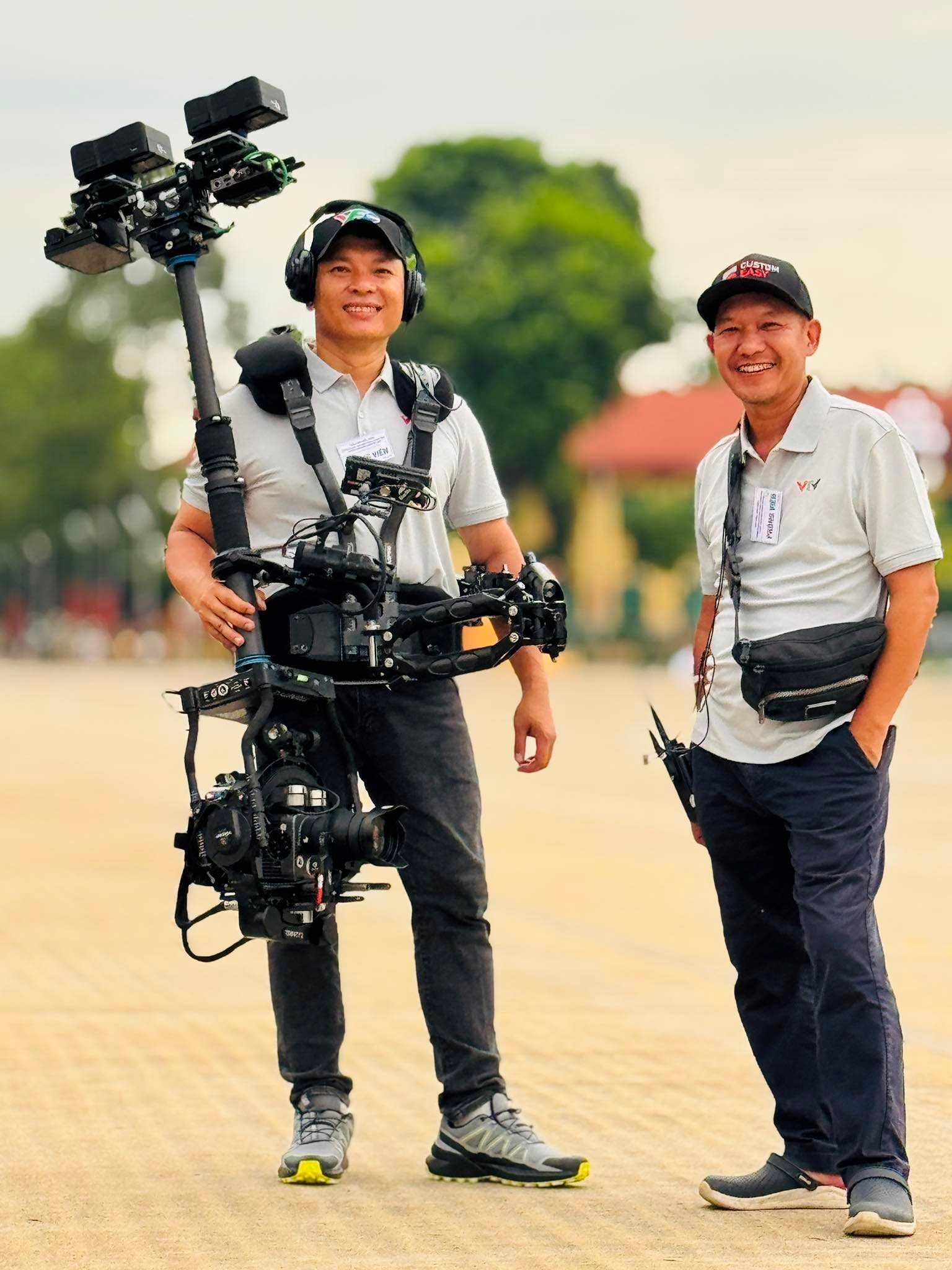
Photo: Le Bao Han
Trinity is a Popular Choice Due to its Unique Features:
Smooth Angle Transitions: One of Trinity’s most unique capabilities is its ability to allow cinematographers to smoothly transition from low to high angles or vice versa in a single take, creating seamless and impressive shots that other systems cannot achieve.
Unprecedented Shots: With its flexible pan and tilt capabilities, Trinity enables operators to effortlessly maneuver the camera around obstacles or “look” around corners, opening up new creative possibilities.
System Integration: Trinity is designed to work seamlessly with various camera lines and accessories, including wireless lens control systems and video feeds.
Intelligent Power Management: The improved battery and power management system provides stable power to the camera and auxiliary equipment, with on-screen displays for easy monitoring by the operator.