















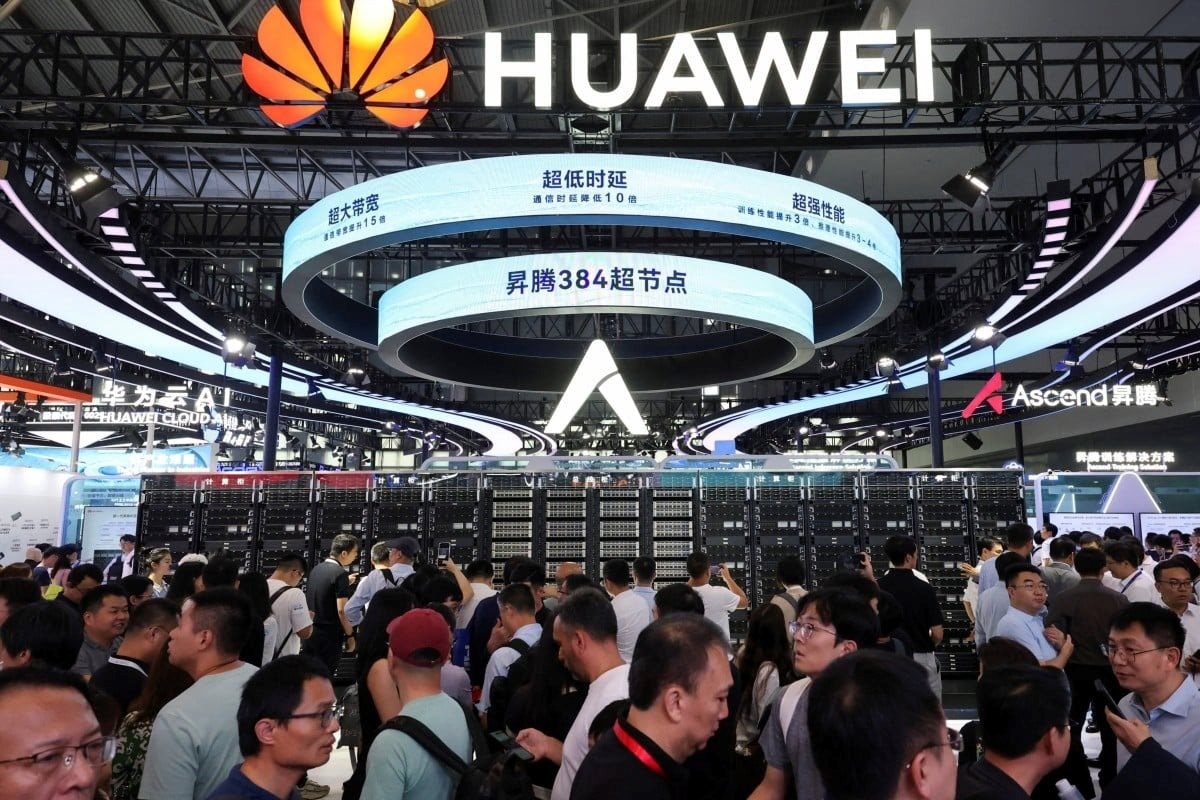
Huawei Technologies has unveiled groundbreaking hardware capable of delivering world-class computing power without relying on advanced Nvidia chips. This development marks a significant leap toward freeing China from the supply constraints that have hindered its artificial intelligence ambitions.
The Shenzhen-based tech giant announced the creation of the world’s most powerful “supernode” computing cluster, leveraging domestically produced chip manufacturing processes. This achievement underscores China’s growing self-reliance in AI computing infrastructure.
“Huawei will build a ‘supernode + cluster’ computing solution using China’s existing chip manufacturing capabilities to meet the surging demand for AI computing,” stated Eric Xu, Huawei’s Deputy Chairman and Rotating Chairman, during the company’s annual Connect conference.
Xu also revealed plans to launch upgraded versions of Huawei’s Ascend AI chips over the next three years, including the Ascend 950PR in Q1 2026, aligning with the release schedules of Nvidia and AMD’s AI chips.
Xu’s announcement comes as Beijing intensifies pressure on major Chinese tech firms to halt purchases of Nvidia chips tailored for the Chinese market, which were designed to comply with U.S. export restrictions.
In response to Beijing’s stance, Nvidia CEO Jensen Huang expressed disappointment but remained patient, stating, “I’m disappointed with what I see, but I’m patient.”
A supernode is a high-performance server cluster that integrates multiple AI accelerators using ultra-fast connections. Huawei introduced the Atlas 950 SuperPoD and Atlas 960 SuperPoD, capable of supporting 8,190 and 15,488 Huawei-manufactured Ascend processors, respectively. The company claims these systems lead globally in processor connectivity scale, total computing power, memory capacity, and connection bandwidth.
“Computing power has been the cornerstone of AI in the past, and it will remain so in the future—especially for China’s AI development,” Xu emphasized.
Huawei also unveiled the Atlas 950 SuperCluster and Atlas 960 SuperCluster, which can support between 500,000 and 1 million processors, making them the “world’s largest AI computing clusters,” according to the company.
How US Sanctions Unwittingly Turned Huawei into China’s Tech “Trump Card”
It turns out that US sanctions on Huawei are inadvertently fueling the growth of China’s tech industry.
The iPhone Model That Could Save a Declining Smartphone Market

The foldable smartphone market is in a rut, but the launch of the iPhone foldable will be a game-changer.
The Race to 100,000: Can Huawei’s Homegrown OS Dream Compete?
Huawei has set an ambitious target for its proprietary operating system, aiming to reach 100,000 apps within the next six months to a year.
‘Apple Should’ve Sold It at Half the Price’: Users in a Country Are Furious Over the Lack of the Most Attractive Feature on iPhone 16

The most anticipated feature on the iPhone 16 will not support Mandarin (or any other Chinese dialect) until at least next year.
The Unfazed Tech Giant: Huawei’s Defiant Unveiling of its Triple-Fold Phone on iPhone 16’s Launch Day

A bold and daring move by Huawei.