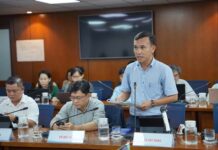
















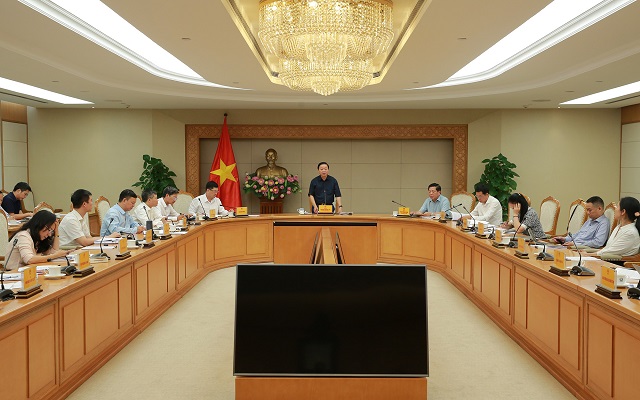
Deputy Prime Minister Tran Hong Ha chaired a meeting to review and provide feedback on the amendments to the Construction Law – Photo: VGP/Minh Khoi
|
On the morning of September 12th, Deputy Prime Minister Tran Hong Ha chaired a meeting to review and provide feedback on the amendments to the Construction Law (Draft Law), with the participation of various ministries, localities, experts, and associations in the construction industry.
Proposal for a “One-Stop, One-Key” Approach in Construction Approval and Permitting
Commenting on the Draft Law, a representative from the Ministry of Justice suggested that the 2014 Construction Law has undergone numerous amendments, making it challenging to reference and apply. Therefore, a comprehensive revision is necessary this time, consolidating all previous amendments. The Draft Law should focus on addressing issues within the scope of the Construction Law, separating the management of public and private projects, and revising provisions on construction contracts and technical content to ensure feasibility.
Delegates agreed that the amendment of the Construction Law should be comprehensive and aligned with the Investment Law, Public Investment Law, and other related laws to avoid overlaps and loopholes in management. Mr. Le Anh Quan, Vice Chairman of Hai Phong City People’s Committee, pointed out that after administrative boundary mergers, many projects had to be halted or transferred to new investors, but the Draft Law does not clarify the settlement procedures. Luu Van Phuong, Deputy Director of Hanoi Department of Construction, proposed reforming the construction permitting process through a “One-Stop, One-Key” mechanism for simultaneous evaluation and time reduction.
Mr. Hoang Quoc Hiep, Chairman of the Vietnam Construction Contractors Association, praised the amended Construction Law Draft for covering non-budget activities and ensuring fairness among entities. However, to accommodate key projects like high-speed railways and Long Thanh Airport, he suggested adding the concept of a “contractor consortium” – a form of collaboration among independent, specialized contractors with a joint management board, replacing traditional joint ventures.
The leadership of the Vietnam Construction Contractors Association also recommended clarifying the authority of investors to adjust contracts, allowing reference to foreign standards and unit prices, mandating a minimum 30% payment guarantee for contract value to protect contractors, and supplementing the responsibility for payment to subcontractors. Additionally, there should be consistency in warranty regulations between the Construction Law and the Housing Law, and project directors and management boards should hold professional certificates.
Eliminating Redundant Provisions Overlapping with Other Laws
Concluding the meeting, Deputy Prime Minister Tran Hong Ha commended the Ministry of Construction for its responsible, scientific, and receptive approach, incorporating various opinions to achieve high consensus. Leaders, representatives from ministries, localities, and experts provided in-depth contributions, directly addressing specific clauses, demonstrating thorough research.
The Ministry of Construction must adhere to the political foundation and directives of the Politburo and the Government, treating the amendment of the Construction Law as an urgent task to institutionalize the policy of decentralization, empowerment, administrative unit reorganization, and local government restructuring at two levels. The Law should be consistent with related laws such as Land, Planning, and Investment, facilitating local implementation.
According to the Deputy Prime Minister, the clauses in the Draft Law should be categorized into four groups:
First, technical and textual amendments to ensure consistency with the two-tier local government model.
Second, policy changes requiring in-depth analysis, particularly regarding decentralization, authority, and management techniques.
Third, administrative procedure simplification, potentially reducing 50% of steps through a “One-Stop, One Dossier” mechanism.
Fourth, the application of information technology and digital data in construction management. “We must remove from the draft any provisions overlapping with other laws,” the Deputy Prime Minister stated.
Encouraging New Technologies, Aiming for Green, Smart, and Digital Transformation in Construction
Commenting on specific issues, the Deputy Prime Minister suggested that project classification should be based on the nature of the structure, technological complexity, and impact on safety, environment, and society. “A large-scale urban area with familiar techniques differs significantly from a bridge using new technology for the first time. The classification method must be more practical.”
Consequently, the identification of management subjects should focus on three groups: investors and investment managers; design consultants, supervisors, and evaluators; and main and subcontractors. Even households and small organizations participating in construction are subjects to be regulated, linked to contractual responsibilities, payments, warranties, and protection of all parties’ interests.
Regarding construction permitting procedures, the Deputy Prime Minister emphasized that this is the final management tool to ensure compliance with planning, design, fire safety, and environmental standards. However, the process should be shortened, avoiding overlaps, while maintaining national and international standards for the capacity of officials, consulting units, supervisors, and contractors.
“We should not fear the name ‘permit.’ What matters is process reform, consolidating multiple procedures into one dossier, one stop, with clear authority. If the feasibility design dossier already integrates these contents, permitting becomes almost confirmatory,” the Deputy Prime Minister noted.
Highlighting the lack of standards, norms, and unit prices in construction, which hinders both central and local agencies, the Deputy Prime Minister proposed allowing reference to and application of international standards and technology from the country of origin for areas where domestic standards are not yet established. This is particularly crucial for new projects like high-speed railways, highways, and airports.
Furthermore, the Law should permit the use of foreign consultants when domestic capacity is insufficient, ensuring objectivity and scientific rigor. Project management board organization must also be flexible to prevent project stagnation due to consultant unavailability.
To protect business interests and encourage innovation, the Deputy Prime Minister noted that current payment and settlement regulations are inadequate, especially for small and medium-sized enterprises and subcontractors. He suggested replacing the rule of payment only after audit conclusions with a contract-binding mechanism. The warranty period for constructions should also be flexibly regulated by the Government, suitable for each project type.
Simultaneously, the Law should create space for investors to apply new technologies, aiming for green, smart, and digitally transformed constructions. Adjustments to total investment levels and technology changes should grant investors more autonomy, reducing excessive dependence on higher authorities.
– 14:20 12/09/2025
NCB Bank’s Two Distinctive Milestones in September

In September, amidst the proud atmosphere of the 2/9 National Day and the 30th anniversary of its establishment, NCB ignited the emotions of millions of Vietnamese with two remarkable milestones: partnering with the million-view MV “Vietnam – Proudly Stepping into the Future” and launching the special edition NCB Visa “Pride” credit card.
Finance Minister Nguyen Van Thang: “I’m Quite Confident About the Upgrade Potential”

Finance Minister Nguyen Van Thang has expressed “cautious optimism” regarding Vietnam’s potential upgrade to Emerging Market status next month.
Top Korean Retail Giant Discovers Vietnam’s ‘Goldmine,’ Plans to Open 2-3 Mega Malls Amid Sluggish Domestic Sales

Lotte’s strategy targets the premium consumer segment by leveraging Korean-style marketing, capitalizing on the growing allure of Korean culture and cuisine to tap into the market’s robust purchasing power.
Sustainable Development: The New Competitive Edge for Vietnamese Businesses

At the “Green for Growth: How Sustainability Unlocks New Opportunities” seminar, co-hosted by EuroCham Vietnam, UOB Vietnam, and partners in August 2025, Mr. Jason Yang, Director of Sustainable Development at UOB Vietnam, shared strategic insights on the role of sustainability in Vietnam’s next phase of economic growth.
Daily Exodus: Over 720 Abandon Multi-Level Marketing, While 560 Join the Ranks
According to commission and bonus data, the average earnings of an active participant in multi-level marketing equate to just 8% of the national average per capita income.