The newly launched program, the Annual Vietnam Private Economic Report, initiated by VCCI and Tan Hiep Phat—a leading beverage company in Vietnam—has been hailed by experts as a groundbreaking initiative. It not only builds on the success of the Provincial Competitiveness Index (PCI) but also elevates it into a regular publication. This report provides comprehensive and objective information to support policymakers and local administrators in crafting policies that align closely with practical realities. Its aim is to foster the sustainable development of the private sector, the most vital driver of Vietnam’s economy, as affirmed in Resolution 68-NQ/TW dated May 4, 2025, by the Politburo.
Creating a “Win-Win” Outcome for Local Governments and the Business Community
The Annual Vietnam Private Economic Report builds upon the esteemed foundation and brand of the PCI. Over two decades, PCI has proven its significant influence on reform efforts within provincial governments.
Speaking at a seminar, Dr. Nguyen Phuong Bac, Director of the Bac Ninh Province Institute for Socio-Economic Development, who had extensively worked with PCI as the former Deputy Director of the Department of Planning and Investment, posed a question: “Why, among numerous indices measuring local governance quality in Vietnam, does PCI garner widespread attention from governments, businesses, and foreign investors?”

Dr. Nguyen Phuong Bac, Director of the Bac Ninh Province Institute for Socio-Economic Development, shares insights at the seminar.
According to this expert, PCI serves not only as an evaluation tool but also as a compass for investors, helping them identify localities with favorable business environments. Many international organizations also utilize PCI for analysis and recommendations.
Compared to other indices like the Public Administration Reform Index (PAR Index), PCI holds a unique influence. While other indices measure various aspects of local governance, few reports generate deep interest or directly impact the emotions of leaders and officials within government structures. PCI stands out by not evaluating from a single perspective but by reflecting the practical interactions between governments, businesses, and citizens. Whereas many indices focus on “hard metrics” or surveys limited to specific groups, PCI combines both quantitative and qualitative data, capturing the collaborative relationship between stakeholders.
PCI guides reform efforts and provides a basis for comparison, enhancing the efficiency of administrative units. It is highly regarded by central leaders, ministries, provincial leaders, the business community, media outlets, and has even become a key political task mandated by the Government for provinces to improve their business environments and national competitiveness, as outlined in Resolutions 19 and 02.
“What makes PCI compelling is its ability to create a ‘win-win’ outcome for provincial governments and the business community. It not only measures but also drives positive change, inspiring reform and improving local governance quality. That’s the core value I see in PCI,” emphasized Mr. Nguyen Phuong Bac.

Economic experts discuss the importance of PCI for local development and state policy planning.
Mr. Le Duy Binh, an economic expert, also affirmed: “PCI has brought the pulse of reality into today’s context, seamlessly integrating resolutions on innovation, science and technology, private sector development, and legal reforms.”
Providing a Comprehensive Snapshot of the Private Sector’s “Health” to Support Policymakers
2025 marks a pivotal year for PCI, as the research team decided to upgrade it to align with the development of private enterprises under Resolution 68-NQ/TW on private sector development, issued by the Politburo on May 4, 2025. This aims to promote the robust and sustainable growth of Vietnamese private enterprises through the “Annual Vietnam Private Economic Report” program.

Deputy Secretary General and Head of the Legal Department at the Vietnam Chamber of Commerce and Industry (VCCI), Dau Anh Tuan, discusses the initiative of the Annual Vietnam Private Economic Report.
The report is based on an annual survey of private enterprises across 34 provinces and cities, conducted according to international standards, with the participation of leading Vietnamese and global economic experts. The survey data will provide practical information and evidence for the Party, State, and local governments to inform their administrative decisions.
The Annual Vietnam Private Economic Report is designed to be a reliable reference source, combining statistical data with real-world insights from businesses on aspects such as resource access, administrative procedures, digital transformation, and sustainable development.
Mr. Dau Anh Tuan shared: “We conduct annual surveys to authentically reflect the vitality and aspirations of Vietnam’s private sector. The report captures businesses’ policy expectations, evaluates implementation quality, and provides a comprehensive snapshot of the sector’s health, thereby supporting effective policy development and promoting sustainable growth.”
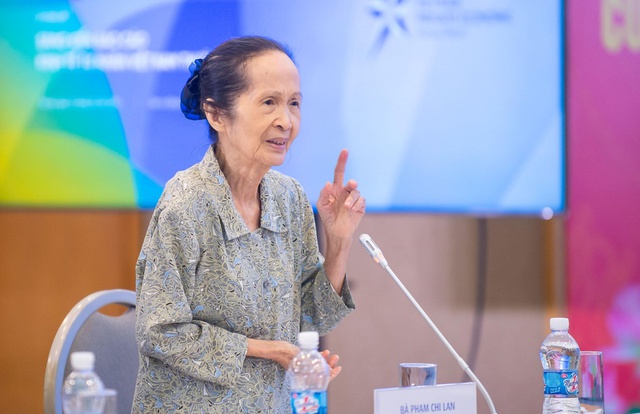
Economic expert Pham Lan Chi shares her perspective at the seminar and launch event for the Annual Vietnam Private Economic Report.
Experts present at the event, including Ms. Pham Chi Lan and Dr. Nguyen Duc Kien, supported this approach and emphasized the need for mechanisms to foster the creation of large private conglomerates capable of leading the entire economy’s development.
According to expert Pham Chi Lan, it is crucial to have reports that accurately assess the contributions and efficiency of each group within the private sector to design appropriate policies or measures to promote their development.
“For Vietnam to escape the middle-income trap, it must have large, internationally competitive private enterprises, not just rely on small and medium-sized businesses,” stressed Mr. Nguyen Duc Kien, former National Assembly Deputy and Head of the Prime Minister’s Economic Advisory Council, at the event.
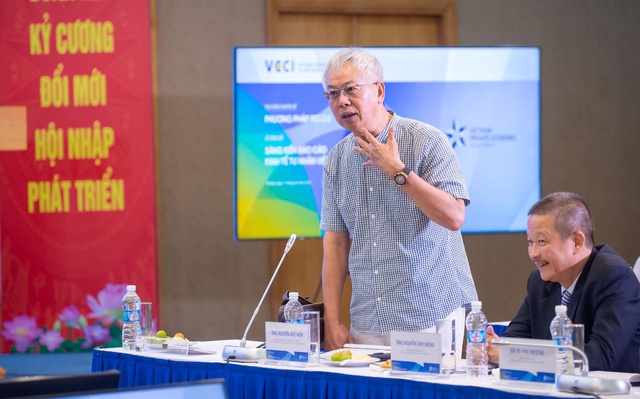
Economic expert Dr. Nguyen Duc Kien, former Head of the Prime Minister’s Economic Advisory Council, shares his insights at the seminar and launch event.
Experts believe the Annual Vietnam Private Economic Report should become a critical foundation for implementing Resolution 68, particularly in fostering leading enterprises—national champions—to help Vietnam overcome the middle-income trap. It will provide data and recommendations to support authorities in formulating suitable policies, enabling large private enterprises to develop rapidly and lead the economy.
The involvement of Tan Hiep Phat as a co-initiator reflects a strong commitment to Vietnam’s economic development. Mr. Nguyen Duy Hung, a member of the company’s Board of Directors, emphasized: “Tan Hiep Phat believes the Annual Vietnam Private Economic Report will make a practical contribution to the private sector’s development. The report’s comprehensive and accurate data will serve as a reliable reference for policy planning.”
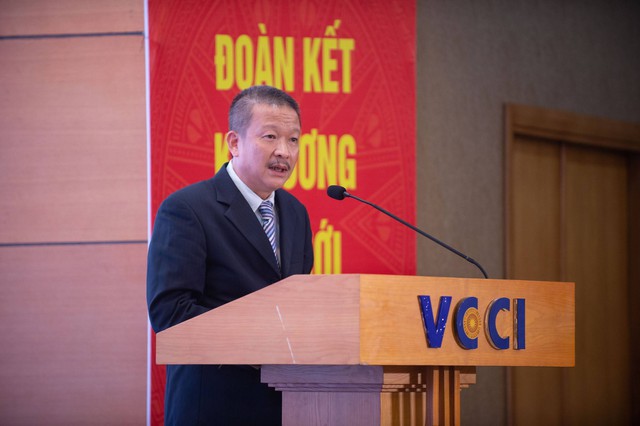
Mr. Nguyen Duy Hung, Member of the Board of Directors at Tan Hiep Phat.
Tan Hiep Phat, a purely Vietnamese private enterprise, has leveraged opportunities from reform policies such as the 1990 Law on Companies and the Law on Private Enterprises to become a leader in the beverage industry. It deeply understands the importance of appropriate policies for business development.
“To create good policies, we need comprehensive and accurate data; for sustainable market development, we need trust among market participants; and for trust, we need transparency, dialogue, and unified commitments and actions,” added Mr. Hung.
The collaboration between VCCI and Tan Hiep Phat demonstrates the self-reliance and resilience of Vietnamese enterprises, as the program is entirely funded by domestic resources rather than relying on foreign sponsorship as in the past. Tan Hiep Phat’s efforts are also expected to inspire other private enterprises.
“We hope that in the future, more private enterprises and conglomerates will participate, enabling the program to deliver greater benefits, impact, and help realize its vision and mission,” said Mr. Dau Anh Tuan.
T&T Group Vice Chairman Presents Key Recommendations at VPFS 2025

On the afternoon of September 16th, during the High-Level Dialogue Session of the Vietnam Private Sector Economic Forum 2025 (VPFS 2025), Mr. Do Vinh Quang, Vice Chairman of the Board of Directors of T&T Group and Chairman of the Board of Directors of Vietravel Airlines, presented several critical recommendations aimed at harnessing the inherent strengths of businesses.
“Public and Private Sectors: United in Building the Nation’s Economy”

“Mr. Truong Gia Binh, Chairman of FPT Corporation and Head of the Private Economic Affairs Committee (Committee IV), emphasizes the need to foster a collaborative mechanism between the private sector and government agencies. He believes that by sharing responsibilities, the private sector can become the most important driving force for the economy, thus contributing to the realization of this ambitious goal.”
“Revolutionary Policies: Vietnam’s 80-Year Journey Towards Reform and Integration”

The national economy has always demonstrated resilience and adaptability, evolving through historical phases to embrace the digital age with a vision. Today, it embarks on a journey to bridge developmental gaps and forge ahead with renewed vigor.
Unlocking Economic Achievements: Embracing Opportunities Amidst Challenges

“Vietnam’s economic reforms and progress over the past eight decades have been nothing short of a remarkable struggle. From a nation scarred by war, Vietnam has risen to become a leading economy in the region and beyond.”
Nurturing an Environment to Foster Private Enterprise Growth

Resolution 68-NQ/TW was enacted with the aspiration to serve as a catalyst for the private sector’s robust quantitative and qualitative growth. However, to materialize this vision, an “incubation” mechanism is imperative to nurture a multitude of high-caliber private enterprises that can spearhead the development of the business community.