


















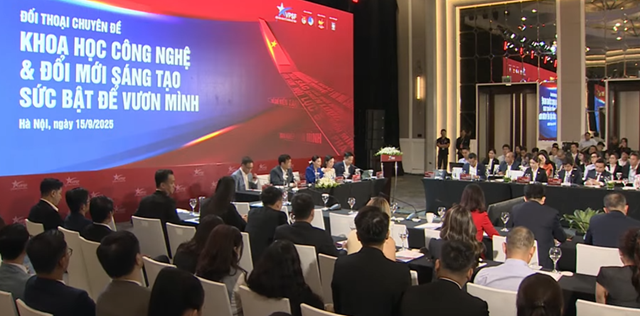
A panoramic view of the specialized dialogue session titled “Science, Technology & Innovation – The Catalyst for Advancement”
|
Embracing Major Transformation
According to Mr. Khoa, within the “four pillars” comprising Resolutions 68, 57, 59, and 66, FPT is currently directly involved in Resolution 57, focusing on breakthrough development, innovation, and technological advancement—a pillar set to overhaul Vietnam’s digital government framework. Data lies at the heart of this transformation.
Previously, digital transformation and e-government initiatives in Vietnam were fragmented, with each locality or ministry acting independently. Resolution 57 has clarified roles: the government manages data, ministries handle platforms, and localities collect and benefit from data. This shift will undoubtedly impact businesses.
Starting January 1, 2026, certain data systems will be accessible for business exploitation. For instance, tracking unusual sales of cold medicine in a city can predict disease outbreaks, fostering new services.
More concretely, with 5,585 administrative procedures currently burdened by excessive paperwork, the digital government vision is set to materialize. FPT, alongside major corporations and ministries, aims to process all tasks on an interconnected data system by January 1, 2026, following the completion of 11 critical government databases and over 100 additional ones, driving significant change.

Mr. Nguyễn Văn Khoa, CEO of FPT, speaking at the forum
|
Businesses Lagging Behind Government
Mr. Khoa highlighted another issue: the government and tech firms are outpacing traditional businesses. Conventional service enterprises risk being left behind due to a lack of innovation.
“This concerns us more than it excites. For those in science and technology, knowledge stems not just from textbooks but from unanswered questions. The current landscape challenges businesses to redefine their role in this new era of transformative governance,” Mr. Khoa remarked.
With resolutions from the Politburo and government—including recent ones on public health, education, and upcoming ones on innovation and entrepreneurship—the focus is on integrating these policies into everyday life, ensuring businesses reap the benefits.
The CEO proposed three solutions. First, embed technology from day one, making it the core of any business, regardless of its product. Building a workforce skilled in AI—currently in short supply—is essential.
Second, businesses must proactively drive change rather than wait for policies. While leveraging policies is ideal, collaboration within ecosystems is key for those unable to do so.
Lastly, partnerships must be legally transparent to ensure sustainability. “Technology will become the core of businesses, enabling transparent, sustainable, and systematic management. This will attract investors and financial institutions,” Mr. Khoa added.
Urgent Need for Legal Frameworks, Implementation Hubs, and Capital
Mr. Khoa emphasized Resolution 57’s broad scope, addressing capital, sandbox mechanisms, the “3-House” collaboration (Government, Academia, and Business), and strategic technology development. It also covers critical fields like quantum computing and biomedical science.
He urged young entrepreneurs to prioritize legal understanding, a critical yet often overlooked aspect in Vietnam. A robust legal environment is vital for Vietnam’s competitiveness, and significant reforms are expected.
Identifying suitable implementation hubs is crucial, with a focus on mastering core technologies and strategic products. While initially adopting foreign technologies is acceptable, the goal is to make Vietnam a science and technology powerhouse.
Capital remains a pressing issue. Mr. Khoa plans to propose the GP-LP model to the government, a global standard for venture capital and private equity funds. This model attracts foreign investment, clarifies fund manager and investor responsibilities, and maximizes profit potential.
– 16:53 16/09/2025
Da Nang Streamlines Business Registration: Paperless and Efficient

Da Nang has officially implemented a 100% online business registration process, streamlining operations to save time, reduce costs, and enhance transparency.
Astonishing First-Day Sales Figures for iPhone 17 Unveiled

Retailers are gearing up for a massive launch, anticipating the delivery of tens of thousands of iPhone 17 series and iPhone Air units on the first day of sale.
Today’s Pepper Price (18/9): Slight Drop of 1,000 VND/kg

On September 18th, pepper prices dropped by 1,000 VND/kg compared to the previous day, settling at 147,000 – 150,000 VND/kg.
iPhone 17 Pro Universe Orange Edition Sells Out in Vietnam: Stunning Real-Life Photos Revealed

On September 19th, the highly anticipated iPhone 17 series officially launched in Vietnam. Amidst a host of valuable upgrades, one feature has captured everyone’s attention: the stunning new Cosmic Orange color for the iPhone 17 Pro.
Pepper Prices on September 19: Declining in Line with Global Trends, Domestic Rates Peak at 151,000 VND/kg

Domestic pepper prices currently range between 147,000 and 151,000 VND per kilogram, reflecting market stability following a series of fluctuating trading sessions.