















With just over three months left in 2025, Ho Chi Minh City’s public investment disbursement rate remains below expectations, lacking sustainability and fundamental improvement—as noted by Chairman of the Ho Chi Minh City People’s Committee, Nguyen Van Duoc, during the August economic and social review meeting on September 9, 2025.
The numbers reveal the issue: in the first six months, the disbursement rate reached 43%, but by the end of August, it had only inched up to 43.3%, an increase of less than 1%.
According to Chairman Nguyen Van Duoc, this pace directly impacts growth. He emphasized that accelerating public investment disbursement is a top political priority. Departments, districts, and wards must view disbursement as a measure of their capacity and responsibility. He also called for specific solutions, linking individual accountability to each project.
At the online seminar titled “Accelerating Public Investment: Realizing Ho Chi Minh City’s 8.5% Growth Target” held on September 20, 2025, experts analyzed the city’s public investment situation, identified major disbursement bottlenecks, and proposed feasible solutions for the final “sprint” of 2025.
The issue extends beyond disbursement alone.
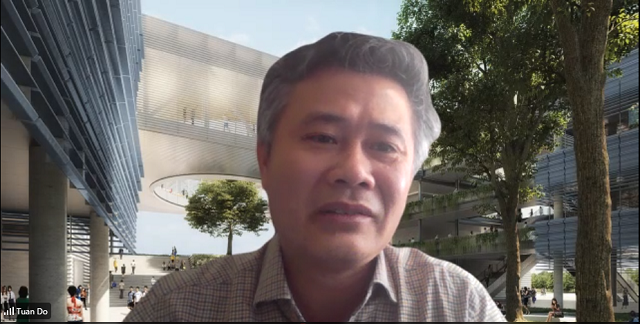 Mr. Do Thien Anh Tuan speaking at the online seminar. Screenshot.
|
Mr. Do Thien Anh Tuan, Lecturer at the Fulbright School of Public Policy and Management, noted that Ho Chi Minh City is the nation’s economic powerhouse, especially after its merger with Binh Duong and Ba Ria-Vung Tau. The new city’s economy is projected to reach nearly 3,000 trillion VND this year, equivalent to Vietnam’s GDP over a decade and a half ago. This poses significant governance challenges. If Ho Chi Minh City fails to meet its 8.5% growth target, it will substantially impact the nation’s overall goal.
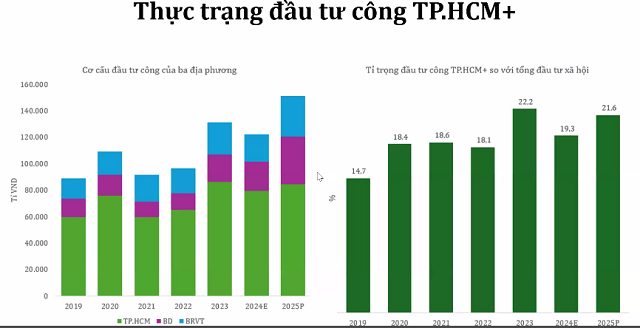
The city’s total public investment capital for this year exceeds 151,000 billion VND. However, the disbursement rate remains low, at around 43% of the Prime Minister’s plan. If measured against the People’s Council’s plan, it is only 36-37%.
Public investment accounts for just 21-22% of the city’s total social investment, compared to the national average of one-third. To achieve higher growth, this proportion must increase.
Despite this, Ho Chi Minh City’s capital efficiency surpasses the national average. Under the most optimistic scenario, if 100% of public investment is disbursed with improved efficiency (ICOR at 3.07), the city could reach 8.5% growth. However, if only 80% is disbursed or efficiency declines (ICOR rising to 3.5 or 4), this target will be unattainable.
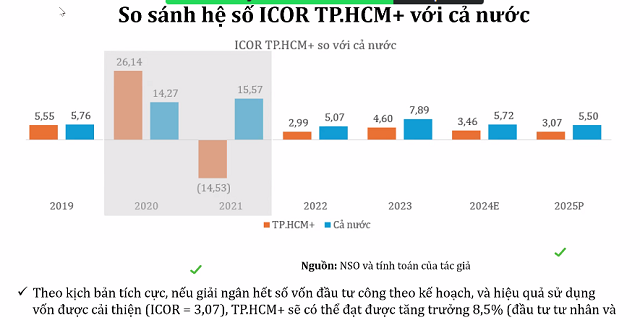
The issue extends beyond disbursement to planning and resource allocation. Many public investment management criteria, such as project selection, risk management, and regional coordination, remain weak.
Why Ho Chi Minh City’s disbursement is slower than the national rate
 Mr. Tran Dinh Thien speaking at the seminar. Screenshot.
|
From a macro and institutional perspective, Mr. Tran Dinh Thien, Former Director of the Vietnam Institute of Economics, argued that Ho Chi Minh City’s slower disbursement is understandable due to its more complex post-merger structure. The city’s challenges reflect broader national constraints rooted in shared institutions like the Land Law, Procurement Law, and Public Investment Law.
According to Mr. Thien, this should not be seen as a shortcoming or lack of effort by the city but as a result of objective factors. Regarding the 8.5% growth target, focusing solely on disbursement in the final three months may be ineffective and counterproductive. Instead, shifting some efforts to next year could achieve both higher and more sustainable growth.
From a business perspective, Mr. Dinh Hong Ky, Chairman of the Ho Chi Minh City Construction Association and the Green Business Association, highlighted the severe impact of slow disbursement. Weak aggregate demand stalls capital flow, dampening production expectations and plans. Delayed infrastructure projects hinder related sectors like construction and real estate. Incomplete infrastructure increases logistics and transportation costs, reducing export competitiveness. Slow customs clearance and high costs affect logistics and urban services. Delayed public infrastructure, such as schools, hospitals, and parks, stifles service sector growth, impacting retail and services. Stalled digital government projects linked to public investment also hinder digital transformation. Most critically, business confidence in the city’s leadership and administration is severely undermined.
Comprehensive solutions are needed to unblock public investment bottlenecks
Mr. Tran Van Bich, Head of Economic Development Research at the Ho Chi Minh City Institute for Development Studies (HIDS), noted that the city has implemented seven key solutions, including close monitoring of major projects, accelerated land clearance, administrative reforms, capital reallocation reviews, and stricter progress enforcement by project leaders.
However, four major bottlenecks persist:
- Institutional and legal delays: Slow issuance of guiding decrees hinders progress.
- Administrative restructuring: The merger and transition to a two-tier government model require time for legal and structural completion.
- Planning: Many units have yet to finalize disbursement plans.
- Project implementation: Land clearance, technical infrastructure relocation, and shortages of construction materials (sand, stone, soil) for major projects remain problematic.
To address these issues, breakthrough institutional reforms are needed, granting localities genuine autonomy and accountability while protecting those who take initiative. In the short term, flexible capital reallocation, dynamic pricing mechanisms, and special task forces to resolve bottlenecks are essential.
Long-term solutions include comprehensive institutional reform, standardized land clearance processes, proactive land banking, and a shift in mindset prioritizing long-term quality and efficiency over rushed disbursement.
– 12:00 20/09/2025
Prime Minister: Red River Delta Must Lead as the “Three Pioneers” in National Development
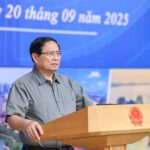
Prime Minister Pham Minh Chinh, chairing the 6th Conference of the Regional Coordination Council, underscored the Red River Delta’s pioneering role in sustainable development, economic restructuring, and the establishment of a two-tier government system. He also outlined 11 key priorities for the region moving forward.
France’s Ambassador Highlights Three Key Factors Positioning Vietnam as Southeast Asia’s Emerging Financial Hub

With its dynamic economy, Vietnam is poised to seize a unique opportunity by establishing international financial hubs in Ho Chi Minh City and Da Nang, according to the French Ambassador to Vietnam.
Lotte Officially Terminates the Thu Thiem Eco Smart City Project

The Department of Finance revealed this information during a press conference on Ho Chi Minh City’s socio-economic status held on the afternoon of September 18th.
Phan Đình Phùng Sports Center Project Slated for Q3 2027 Groundbreaking

At the press conference on September 11th, addressing socio-economic issues in Ho Chi Minh City, the Department of Finance provided an update on the current status of the Phan Dinh Phung Sports Center construction project in District 3 (formerly known as District 3).
Southern Construction Departments Criticized by the Department of Roads for Delayed Capital Disbursement
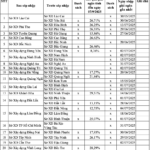
The Vietnam Road Administration has released a list of 21 Departments of Construction and one project management board that are lagging in disbursing public investment funds for 2025.