














On September 19th, the Ho Chi Minh City National Assembly (NA) Delegation held a questioning session on the implementation of Resolution 98, focusing on pilot mechanisms and special policies for the city’s development, public investment disbursement, digital transformation, and e-government construction.
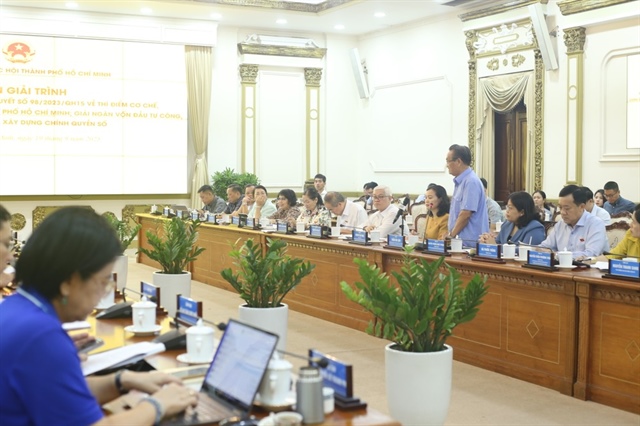
NA Delegation’s supervision session. Photo: THANH TUYỀN |
Expanding Strategic Sectors and Attracting Investors
Dr. Tran Du Lich noted that despite existing mechanisms, the city has yet to effectively attract resources in science and technology, as well as experts. Ho Chi Minh City has not secured any strategic investors, and the breakthrough initiative to leverage existing transportation infrastructure to attract private investors for BOT projects remains stalled, despite the City Council’s resolution.
“While resource mobilization is crucial, its impact on the economy remains limited,” Dr. Tran Du Lich stated, emphasizing the need to fully implement the remaining provisions of Resolution 98. He stressed that mechanisms previously applied to the old Ho Chi Minh City should be uniformly extended to the newly expanded city, given its vast development potential.
According to Dr. Tran Du Lich, alongside Resolution 98, the city also has Resolution 188 on urban railways and Resolution 222 on the International Financial Center. Synchronized implementation of these three resolutions would create significant momentum for the city’s new development phase.
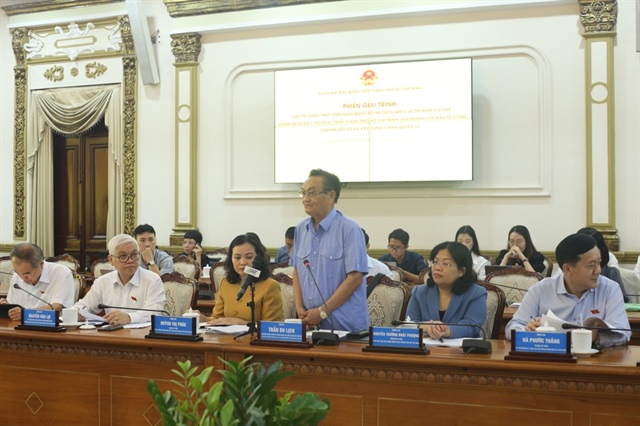 Dr. Tran Du Lich emphasizes the need for stringent regulations to ensure feasibility in attracting strategic investors. Photo: THANH TUYỀN |
Ho Chi Minh City is currently supplementing mechanisms and policies within Resolution 98 for submission to the National Assembly in October. Dr. Tran Du Lich highlighted the necessity of “upgrading Resolution 98” by removing impractical and unattractive clauses to entice strategic investors. This includes expanding the list of sectors and industries requiring strategic investors.
Dr. Tran Du Lich cited Resolution 188, which lists eight urban railway lines. Routes like Ho Chi Minh City to Long Thanh and the city center to Can Gio, not included in the list, cannot benefit from Resolution 188 mechanisms. Future projects, such as the Ho Chi Minh City – Can Tho railway, must be added to the list to qualify for these mechanisms.
“While attracting strategic investors is essential, stringent regulations are needed to ensure feasibility. True strategic investors should focus on long-term goals, not exploit policies,” Dr. Tran Du Lich emphasized.
He also mentioned that the city will introduce mechanisms to develop the Cai Mep Ha Free Trade Zone with five key functions to integrate into the global supply chain. Dr. Tran Du Lich believes that the mechanisms in the upcoming Resolution 98 must be stronger and broader to match the scale of the new Ho Chi Minh City.
Tran Anh Tuan, Chairman of the Members’ Council of Tan Thuan Development Corporation, suggested that with the city’s expanded space and scale post-merger, the selection of strategic investors should be adjusted based on sectors, investment scale, charter capital, and implementation capabilities.
Mr. Tuan advised against overly rigid mechanism regulations but stressed the need for supervision in investor selection to prevent policy exploitation.
Huynh Thi Phuc, Deputy Head of the Ho Chi Minh City NA Delegation, emphasized the need for an effective work governance model and port infrastructure development aligned with the Free Trade Zone model of a leading economic city aspiring to become a megacity.
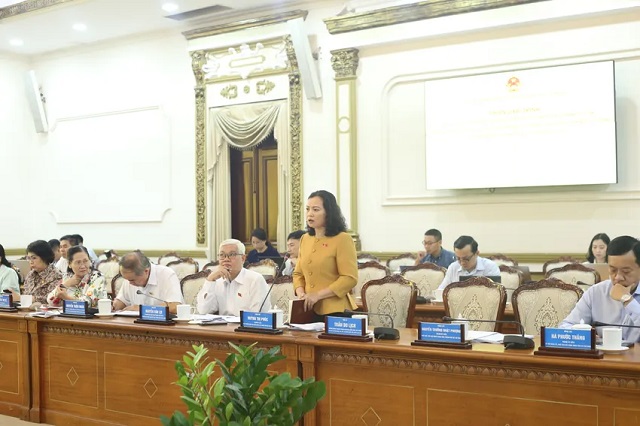
Huynh Thi Phuc advocates for an effective work governance model in Ho Chi Minh City. Photo: THANH TUYỀN
|
NA Deputy Tran Kim Yen, former Head of the HCMC Party Committee’s Inspection Commission, highlighted the importance of land clearance for clean land funds to implement TOD projects under Resolution 98 mechanisms.
She recommended evaluating the effectiveness of nine approved TOD development sites to promptly address successes and challenges.
Nguyen Van Loi, Head of the Ho Chi Minh City NA Delegation, urged the city government to mobilize social resources and encourage businesses to invest in BOT and PPP projects. He noted that the city still has untapped potential and resources from existing mechanisms and should focus on exploitation.
“Ho Chi Minh City must take full responsibility for investment projects, from start to finish, in accordance with legal procedures,” Nguyen Van Loi stated, urging the city to resolve hundreds of pending projects to enhance overall capital absorption.
Preparing to Select Investors for Can Gio Super Port
According to reports, the Ho Chi Minh City People’s Committee, in collaboration with central ministries, has prepared an information disclosure template for projects attracting strategic investors. This includes the Can Gio International Transshipment Port project, currently in the investor selection phase.
The city has also issued a plan to mobilize social resources for infrastructure development from 2024 to 2030, aiming to reach VND 620 trillion in total social investment by 2025.
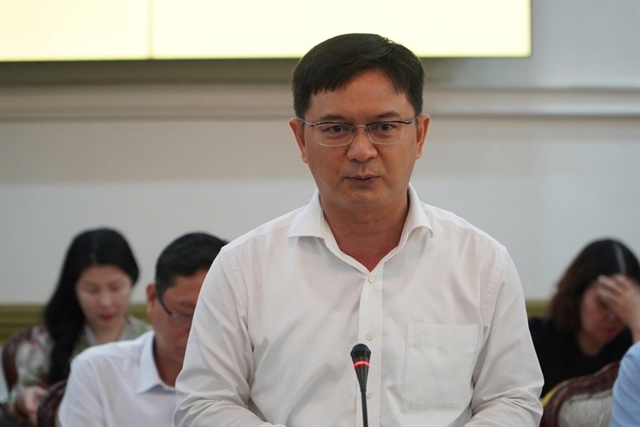 Vice Chairman of the Ho Chi Minh City People’s Committee Nguyen Manh Cuong reports at the session. Photo: THANH TUYỀN |
Ho Chi Minh City has approved nine TOD development sites along Metro Line 1, Metro Line 2, and Ring Road 3 for 2024-2025, as well as two additional sites along Ring Road 3, Metro Line 3 extension, and the Ho Chi Minh City – Can Tho railway for 2026-2028. Implementation plans for these TOD areas have been issued.
For PPP projects, the city has listed 41 investment projects in healthcare, education, and culture. The government has approved four BOT projects to upgrade and modernize existing roads, with a total investment of VND 57.503 trillion (approximately VND 35.144 trillion from the city budget, or 61.12% of the total).
Vice Chairman Nguyen Manh Cuong announced that the city has finalized the draft proposal to amend and supplement certain provisions of Resolution 98, which has been approved by the City Party Committee’s Standing Board.
Ho Chi Minh City will submit the proposal to the Ministry of Finance for government review and subsequent approval by the National Assembly in October.
THANH TUYỀN
– 12:51 19/09/2025
Tropical Retreat at Salacia Villas: A Serene Escape Amidst the International Port

Nestled at the heart of Phú Mỹ—a pivotal crossroads of inter-regional growth—Salacia Villas crafts a distinctive community. Here, global professionals and elite residents seamlessly blend the luxury of “resort-style living at home” with unparalleled opportunities from a rapidly ascending region.
Abandoned $110 Million Hospital in Ho Chi Minh City: A Closer Look at the Desolate Structure

A 300-bed specialized psychiatric hospital, constructed with an investment of 250 billion VND, has lain abandoned for 8 years since completion. Ho Chi Minh City is now surveying and planning renovations to bring the facility into operation.
Unraveling the Progress: A $43 Million Traffic Congestion Relief Project in Ho Chi Minh City After 7 Months of Construction
The Chu Van An Road upgrade and expansion project in Binh Thanh District, Ho Chi Minh City, is entering its final stretch after nearly 7 months of construction. With the drainage system nearing completion, the entire project is on track for a November finish.
New Directive from Ho Chi Minh City on the VND 3.5 Trillion Inter-Ward Road Project in the Northwest Gateway

The Thới An – Thạnh Xuân Inter-Ward Road project, spanning nearly 4.5 kilometers at the northwestern gateway of Ho Chi Minh City, boasts a total investment of over 3,563 billion VND. Construction is slated to commence in late 2026, with completion expected by the end of 2027.
Southeast Region’s Credit Growth Surges 7.7% in First 8 Months of the Year
By the end of August 2025, the total outstanding credit balance in the Southeast region of Vietnam (encompassing Ho Chi Minh City, Binh Duong, Dong Nai, Ba Ria-Vung Tau, and the former Binh Phuoc) reached 5.39 quadrillion VND. This figure represents a 0.9% increase compared to the previous month and a 7.7% rise from the end of 2024.