















According to a report by Dragon Capital, Vietnam is among the top five countries globally with the highest cryptocurrency adoption rates, with an estimated total holding value of approximately $100 billion. In this context, the government’s issuance of Resolution 05/2025/NQ-CP on piloting the digital asset market for five years is considered a crucial step by experts, laying the foundation for rapid yet well-directed market development.
Legitimizing Digital Asset Investors
Data from Triple-A reveals that over 20% of Vietnam’s population owns digital assets, and most are willing to pay taxes and trade legally if protected by law. This highlights the significant demand for a transparent legal framework.
At the talk show “Perfecting the Legal Framework for the Digital Asset Market” organized by Lao Dong Newspaper on September 19, Mr. Vo Trung Tin, Vice Chairman of the Ho Chi Minh City Blockchain Association, emphasized that the digital currency market has long been ambiguous. Many investors have poured money into this channel but remain uncertain about the legality and protection of their transactions. Resolution 05 will change this by providing a clear legal basis for regulatory oversight, thereby reassuring investors.
“Previously, many investors committed substantial capital but were always anxious about potential legal violations. Now, with the pilot market, they will clearly understand which agency oversees their activities and how they are protected. This is key to building trust and attracting capital,” Mr. Tin stressed.

Blockchain experts and businesses at the Lao Dong Newspaper talk show on September 19
Echoing this view, Mr. Pham Duy Dong, founder of the Saigontradecoin community, believes Resolution 05 has legitimized investors. Previously, digital assets were often associated with virtual currencies, multi-level marketing, or scams. Now, investors are recognized as legal entities with clear rights. “While full protection may not be expected initially, Resolution 05 is a foundation for a more transparent, legitimate, and secure market for investors,” Mr. Dong analyzed.
However, for the resolution to be implemented effectively, Mr. Vo Trung Tin suggests that regulatory authorities should promptly issue detailed guidelines. Additionally, prioritizing public education on digital assets is essential, as blockchain and its derivatives like NFTs and cryptocurrencies are still novel and can be confusing. Without sufficient knowledge, individuals may struggle to recognize value, legal protections, and potential risks.
Therefore, alongside expert and regulatory outreach, the government should issue clear definitions and guidelines for public reference.
Mr. Tin proposed establishing an official portal to publicly disclose asset verification processes, complaint mechanisms, and responsible parties. “Vietnam could integrate this information into VNeID, which directly connects to the government portal, to enhance transparency and create a competitive advantage,” he shared.
From a business perspective, Mr. Le Huu Quang Vinh, Development Director of Viction (a Vietnamese blockchain company), believes Resolution 05 changes the game. Businesses no longer operate under the principle of “what is not prohibited is permitted” but now have a legal framework to follow.
However, the resolution focuses primarily on centralized exchanges, while the market includes other segments, particularly decentralized finance (DeFi). “If the law does not expand in time, Vietnam risks falling behind global trends,” Mr. Vinh noted.
Furthermore, Resolution 05 is currently a framework, and businesses need additional legal documents for specific guidance. Without clear regulations, businesses may opt for safer, less innovative approaches, missing opportunities for new product development.
Caution is Key
Under Resolution 05, to operate a digital asset exchange, companies must have a minimum charter capital of 10 trillion VND, with at least 65% from domestic organizations and a minimum of 35% from at least two financial institutions such as banks, securities firms, insurance companies, investment funds, or technology companies. Additional requirements include specialized personnel and secure technology systems.
Mr. Le Huu Quang Vinh views the initial capital requirement as a measure of business credibility, though Vietnam’s threshold is higher than many other countries. This boosts investor confidence, but the market is not limited to centralized exchanges; intermediary units are also essential. Without clear legal roles for these entities, investor experience will be limited, hindering international competitiveness.
From another perspective, lawyer Phan Vu Tuan, Head of Phan Law Vietnam, believes that capital and technical standards are necessary but not sufficient. Investors are most concerned with the safety of personal information, transactions, and assets.
“During the pilot phase, caution is paramount. Participating entities must adhere to strict standards to ensure stable operations, prevent legal violations like money laundering or terrorist financing, and protect investors’ legitimate rights. This is foundational for building a transparent, secure market in Vietnam,” Mr. Tuan affirmed.
Meanwhile, Mr. Vo Trung Tin noted that many technology companies remain uncertain about launching new products, such as registration requirements, legal protections, tax implications, and more. They urgently need detailed guidance.
Nonetheless, Mr. Tin believes Resolution 05 has partially addressed these issues by providing a clearer path for businesses, at least offering a roadmap for transparent product deployment. “Alongside the legal framework for digital assets, businesses must prioritize intellectual property protection. Without timely safeguards, technological products can be easily copied, devaluing them, harming businesses, eroding investor trust, and significantly impacting the market,” he emphasized.
Effective Capital Control
According to Resolution 05, Vietnamese investors must transfer their digital assets to licensed custodians and trade on platforms approved by the Ministry of Finance. Six months after the first domestic exchange launches, unauthorized transactions will face penalties, ranging from administrative fines to criminal charges depending on the violation’s severity.
Lawyer Phan Vu Tuan believes this regulation will reduce “black market” transactions and enhance investor protection. However, he calls for swift clarification of technical and financial spaces to prevent technology companies from being held responsible beyond their expertise. With a complete legal framework, the government can effectively control capital flows, combat financial crimes, increase budget revenue, and create a transparent, secure environment for both investors and digital asset businesses to thrive sustainably.
Coin98 Halts Crypto Wallet Services for Vietnamese Users Following New Crypto Asset Regulations?
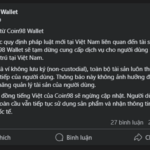
Just days after Vietnam officially enacted a resolution to pilot the cryptocurrency market, Coin98 Wallet (owned by Ninety Eight) announced on its fanpage the suspension of services for Vietnamese citizens and residents. Concurrently, all Vietnamese-language community channels of Coin98 will cease updates.