Red Book Issuance for Land Without Documentation if Criteria are Met
The 90-day campaign (from September 1 to November 30, 2025) to review and clean up the entire land database, jointly implemented by the Ministry of Public Security and the Ministry of Agriculture and Environment, is garnering attention from citizens and real estate market participants. In reality, the lack of accurate and complete information about land and housing is considered the primary cause of repeated overheating in the real estate market. However, once this information is made transparent, such occurrences are expected to decrease.
In many localities, alongside houses and land plots already issued with land use right certificates (commonly known as Red Books), there are still numerous properties, even entire streets, without Red Books. This poses challenges in management and impacts market prices. Following the implementation of the two-tier local government model and the database cleanup campaign, several localities are re-examining documents and expediting Red Book issuance for undocumented land that meets current regulations.
According to the Land Law, certain types of undocumented land will be issued Red Books if they meet specific criteria: stable land use before July 1, 2014, no disputes, and confirmation from the commune-level People’s Committee. In various localities, undocumented land primarily originates from: land acquired through handwritten transfers, gifts, or inheritances (without notarization), encroached or reclaimed land, or land allocated without proper authority.
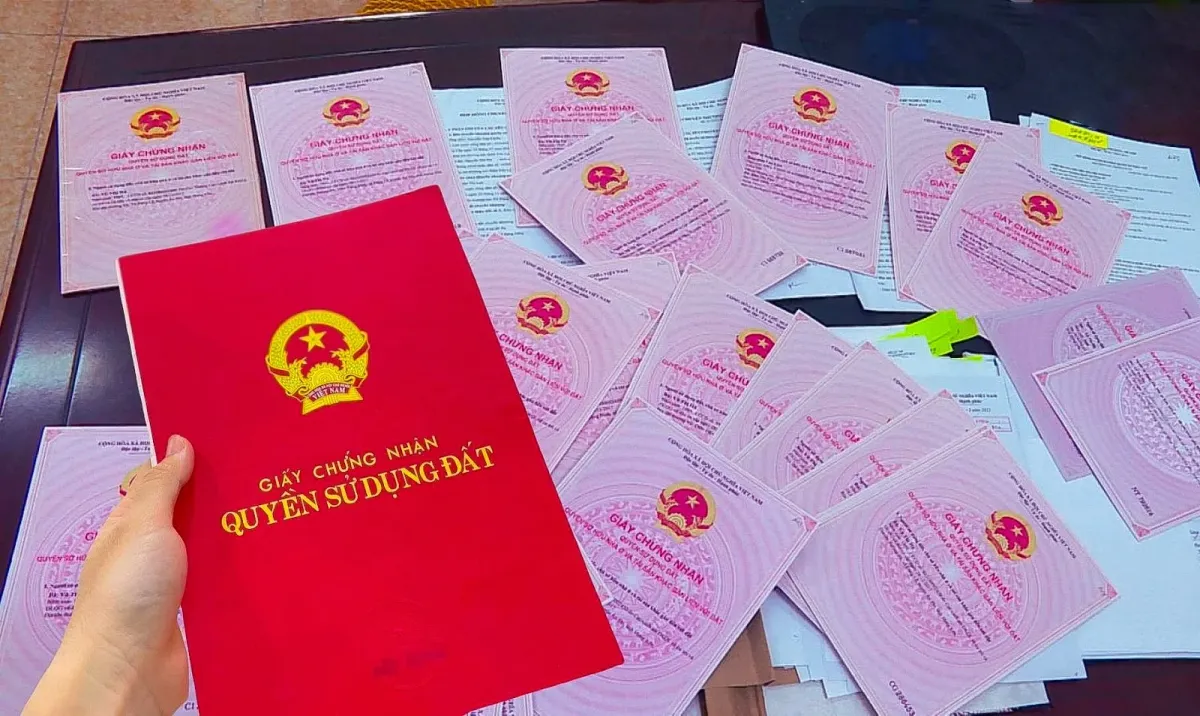
The absence of a Red Book creates significant difficulties for residents.
Accelerating Red Book Issuance for Undocumented Land
The lack of a Red Book poses numerous challenges for residents. For instance, they cannot use the property as collateral for bank loans. When selling, these properties often fetch only two-thirds or even half of the market price. Therefore, obtaining a Red Book has become the most significant aspiration for many households. For local authorities, this is a crucial task to enrich and clean up the land database.
Forty sturdy houses in Tu Son Ward, Bac Ninh Province, built on land allocated without proper authority 30 years ago, remain without Red Books. Mr. Ngon’s family home, bearing the marks of time, has yet to receive one. Despite multiple attempts and prepared documents, the outcome remains uncertain. This time, ward officials have directly visited to verify information.
Mr. Nguyen Van Ngon from Tu Son Ward, Bac Ninh Province, shared: “The paperwork is still unclear. We just hope the authorities will issue the Red Book so we can have peace of mind.”
The biggest challenge for local authorities in issuing Red Books for undocumented land is determining its origin and usage period. The Land Law categorizes undocumented land eligible for Red Books based on three usage milestones: 1980, 1993, and 2014. Depending on the milestone, the land use fee varies significantly, ranging from hundreds of millions to billions of Vietnamese dong. For example, a row of houses may require residents to pay 200-300 million dong per plot for a Red Book.
Mr. Nguyen Huy Cuong from Tu Son Ward, Bac Ninh Province, stated: “If it’s around 300 million dong, we can manage. Our family wants to complete the Red Book process.”
The substantial difference in land use fees necessitates meticulous verification. After implementing the two-tier local government model, procedures for issuing Red Books to undocumented land have been streamlined, eliminating steps like establishing a review board and county-level approvals.
Despite challenges, establishing an accurate and clean land database by issuing Red Books for undocumented land is essential at this time.
Mr. Nguyen Van Lang, Deputy Head of the Economic Department, Thanh Tri District People’s Committee, Hanoi, commented: “It helps local state management agencies manage more easily, and residents can understand any issues with their land.”
Mr. Vo Hong Thang, Investment Director of DKRA Group, noted: “Market transparency reduces transaction risks, prevents tax losses, and enhances market clarity.”
In many localities, undocumented land accounts for 70-80% of first-time Red Book applications. This review campaign, combined with streamlined procedures under the two-tier local government model, is expected to resolve decades-long waits for households.

Determining the origin and start date of land use are the most challenging tasks for localities in issuing Red Books for undocumented land.
Overcoming Challenges in Issuing Red Books for Undocumented Land
Determining the origin and start date of land use are the most challenging tasks for localities in issuing Red Books for undocumented land, especially when the process spans multiple administrations. Many localities are employing various methods to find suitable solutions.
Electricity and water bills, annual tax receipts, and construction violation fines (if applicable) are documents residents on undocumented land can submit to authorities to establish land usage timelines. This ensures accurate calculation of land use fees. The draft amended Land Law, currently under review for the October National Assembly session, includes proposals to clarify the Red Book issuance process for undocumented land.
Mr. Le Van Tuan from the Economic Department, Thanh Tri District People’s Committee, Hanoi, suggested: “Revise clauses for clarity. Consolidate decrees and circulars for easier reference and application. Currently, numerous amendments require extensive research, so integration would be more convenient.”
Commune officials rely on multiple information sources to prevent exploitation for legalizing violations, which could lead to public land losses. Under current regulations, the board for reviewing undocumented land origins has been disbanded. To ensure accuracy, commune land officers continue gathering information from sources like neighborhood heads, front organizations, and elderly residents.
Mr. Nguyen Duc Manh, Deputy Chairman of Tu Son Ward People’s Committee, Bac Ninh Province, shared: “Under Decree 151, the review board is no longer required, and all responsibilities are assigned to the ward’s specialized agency. This is challenging, as many officers are unfamiliar with determining usage timelines. Since our ward recently merged, some officers lack knowledge of timelines and areas, making financial obligation determination difficult. We seek guidance.”
Experts believe that identifying each land plot will enable authorities to closely monitor housing market fluctuations, formulate timely policies, and ensure social welfare. Additionally, establishing a national database will improve transfer pricing and tax control for real estate, preventing underreporting to evade taxes and enhancing market price determination.
Deputy Prime Minister: Implement Land Price Tables Every 5 Years, Accompanied by Market Fluctuation Coefficients

Vice Prime Minister Tran Hong Ha has endorsed the proposal to maintain the land price list on a five-year cycle, incorporating an adjustment coefficient to reflect market fluctuations.
How to Reduce Land Use Charges When Changing the Purpose to Residential?

The current land use charges, post-change in purpose, are calculated at 100% of the priced land rate, resulting in exorbitant fees for citizens. For instance, a 400 sq. m plot in the former Vinh City, Nghe An Province, incurs a fee of VND 4.5 billion, while a 208 sq. meter plot in Hoc Mon District, the former Ho Chi Minh City, costs VND 1.7 billion. Similarly, a 400 sq. meter plot in District 7 of the old Ho Chi Minh City will cost a staggering VND 14 billion. These charges are incredibly burdensome for landowners.
The Five Amendments Legacy: Revolutionizing Vietnam’s Provincial Landscape

After 80 years of nation-building, Vietnam’s land management has undergone several pivotal transitions, evolving from feudal ownership to state ownership and eventually embracing market mechanisms. Each reform has been intrinsically linked to significant shifts in the nation’s trajectory. Experts view the current wave of institutional reforms, including provincial mergers, streamlining of bureaucratic apparatuses, and the establishment of a national database, as tantamount to a “fourth revolution” in land management.
Two Additional Land Procedures at the Commune Level: What Citizens Need to Know

As of August 25th, the communal authorities will commence the process of facilitating economic organizations to contribute capital in the form of land-use rights for project implementation and allocation of coastal areas for land reclamation.
The Ultimate VIP Transport: Introducing the Armored Lac Hong 900 LX for Global Leaders at the 80th National Day Celebrations.

This exclusive limited-edition vehicle series embodies the essence and cultural identity of Vietnam, serving as a new symbol of Vietnamese pride. With two variants, the Standard and the Bulletproof, this range is an embodiment of resilience and a testament to the indomitable Vietnamese spirit.