On September 22nd, during the 49th session, the National Assembly Standing Committee unanimously approved the principles for allocating and adjusting the 2024 public investment plan funded by the central budget. This decision, based on the government’s proposal, outlines the distribution among ministries, central agencies, and local authorities.
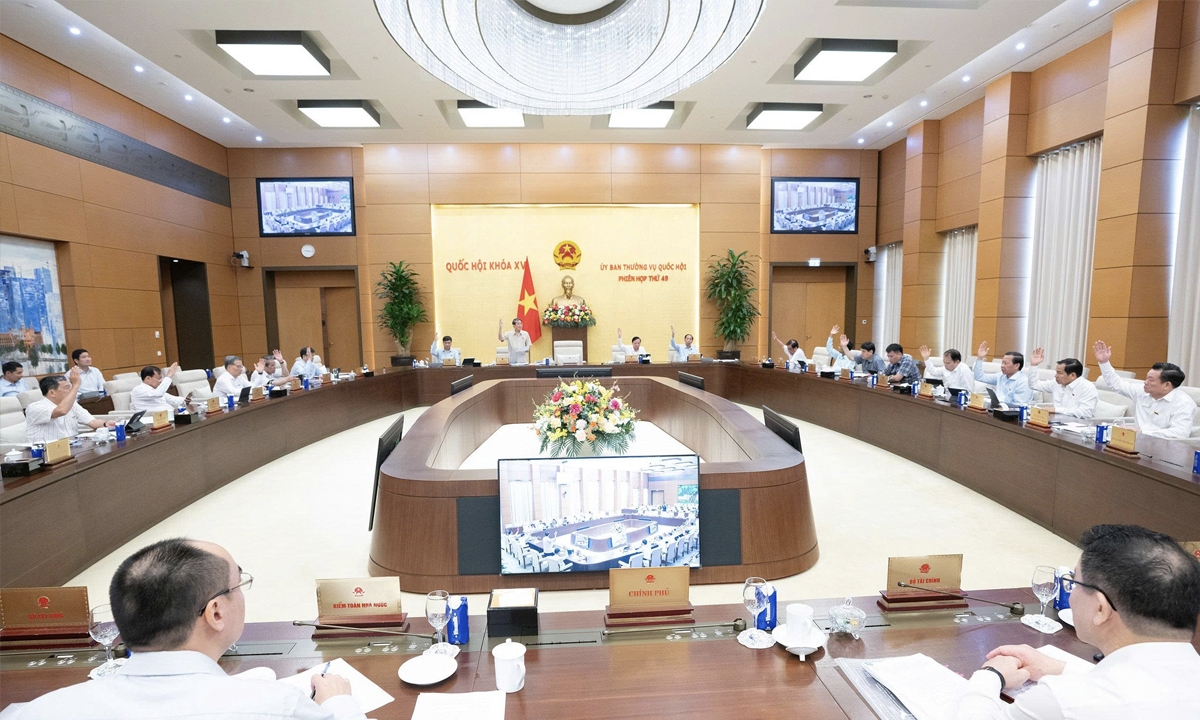
National Assembly Standing Committee voting in session.
Deputy Minister of Finance Tran Quoc Phuong presented the proposal, stating that the government recommends allocating VND 1,927 billion from the 2022 central budget surplus to Lam Dong Province. This funding will support the construction of the Bao Loc – Lien Khuong Expressway project.
Additionally, the government proposes reallocating VND 723 billion from the 2022 central budget surplus, originally intended for the Ministry of Finance and the Ministry of Construction but no longer required. This amount will be redirected to Quang Ngai Province (VND 150 billion) and Lam Dong Province (VND 573 billion).
Regarding adjustments to the 2025 central budget allocation among ministries, central agencies, and local authorities, the government suggests reducing VND 3,270 billion from the domestic central budget of nine ministries, central agencies, and three localities. This reduction will be reallocated to three ministries, central agencies, and 13 localities.
Furthermore, VND 703.036 billion from the Ministry of Agriculture and Rural Development’s foreign-funded central budget will be reallocated to three localities: Tuyen Quang, Ho Chi Minh City, and Tay Ninh.
The government’s proposal also includes adjustments to the 2025 central budget to align with the reorganization of ministries, central agencies, and local authorities.
Specifically, the government proposes reducing the entire 2025 central budget allocation for eight ministries and central agencies (including the Management Board of President Ho Chi Minh’s Mausoleum, the Ministry of Planning and Investment, the Ministry of Agriculture and Rural Development, the Ministry of Transport, the Ministry of Natural Resources and Environment, the Management Board of the Vietnamese Ethnic Culture Village, the Committee for Ethnic Minority Affairs, and the Management Board of Hoa Lac Hi-Tech Park). These funds will be reallocated to seven ministries and localities: the Ministry of National Defense, the Ministry of Finance, the Ministry of Agriculture and Environment, the Ministry of Culture, Sports and Tourism, the Ministry of Construction, the Committee for Religious Affairs, and Hanoi City.
The proposal also includes reducing VND 381 billion from the Ministry of Home Affairs to increase funding for the Ho Chi Minh National Academy of Politics. Additionally, VND 187 billion will be reduced from the Ministry of Labor, Invalids and Social Affairs, with VND 100 billion allocated to the Ministry of Home Affairs, VND 61 billion to the Ministry of Education and Training, and VND 25.3 billion to the Ministry of Health.
Finally, VND 66 billion will be reduced from the Ministry of Information and Communications, with VND 52.5 billion allocated to the Ministry of Science and Technology and VND 13.5 billion to the Ministry of Public Security.
The 10th Session of the 15th National Assembly: A 42-Day Legislative Marathon
The Secretary-General of the National Assembly, Le Quang Tung, announced that the National Assembly will convene for its 10th session on October 20th. With an ambitious agenda, the assembly plans to deliberate on 43 legal projects and resolutions, employing a two-pronged approach to ensure both efficiency and quality.
The House of Representatives Standing Committee Approves the 2025 Budget Adjustment for the Ministry of Construction
Under the stewardship of Vice Chairman Nguyen Duc Hai, the afternoon session on September 5th concluded with a decision to reduce the Ministry of Construction’s budget by over VND 1,400 billion. This substantial reallocation of funds will be directed towards local governments, ensuring compliance with legal regulations and jurisdictional authority.
The Capital City’s Administrative Evolution:
“Hanoi Restructures 109 Grassroots Administrative Units into 56 New Ones”
The resolution outlines Hanoi’s plans to restructure 109 communal-level administrative units, resulting in the formation of 56 new communal-level units across 20 districts, counties, and provincial cities.
How Many Wards and Communes Are There in Hanoi After the Merger?
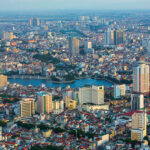
The restructuring of Hanoi’s communal-level administrative units has resulted in a streamlined structure. The city now boasts 12 dynamic districts, 17 vibrant counties, one thriving township, and 526 communal-level administrative units. This new organization positions Hanoi for enhanced efficiency and effective governance, fostering a brighter future for all its residents.
Why Is This City, a Former First-Class Municipality, Now Facing Demotion to Second-Class Status?
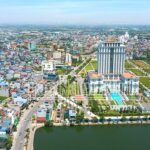
The city will be downgraded to a second-tier metropolis from September 1st.