

















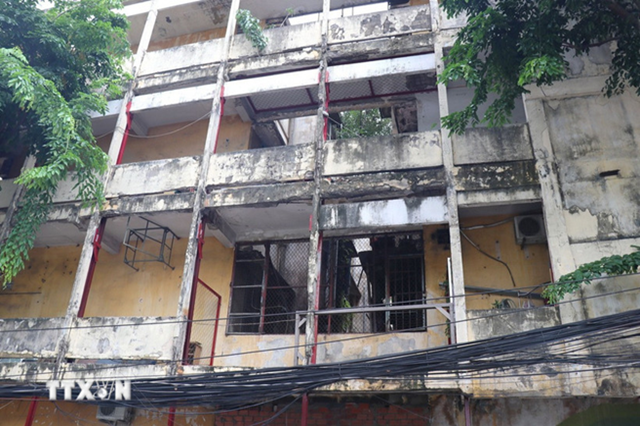
Temporary barriers have been erected around some sections of the Vinh Hoi apartment complex (Vinh Hoi Ward) due to deteriorated railings, posing potential hazards. (Photo: Thanh Vu/TTXVN)
|
Addressing the issue of aging apartment buildings in Ho Chi Minh City requires a collaborative effort among local authorities, investors, and residents, rather than relying on isolated initiatives.
The government plays a pivotal role in fostering a conducive environment by streamlining administrative procedures. Investors are not merely financial contributors but strategic partners in urban redevelopment, while residents’ consensus is paramount.
Unifying Voices for Change
Given that most old apartments are located in the city center, any rezoning must consider social infrastructure, transportation networks, and technical facilities to ensure project viability. Relocation plans are also essential to meet project objectives.
According to Nguyen Quoc Bao, Chairman of the Ho Chi Minh City Real Estate Association (HREC), this is a complex challenge, especially for buildings under 1,000 sqm. Coordination is crucial to balance the interests of authorities, investors, and residents.
Bao suggests that authorities should clarify policies, support relocation, and create incentives for investors. Residents need to embrace change, while businesses must offer fair compensation packages to facilitate smooth transitions.
Rebuilding old apartments is a unique investment, blending commercial housing with social responsibility. Financial support, favorable credit terms, and streamlined legal processes empower investors to propose better relocation solutions, particularly in negotiating compensation with residents.
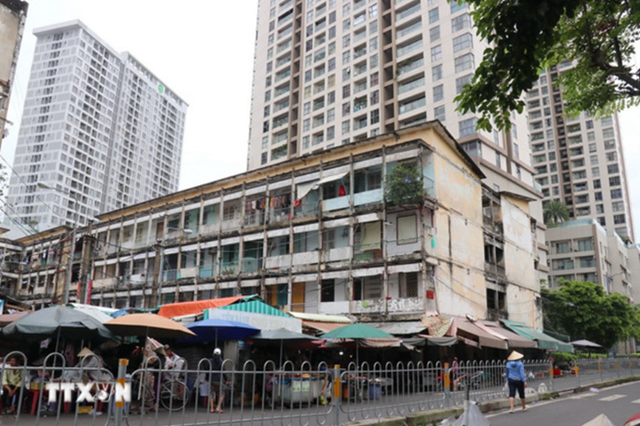 Blocks A, B, and C of the Vinh Hoi apartment complex (Vinh Hoi Ward), constructed before 1975, have been classified as Grade D (hazardous) due to severe deterioration. (Photo: Thanh Vu/TTXVN)
|
Nguyen Tien Dung, CEO of Savista Corporation, emphasizes that gaining resident consensus is challenging but essential for investors to propose viable agreements. A clear framework is needed to assess remaining property values, land compensation coefficients, and post-redevelopment rental rates.
“Once consensus is achieved, policies can be finalized: investor compensation, apartment exchanges, and resident top-ups,” Dung explains.
Experts suggest studying models from Japan and South Korea, which balance stakeholder interests. Germany’s approach combines architectural preservation with quality-of-life upgrades. Some historically significant buildings can be renovated to preserve cultural heritage while enhancing resident living standards.
Nguyen Quoc Bao, citing Singapore’s Housing and Development Board (HDB), believes state-owned enterprises are best suited for current redevelopment projects.
Enhancing Urban Living
The Ho Chi Minh City Department of Construction reports that city leaders recently approved a plan to rebuild deteriorated apartments, introducing policies to encourage resident relocation.
Residents will receive replacement apartments 1-2 times larger than their original ground-floor units, or 1-1.5 times larger for upper-floor units.
Those who sign relocation contracts but opt not to occupy new apartments may transfer their units.
Residents who prefer cash compensation at relocation can receive amounts equivalent to their replacement apartment values.
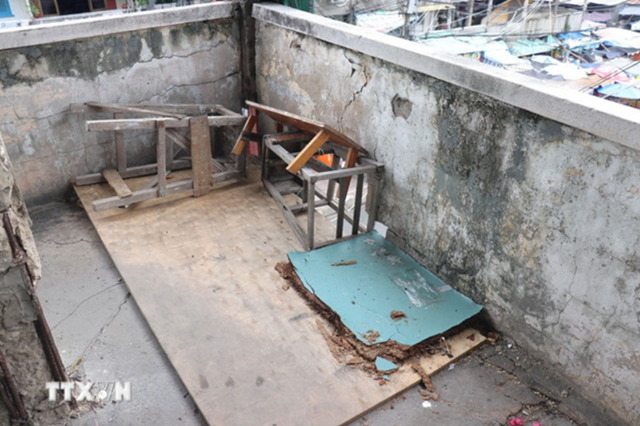
Severely damaged railings and floors at the Pham The Hien apartment complex (Chanh Hung Ward) leave large gaps, held together only by rusted steel. (Photo: Thanh Vu/TTXVN)
|
Investors in redevelopment projects may negotiate land use rights transfers with residents.
Investors submit investment approval requests alongside compensation and relocation plans.
Bui Xuan Cuong, Vice Chairman of the Ho Chi Minh City People’s Committee, states that the plan ensures balanced stakeholder interests, prioritizing community welfare and social goals.
On September 23, the committee implemented City Council Resolution 17, offering incentives for investors in apartment redevelopment projects.
The city directs the Finance Department to guide the Construction Department in allocating funds from the city’s regular budget. Ward authorities responsible for pre-1994 apartments must inform affected residents.
The Construction Department will collaborate with relevant agencies to advise the People’s Committee on resolving investor issues, ensuring compliance with legal regulations.
“Redeveloping old apartments is urgent yet complex, impacting tens of thousands of households. These incentives will alleviate financial burdens on businesses, ensuring project feasibility and accelerating redevelopment for a modern urban landscape,” Cuong stresses.
To expedite progress, the committee will allocate state funds for government tasks like quality assessments, planning approvals, and investment licensing.
The city aims to complete all pre-1975 apartment redevelopments based on inspections and redevelop deteriorated (Grade D) or expired (1975-1994) buildings by 2035.
Redeveloping old apartments revitalizes urban living spaces. Most importantly, residents enjoy comprehensive improvements: safer environments, enhanced fire safety, security, and sanitation, significantly improving their quality of life. The benefits to residents are immeasurable.
Thanh Vu
– 06:00 03/10/2025
Unlocking Progress: 47 Private Investment Projects in Former Ho Chi Minh City Cleared of Obstacles as of September 24th

Unblocking over 47 long-stalled projects in former Ho Chi Minh City territories, totaling more than VND 420.3 trillion in registered investment and spanning nearly 25,859 hectares, has been achieved.
23 New Residential Projects in Ho Chi Minh City Approved for Foreign Ownership
The Ho Chi Minh City People’s Committee has added 23 new housing development projects to the list of properties eligible for foreign ownership. This marks the third update this year, bringing the total number of approved projects for foreign investment to 88.
Ho Chi Minh City Explores Dedicated Bike Lanes, Pilot Project on Mai Chí Thọ Street

At the press conference on Ho Chi Minh City’s socio-economic situation on October 2, Mr. Nguyễn Kiên Giang, Deputy Head of the Department of Traffic Infrastructure Management and Exploitation at the Department of Construction, shared his perspective on the cycling community’s proposal to expand the city’s dedicated bike lane network.
Phan Xich Long Food Street Seeks Extended Late-Night Hours

Numerous proposals advocate extending the operating hours and organizing entertainment activities at Phan Xích Long food street to boost Ho Chi Minh City’s night-time economy.
Ho Chi Minh City People’s Committee Appoints New Chairman of Benthanh Group’s Board of Members

On September 30, 2025, during the Personnel Decision Awarding Ceremony hosted by the Ho Chi Minh City People’s Committee, Comrade Vũ Đình Quân—Secretary of the Party Committee and Deputy General Director of Benthanh Group (official name: Ben Thanh Corporation – LLC)—officially received his appointment as Chairman of the Members’ Council of Ben Thanh Corporation.