










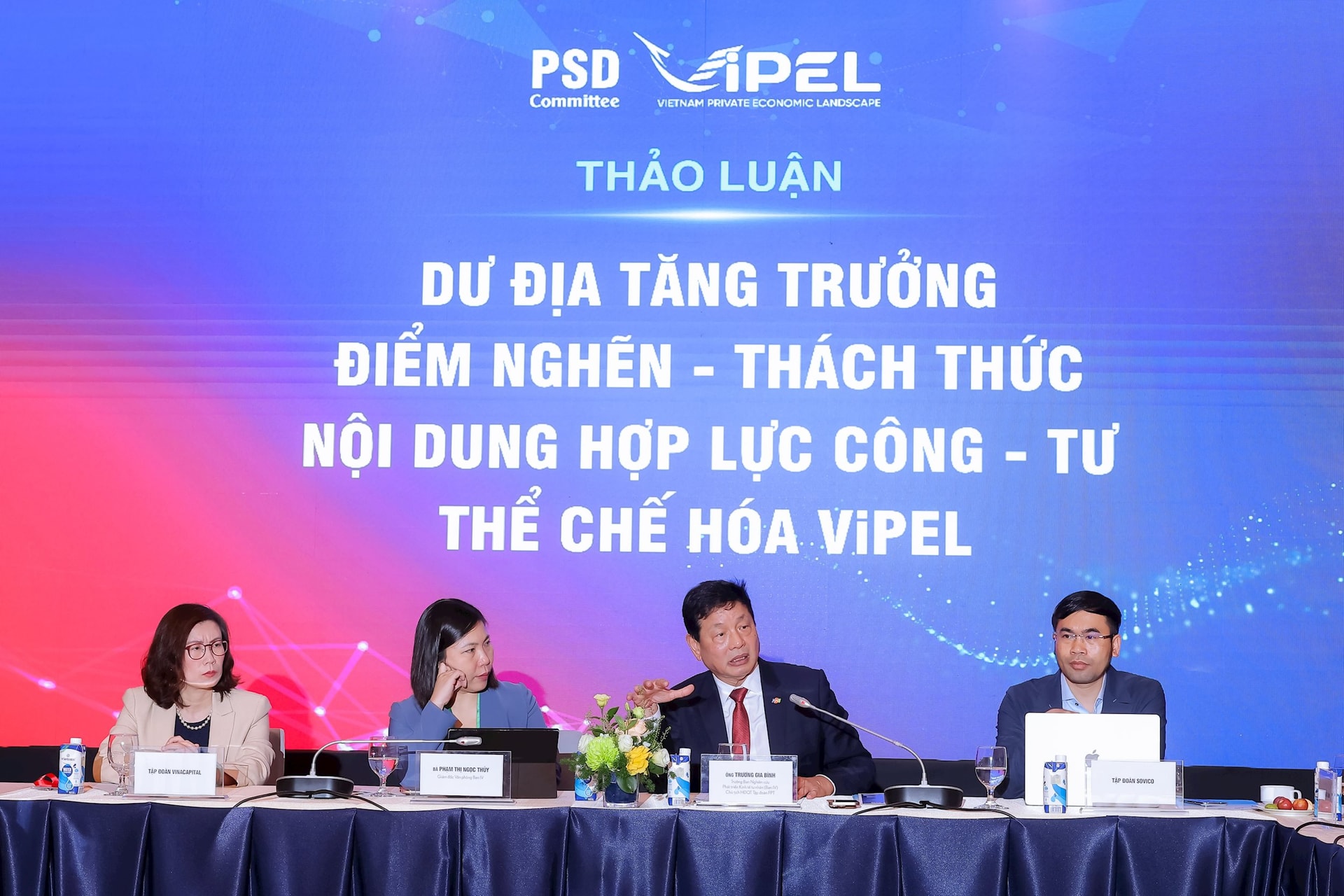
On October 10, the first “Comprehensive Overview of the Private Economy” program (ViPEL 2025) took place at the National Convention Center in Hanoi.
Over 500 businesses participated in discussions across four specialized committees and the ViPEL Women Entrepreneurs Forum. At Committee 1, focusing on new technology sectors and innovation, a Low-Altitude Economy (LAE) Alliance was formed, comprising 10 representatives from businesses, institutes, and universities in emerging technology fields.
Vietnam LAE brings together technology corporations, financial institutions, startups, and experts to research, develop strategies, and create plans for Vietnam LAE’s growth. Its core objective is to establish LAE as a key economic sector, fostering the development of thousands of supporting businesses, generating tens of billions of USD within the next 10-15 years, and creating one million high-quality jobs.
Speaking at Committee 1’s discussion session, Mr. Tran Anh Tuan, Vice Chairman & CEO of the Vietnam Aviation, Aerospace & UAV Network, outlined a detailed roadmap and Vietnam’s potential in this industry.
The Global Race and the $1 Trillion Opportunity
The low-altitude economy focuses on utilizing airspace below 1,000 meters for civil and commercial activities, primarily through unmanned aerial vehicles (UAVs/drones) and vertical takeoff and landing (eVTOL) aircraft.
Mr. Tuan highlighted that while humans have extensively exploited resources on land, seabeds, and high-altitude airspace for civil aviation, the airspace from the ground to 1,000 meters remains largely untapped globally.
Projections indicate that the low-altitude economy will reach $700 billion by 2035 and $1 trillion by 2040.
Many countries have taken decisive action. China’s LAE sector generated a market value of approximately $71 billion in 2023 (a 33.8% increase year-over-year) and is expected to reach $93 billion in 2024, creating over one million jobs.
In the U.S., giants like Amazon are actively testing drone delivery, aiming for 500 million annual deliveries by 2030. The United Arab Emirates (UAE) has pledged $100 billion in investments in this field by 2030.

Vietnam’s Potential
According to Mr. Tuan, Vietnam, particularly Ho Chi Minh City, possesses numerous advantages for entering the low-altitude aviation sector.
In this field, Mr. Tuan revealed, “We have already produced and sold products to 63 countries, ranking among the top three globally in gimbal camera production for UAVs. Seven out of the top ten drone manufacturers use products made in Vietnam. This demonstrates our technological and manufacturing capabilities.”
Additionally, Vietnam has a robust supporting industry, including mechanical processing and circuit board manufacturing, which are essential for this sector.
Vietnam’s stable political system and favorable geopolitical position make it an attractive destination for countries to establish UAV manufacturing plants, serving the global market.
Mr. Tuan noted that the LAE Alliance identifies Ho Chi Minh City as the ideal pilot location for Vietnam’s low-altitude economy development. Its rapid urbanization, vast area, high population density, and satellite cities provide ideal conditions for testing and refining drone operations in the low-altitude economy.
Challenges to Takeoff
However, the low-altitude aviation sector faces unique challenges, particularly in security and defense. Activities involving aerial devices are tightly regulated.
Mr. Tuan pointed out that there are no opportunities for flight testing in Vietnam. Products are developed but cannot be tested. Current regulations restrict flights to 120 meters in altitude and within very limited areas.
“Legal barriers are the biggest obstacle to developing the low-altitude aviation sector and producing for the international market,” said Mr. Tuan.
To harness LAE’s potential, Vietnam must address key legal and technological readiness challenges.
Recommendations include establishing a favorable legal framework for R&D, manufacturing, testing, and exporting UAVs and UTM systems; attracting investment and technology transfer; encouraging domestic businesses to invest in R&D with government support for core technology development; and creating specialized LAE training programs at key universities along with special credit packages.
The private sector proposes a comprehensive framework and a leading alliance to drive the national Low-Altitude Economy strategy. The LAE Alliance will foster the LAE ecosystem, with Ho Chi Minh City serving as a pilot for investment attraction and application testing.
The Alliance will advise on solutions, R&D, cooperation, investment attraction, manufacturing, exports, and LAE application deployment, aiming to make Ho Chi Minh City a global Drone Capital by 2026-2035.
It advocates for flexible policies, special incentives for LAE, digital economy promotion, and drone testing for delivery and healthcare using UTM platforms. It also encourages private sector investment in R&D, technology transfer, and LAE participation.
The Alliance aims to establish domestic and international joint ventures to complete the LAE ecosystem.
The Vietnam LAE Alliance and partners commit to investing and attracting over $1 billion into the LAE ecosystem from 2026 to 2030.
The LAE development roadmap in Vietnam consists of three phases:
Phase 1 – Foundation Building (2025-2030): R&D, training, processing, assembly, and establishment of LAE industrial zones.
Phase 2 – Integration & Technology Mastery (2031-2035): Achieving technological autonomy, completing legal frameworks, and large-scale production.
Phase 3 – Export & Regional Leadership (2036-2040): Setting regional standards and becoming a global LAE hub.
Over 30 Strategic Partners Sign On to Distribute The Win City Project

Thắng Lợi Group has officially launched The Win City project to the market, unveiling over 30 pioneering strategic distribution partners to bring this exceptional development to a wide audience.
“A Step Towards Home with Fenica: The Ultimate Residential Solution in Ho Chi-Minh City’s Northeast Infrastructure”

On October 10th, Fenica, a high-rise project located on Tran Quang Dieu Street in Tan Dong Hiep Ward, unveiled its concept “One Step Home,” emphasizing its vision to create a convenient and well-connected living space tailored for young individuals.
Saigon Co.op Appoints New CEO

The CEO of Saigon Co.op is a homegrown leader with over 20 years of dedicated service within the company.
Surge in Real Estate Interest Shocks Hanoi and Ho Chi Minh City Markets

In Hanoi, the real estate market is experiencing a notable resurgence in interest, with property prices continuing to rise. After a prolonged period of stagnation, the market has entered a clear recovery phase, marked by growth in both sales prices and investor engagement.
74% of Ho Chi Minh City Businesses Urge Tax and Fee Reductions

A recent survey by the Ho Chi Minh City Business Association reveals a concerning trend: 41% of businesses reported a decline in profits during Q3 2025.