Minimum Commune Staffing Set at 40 Individuals
On the afternoon of October 16th, the National Assembly Standing Committee provided feedback on the draft Resolution guiding the determination of the projected structure, composition, and allocation of nominees for People’s Council delegates at all levels for the 2026-2031 term. Additionally, they discussed the Resolution outlining the number of Deputy Chairs of the People’s Council and Deputy Heads of Council Committees at provincial and commune levels, as well as the arrangement of full-time delegates at these levels.
During the session, National Assembly Chairman Trần Thanh Mẫn emphasized that guidelines for the structure, composition, and allocation of nominees must align with the Party’s directives, particularly recent regulations pertaining to local governance at two administrative levels.
Given the limited time, Chairman Mẫn urged the Committee on Delegate Affairs to review and expedite the issuance of guidelines to ensure timely implementation. The resolutions aim to establish a legal framework for localities to prepare for elections, addressing existing limitations and inadequacies.
“Therefore, the structure, composition, and number of People’s Council delegates must be adjusted to suit the scale, requirements, responsibilities, and representation needs of the people at each level. Currently, we have only two levels (provincial and commune), so the selection of candidates must ensure adequate representation,” Chairman Mẫn noted.
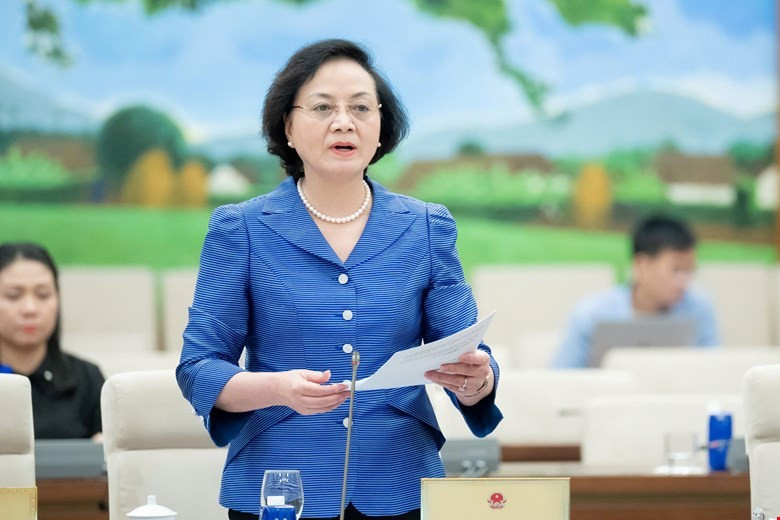
In response, Minister of Home Affairs Phạm Thị Thanh Trà expressed concerns regarding the calculation of leadership positions, especially following the completion of the job position catalog for communes. This catalog identifies approximately 40 detailed job positions.
Correspondingly, a commune should have a minimum of 40 staff members (for standalone communes without prior mergers). However, future calculations must consider population size, natural area, economic scale, and other specific factors.
The Minister also noted that communes currently average about 30.5 leadership positions, which is substantial. Therefore, she stressed the importance of decentralization and delegation of authority, tied to local responsibilities, to suit each administrative unit. Otherwise, the number of leaders in communes could become a significant concern.
Regarding the number of Deputy Heads of Commune-level Council Committees, the proposal suggests two full-time deputy positions, leading to a large number of deputy positions overall. The Minister suggested a comprehensive approach, with some areas potentially requiring only one full-time deputy and one part-time deputy.
Maximum of 4 Deputy Chairs for People’s Councils
At the conclusion of the discussion, the National Assembly Standing Committee voted to approve the draft resolutions. Accordingly, nominees for People’s Council delegates at all levels for the 2026-2031 term must ensure a reasonable composition of delegates working in political organizations, socio-political organizations, and state agencies.
Additionally, female candidates must constitute at least 35% of the final list of nominees at each level, with efforts to achieve a 30% representation among elected delegates. Non-Party members should strive for a minimum of 10% representation, and young delegates should aim for at least 15%.
The Resolution stipulates that cities formed through the merger of three provincial-level administrative units shall have no more than 4 Deputy Chairs of the People’s Council; those formed from two units shall have no more than 3.
Provinces formed through mergers shall have no more than 3 Deputy Chairs, while non-merged provinces and cities shall have no more than 2.
Regarding Deputy Heads of Council Committees: provinces and cities formed from three merged units shall have no more than 4 Deputy Heads; those formed from two units shall have no more than 3.
41 Resolutions Set for Approval at Ho Chi Minh City People’s Council Session

The fourth session of the Ho Chi Minh City People’s Council, as highlighted by Chairman Vo Van Minh, marks the most extensive workload since the city’s two-tier local government structure was established. A total of 41 resolutions are set to be reviewed and adopted during this pivotal meeting.
Unveiling the ‘Silk Steel Bridge of Union’ Spanning the Duong River

The graceful, soaring steel arches of the new Duong Bridge are beginning to take shape, their elegant curves reaching skyward.
The New Face of Ho Chi Minh City: Unveiling the Renaming of Merged Neighborhoods
The neighborhood of Binh Duong, in Ho Chi Minh City, underwent a transformation with a unique twist. The original four wards, upon merging, encountered an unusual challenge—a numbering system for their streets that led to duplication. In a creative resolution, the streets were renamed, with a nod to their historical roots. The new names now bear the prefix of the old ward, followed by a number, except for one street, which, in a break from the pattern, was renamed after a distinct landmark, thus preserving its unique identity.