









The Risk of Money Laundering Through Cryptocurrency Assets
On September 15th, the Governor of the State Bank of Vietnam (SBV) issued Circular No. 27/2025/TT-NHNN (effective from November 1st), replacing Circular 09/2023/TT-NHNN. This new circular provides guidance on implementing certain provisions of the Anti-Money Laundering Law and outlines the content of Resolution 05 issued by the Government regarding the pilot cryptocurrency market.
The document also updates the national risk assessment results for money laundering and terrorist financing.
At a dissemination workshop held on October 16th, Ms. Nguyễn Thị Minh Thơ, Deputy Director of the Anti-Money Laundering Department (SBV), stated that Circular 27 emphasizes a risk-based management approach. Accordingly, organizations must periodically assess money laundering risks and establish customer identification and verification procedures, even for customers without accounts or with minimal transactions.
Reporting entities must also regularly monitor business relationships to ensure transactions align with legitimate funds and customer profiles.
During the workshop, Mr. Tô Trần Hoà, Deputy Head of the Securities Market Development Department at the State Securities Commission, warned of prevalent money laundering schemes through cryptocurrency assets worldwide.
According to Mr. Hoà, individuals and organizations have circumvented verification systems on service platforms by providing counterfeit documents to execute illegal money transfers. They also exploit peer-to-peer transactions through “black markets” to directly buy and sell cryptocurrency assets using cash.
However, the most challenging to detect is the act of “mixing” cryptocurrency assets, where service providers can only identify the individual owning the asset, while the asset’s origin often remains unverified.
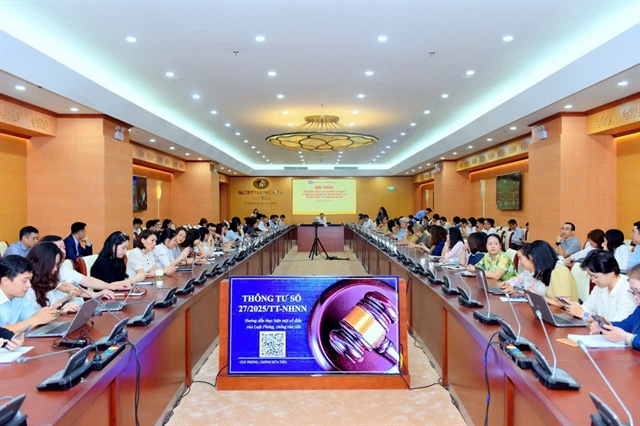 The workshop was attended by representatives from regulatory bodies, securities companies, fund managers, insurance firms, real estate businesses, notaries, accounting and auditing firms, casinos, and gold traders. |
Additionally, perpetrators transfer cryptocurrency assets through various blockchains, generating numerous transactions below the alert threshold, making tracing difficult.
Another money laundering method involves creating “clean” projects, using illicit cryptocurrency assets to acquire these projects, and then transferring funds back before collapsing the projects to erase traces.
According to Senior Colonel Đàm Văn Minh, a Central Legal Reporter from the Domestic Security Department (Ministry of Public Security), with the growth of the internet and digital assets, a significant number of Vietnamese individuals participate in digital asset trading. It is estimated that approximately 26 million digital asset accounts are held by Vietnamese nationals.
Mr. Đàm Văn Minh noted that, to date, Vietnam has not recorded any cases of using digital assets to finance terrorism. “The risk of terrorist financing through digital assets in Vietnam remains low,” he stated.
However, the representative from the Ministry of Public Security believes that the risk of money laundering is still concerning. Therefore, it is necessary to assess the capacity of organizations and the risk factors associated with specific customers, rather than making general assessments as currently done with businesses and professional associations.
Preventing Price Manipulation and Money Laundering in Real Estate
Mr. Lê Hoàng Châu, Chairman of the Ho Chi Minh City Real Estate Association (HoREA), believes that Circular 27 is a significant step toward making the real estate market more transparent and secure.
Real estate is a high-risk sector for money laundering due to its large-scale investments and complex transactions, which can be exploited to legitimize illicit funds. Thus, Circular 27 is timely, providing a stricter legal framework to mitigate risks and enhance investor confidence.
The representative from the Real Estate Association emphasized that the key message of Circular 27 is to promote compliance and transparency. “If implemented rigorously, this document will help the market operate more healthily and reduce speculation, price manipulation, and money laundering through real estate transactions,” he stressed.
Given that real estate credit accounts for nearly 24% of the total outstanding debt in the system, transparent fund management is essential.
“In the first nine months of the year, consumer credit for real estate increased by over 12%, primarily for home purchases and renovations, reflecting genuine demand. However, regulatory bodies and credit institutions must closely monitor to prevent the misuse of consumer credit for money laundering,” he warned.
The Chairman of HoREA proposed enhancing training, guidance, and legal awareness for businesses, particularly brokerage firms, trading floors, and developers, to improve compliance.
Tuân Nguyễn
– 15:24 16/10/2025
MB Wins Four Prestigious Awards from Visa

Not only does this award recognize the success of MB Bank’s card services, but it also stands as a testament to the bank’s relentless efforts in implementing cashless payment solutions and cutting-edge technology. These initiatives are designed to provide customers with a secure and seamless experience.
Expert: Speculation Not the Primary Cause of Rising Real Estate Prices

Dr. Lê Xuân Nghĩa asserts that speculative demand does exist, but it is not the primary driver of rising real estate prices. The core reason behind the surge in property values lies in the fundamental imbalance between supply and demand.
Why Vietnam’s Land Law Hasn’t Been Fully Revised Yet

According to a dedicated member of the National Assembly’s Committee on Economics and Finance, the comprehensive revision of the Land Law requires additional time to thoroughly assess and address all existing challenges and complexities. As a result, the full-scale amendment of the Land Law will continue to be studied in the upcoming period.
From Hesitant to Hooked: Why Electric Motorcycles Are Winning Over Vietnamese Riders

Electric scooters with weak performance, rapidly degrading batteries, and limited charging stations were once major concerns for Vietnamese consumers just a few years ago. However, the Vietnamese market has witnessed a faster-than-expected transformation, driven by the rapid advancements and innovations from electric vehicle manufacturers.
The Bizarre Journey of a Real Estate Empire: 9X Profit Surge During the Pandemic, From Broker to Tycoon, and the Founder’s Hidden Secret
Khải Hoàn Land, once a modest player in the real estate brokerage industry, has emerged as a powerhouse, achieving a staggering ninefold profit surge during the pandemic. Today, the company is forging an empire with multi-billion-dollar projects, while its founder’s intriguing connection to Vietnamese literature remains a captivating enigma.