






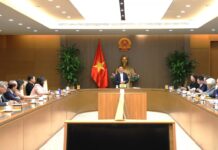











On October 15th, at the Central Party Headquarters, the Standing Committee of the Central Steering Committee for Science, Technology, Innovation, and Digital Transformation held its Q3 meeting. General Secretary Tô Lâm, Head of the Steering Committee, chaired the session.
The meeting was conducted both in-person and online with local representatives to evaluate the progress of Resolution No. 57-NQ/TW issued by the Politburo on breakthroughs in science, technology, innovation, and national digital transformation over the past nine months.
General Secretary Tô Lâm emphasized that implementing Resolution No. 57 is crucial, serving as the primary driver for achieving strategic breakthroughs, transitioning the country’s development model, and establishing a new growth framework in line with the 13th National Party Congress’s directives.
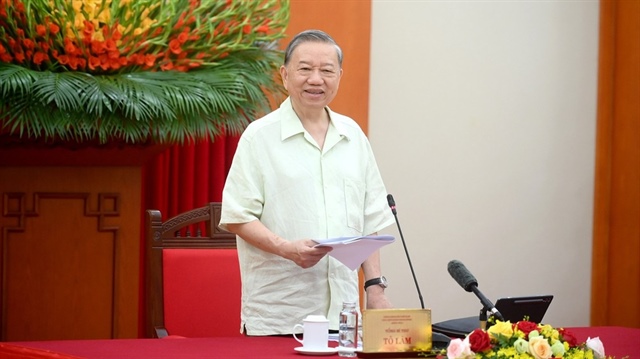
General Secretary Tô Lâm. Photo: Nhân Dân |
Breaking Down ‘Silo Mentality’
The General Secretary mandated adherence to the new governance principle adopted by the 13th National Party Congress: “Discipline First – Resources Alongside – Results as the Measure.” This principle must guide all activities consistently.
Discipline entails strict compliance with directives, meeting deadlines, avoiding delays or evasion, and resolving overdue tasks promptly. Resources must be allocated efficiently, accurately, and without waste.
Progress must be measured by tangible, quantifiable outcomes, not superficial reports.
The General Secretary prioritized removing institutional bottlenecks and leveraging data to eliminate “silo mentality.”
He also highlighted the need for intellectual property frameworks, research commercialization, and public-private partnerships to mobilize societal resources.
Crucially, mechanisms must protect officials who take bold, accountable actions for the greater good.
Additionally, the General Secretary called for fostering an ecosystem centered on businesses, shifting from a “State-led” to a “State-enabled” model to maximize private-sector involvement in science, technology, and innovation.
He stressed, “Where the private sector can operate effectively without state dominance, enable and encourage their participation.”
Only when businesses lead will the “Three Houses” model (State-School-Enterprise) become meaningful, he added.
The General Secretary urged using citizen and business satisfaction as the ultimate metric, emphasizing full-scale digitization and integrated “one-stop, one-declaration” public services.
To realize these goals, he outlined a clear action mantra: “Three Focuses – Three Transparencies – One Measure,” as directed by the 13th National Party Congress.
The Three Focuses are: Rapidly institutionalizing Steering Committee directives; executing with concrete deliverables; and monitoring to address challenges promptly.
The Three Transparencies involve: Publicizing progress, responsibilities, and outcomes for societal oversight.
The One Measure is citizens’ living standards and trust.
Less Talk, More Action, Decisiveness, Efficiency
The General Secretary also directed institutionalizing and scaling the “Breakthrough Implementation Governance Model” for complex, cross-sector tasks.
He urged all agencies, especially leaders, to exemplify accountability to the Party, State, and people, ensuring timely, impactful task completion.
Leaders—ministers, provincial chiefs, and department heads—must deeply internalize their role in national science, technology, and digital transformation.
They must reject “term-limited thinking,” “sectoral interests,” and inaction, he warned, adding, “Those failing to adapt must be replaced to avoid hindering progress.”
He called for a “less talk, more action” approach, urging officials to propose cross-sector solutions benefiting the nation.
|
General Secretary Tô Lâm directed Party committees at all levels to implement digital transformation plans effectively, adhering to set timelines. The Government Party Committee must resolve pending legal guidelines, ensuring 100% of decrees and circulars for new science, technology, and innovation laws are enacted by March 31, 2026. The National Assembly Party Committee should focus oversight on: National database progress; budget utilization; and commercialization of science-technology products under the “Three Houses” model. The Vietnam Fatherland Front Committee must digitize operations and independently monitor science quality, public services, and database implementation impacting citizens. |
NGUYỄN THẢO
– 15:40 15/10/2025
EXIMBANK Shines with Two Prestigious Awards at APEA 2025

On October 9, 2025, Eximbank was honored at the Asia Pacific Enterprise Awards (APEA) 2025 with two prestigious accolades: the Corporate Excellence Award and the Fast Enterprise Award.
Breaking News: Ho Chi Minh City Police Issue New Driver’s License Update

The Ho Chi Minh City Traffic Police Department has issued a new announcement regarding outdated driver’s licenses.
Accelerating Digital Transformation: NCB Triumphs at Global Banking & Finance Review 2025

National Citizen Commercial Bank (NCB) has been honored with three prestigious technology awards by Global Banking & Finance Review (UK), recognizing its significant strides in comprehensive digital transformation, elevating customer experience, and leading the way in the era of digital finance.
“People” as the Core of All Transformation: VNDirect’s Chairwoman Pham Minh Huong Offers a “Compass” for Organizational Change

At the heart of every transformation in our ever-changing reality lies the essence of “humanity,” asserts Phạm Minh Hương. She emphasizes that we must prioritize investing time in nurturing this core aspect of our existence.
ACB CEO: We’re Grappling with the Low-Interest Loan Race Against Big4

Mr. Tu Tien Phat, CEO of ACB, explains that while banks’ annual profits of 20-30 trillion VND may seem substantial, they are relatively insignificant when compared to their total assets.