

















This will serve as the basis for commune-level People’s Committees to process construction permits for residents.
Ho Chi Minh City is currently seeking input to finalize the draft regulations on urban architectural management (replacing Decision 56/2021 on the city’s architectural management regulations) to address challenges and obstacles faced by residents when building homes.
Resolving Setback Issues
At the voter meeting preceding the 10th session of the 15th National Assembly held in late September 2025, voter Phan Nguyễn Minh Tùng (Bà Điểm commune) urged authorities to promptly resolve difficulties and obstacles to make home construction more convenient for residents.
Mr. Tùng expressed his desire for the consideration and issuance of official or temporary construction permits for residential land in new urban areas. According to this voter, the suspension of permits is causing difficulties for residents, as they cannot settle down despite the area’s population density reaching 80-90%. “Residents are allowed to buy and transfer land but cannot obtain construction permits for the remaining plots,” he noted.
Not only in newly planned residential or mixed-use areas but also in many existing residential areas and inner-city districts, residents have petitioned for the swift resolution of inconsistencies in Decision 56/2021 to facilitate home construction. Among these, the regulation on construction setbacks has impacted residents’ ability to build homes.
Speaking with a reporter from Người Lao Động Newspaper, Mr. N.V.T (Hòa Hưng ward) shared that after years of saving, his family decided to build a house in 2024. However, their plans were put on hold as they awaited the city’s resolution of setback issues. To date, his family continues to wait and hopes the city will soon adjust this regulation. Many others have also postponed their construction plans due to limited building areas when applying the mandated setbacks.
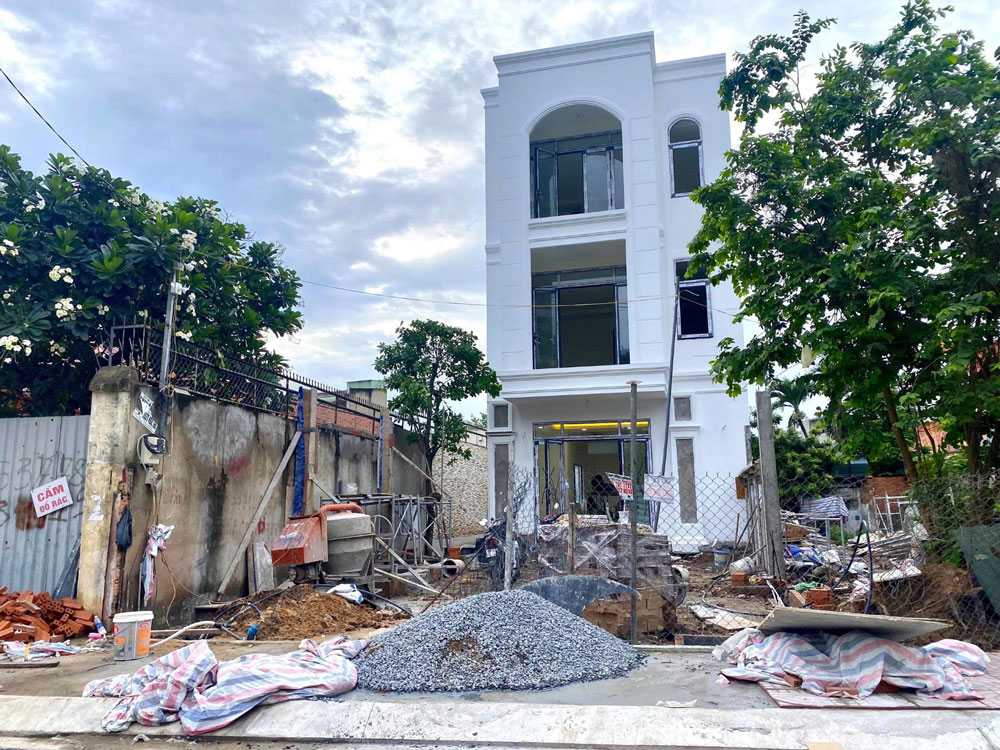
Ho Chi Minh City will soon adjust and replace Decision 56/2021 to align with practical needs, facilitating residents’ home construction.
Previously, many districts faced considerable confusion in managing and issuing construction permits due to setback regulations and other provisions in Decision 56/2021. Consequently, several areas have proposed adjustments, such as eliminating setbacks for structures in central and existing urban areas, applying them only to new planning zones. Some have even suggested making setbacks optional rather than mandatory and clarifying their application to new construction permits versus renovations.
The Ho Chi Minh City People’s Committee has acknowledged these inconsistencies and directed relevant agencies to draft adjustments to replace Decision 56/2021.
The Department of Construction has also confirmed that the city is reviewing adjustments to Decision 56/2021 to address challenges in construction within newly planned residential and mixed-use areas.
To date, the Ho Chi Minh City Department of Planning and Architecture has drafted the city’s urban architectural management regulations and is gathering feedback for finalization. These regulations are expected to be submitted to the City People’s Council for approval in the fourth quarter of 2025. This will provide a foundation for commune-level People’s Committees to process construction permits for residents.
Thus, alongside resolving issues related to residential land in newly planned and mixed-use areas, the new regulations will make home construction more convenient for city residents.
Streamlining Construction Permit Procedures
Regarding the processing of residential construction permits, Deputy Chairman of the Ho Chi Minh City People’s Committee Bùi Xuân Cường has instructed the Department of Construction to collaborate with ward and commune People’s Committees, special zones, and relevant agencies to urgently implement the city’s and Prime Minister’s directives on reducing and simplifying administrative procedures in the construction sector.
Accordingly, the Department of Construction will work with the Department of Justice to advise and propose that the City People’s Committee issue a decision on decentralization and authorization for issuing construction permits, as well as the scale and duration of temporary construction permits citywide. Additionally, they will explore proposals to simplify construction permit procedures and exempt single-family homes in certain areas from requiring permits, based on the city’s specific conditions, to facilitate residents’ construction processes.
The Department of Construction will also collaborate with ward and commune People’s Committees, special zones, and related units to review and consolidate challenges, obstacles, and inconsistencies in issuing construction permits for residents, organizations, and businesses, and propose solutions.
Notably, the Ho Chi Minh City People’s Committee is implementing the Standing Committee of the City Party Committee’s conclusion on organizing and deploying forces to enhance urban and construction order management citywide. The Department of Construction has been tasked with coordinating with the Department of Home Affairs and ward, commune, and special zone People’s Committees to define requirements and plans for force deployment, tailored to each locality’s realities. They will also develop coordination regulations for urban and construction order management.
The Ho Chi Minh City Department of Home Affairs will lead in proposing support policies for the seconded urban and construction order management force to ensure their stability. Ward, commune, and special zone chairpersons will collaborate with the Department of Construction to receive, assign tasks, and evaluate this seconded force.
Ministry of Construction: Public Investment Disbursement Expected to Surpass 54% of Annual Plan

By the end of October 2025, the Ministry of Construction is projected to disburse approximately 50% of its initial annual plan and surpass 54% of the adjusted plan, following reductions in expenditure tasks and reallocations to local authorities.