The Ministry of Public Security is seeking public input on a government resolution to eliminate the requirement for notarization, marital status verification, and the submission of personal document copies in transactions involving land and vehicle purchases, where digital data is already available. Under this proposal, electronic contracts signed with digital signatures or Level 2 authentication accounts would replace traditional notarized contracts.
The Ministry’s proposal has garnered support for its potential to accelerate digital transformation and reduce administrative burdens in civil transactions for citizens.
Mr. Nguyễn Vũ Cao, Chairman of Khang Land’s Board of Directors, views the elimination of notarization as part of the broader public administrative reform trend, aimed at integrating technology into civil transaction management.
According to Mr. Cao, implementing this process on digital platforms like VNeID would enhance verification compared to manual procedures at notary offices.
“Digital systems eliminate duplicate data, optimize costs, reduce travel, and crucially, prevent fraudulent or inaccurate notarization, which has occurred in the past,” Mr. Cao stated.
He acknowledged that any reform creates tension between old and new systems. For successful implementation, the government must provide clear guidelines, synchronized solutions, and robust technical support.

Citizens completing property purchase procedures at a notary office in Ho Chi Minh City. Photo: Anh Phương |
Concerns have been raised about the safety of eliminating notarization in high-value asset transactions, particularly for real estate. Can this change ensure security?
Attorney Lê Hằng, a member of TAT Law Firm – Trương Anh Tú LLC, with extensive experience in advising and protecting clients in major property disputes in Ho Chi Minh City and southern provinces, argues that notarization currently acts as a protective shield for citizens.
Under the 2024 Land Law, transactions involving land use rights—such as transfers, gifts, mortgages, or capital contributions—must be notarized or certified. For vehicles, sales contracts do not require notarization but must be verified by police when transferring ownership.
Ms. Hằng explains that notaries do more than verify signatures; they act as gatekeepers, ensuring transaction legality. They assess property ownership, legal status, and identify disputes or restrictions to safeguard citizens before signing.
With incomplete digital systems, buyers face legal risks if notarization is removed, as verifying asset status—such as mortgages, seizures, or ownership—becomes challenging. This could lead to prolonged disputes.
Need for Equivalent Notarization Alternatives
Attorney Lê Hằng highlights that marital status verification in property transactions is another critical safeguard. In many cases, one spouse unilaterally sells joint assets without the other’s consent. Courts often declare such contracts void in disputes. Without interconnected databases, removing this verification step leaves buyers unaware of asset ownership status, increasing risk.
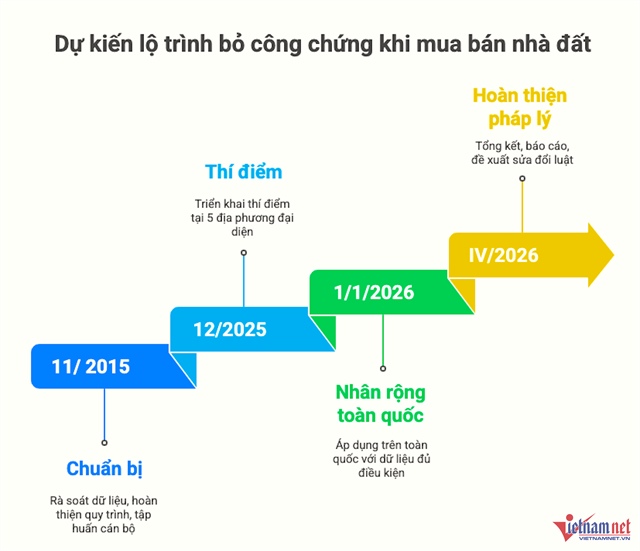
Proposed roadmap for eliminating notarization in property transactions. Graphic: Hồng Khanh |
Ms. Hằng notes that some countries have reduced or eliminated notarization in real estate transactions but have robust public ownership registries, transparent data, and strong digital identification systems. Transactions are verified digitally within minutes, and state compensation mechanisms exist for inaccurate information.
In Vietnam, however, land registration and marital status databases lack synchronization, making them inadequate substitutes for notaries.
“Eliminating notarization and marital status verification should only occur once equivalent or superior protective mechanisms are in place,” Ms. Hằng asserts.
A viable solution, she suggests, is to digitize all civil transaction processes. A unified electronic asset registry should allow citizens to verify legal status, ownership, mortgages, and seizures.
Additionally, digital authentication mechanisms, legally binding digital signatures, and clear liability for data errors by managing agencies must be developed.
“In Vietnam, property is more than an asset—it’s a home and a family legacy. Even minor procedural errors can result in loss or prolonged legal disputes,” Attorney Lê Hằng emphasizes.
She advises citizens to remain legally informed and cautious, not skipping legal checks. Retaining digital transaction evidence—such as signed contracts, payment receipts, and emails—is essential for providing to authorities when needed.
Hồng Khanh
– 05:20 22/10/2025
Mounting Challenges and Bankruptcy Risks Due to Flawed Construction Material Pricing Mechanisms

Skyrocketing construction material costs have left contractors reeling, with some reporting losses of 15-20% on projects. Multi-billion dong shortfalls and even halted construction sites have become stark realities as companies grapple with the volatile market, desperately awaiting price stabilization.
EVF Achieves Exceptional Growth: 9-Month Profits Surge by Nearly 70%
Amidst the challenges facing the consumer finance industry, EVF Finance Joint Stock Company (EVF, listed on HOSE, Stock Code: EVF) demonstrated remarkable resilience with impressive business results in Q3/2025.
FPT Profits Soar: Earning $1.5 Million Daily

After the first nine months of 2025, FPT reported revenues of VND 49,887 billion and pre-tax profit of VND 9,540 billion, achieving 71% of the annual plan and marking a nearly 18% increase compared to the same period last year. This positive performance is driven by the growth of the Technology and Telecommunications segments, with overseas IT services and the Made-by-FPT ecosystem continuing to expand robustly.
Entrepreneur Hoang Quoc Viet Shares Insights on Hong Bang International University Investment: 20x Growth in 10 Years, Emphasizing M&A Success Through Expertise, People Understanding, and Strategic Positioning

“When investing, it’s crucial to believe in the potential for exponential growth, as no one wants to sell their company at a low price,” emphasized Mr. Hoàng Quốc Việt, Chairman of Nguyễn Hoàng Group (NHG).
Digital Land Titles Coming to VNeID App

The Ministry of Public Security is collaborating with the Ministry of Agriculture and Environment to develop a feature on the VNeID app. This feature will enable citizens to self-submit, verify, and authenticate land and residential ownership information directly from the National Population Database, eliminating the need to provide physical copies of land certificates or citizen ID cards.