














In recent years, Vietnam’s large family businesses have witnessed the rise of a new generation of successors. They are not merely inheriting ownership but actively engaging in management and strategic leadership. These young individuals are stepping into roles such as CEO, Chief Operating Officer, or Board Members, going beyond being mere “heirs.”
Notably, Vietnam’s NextGen brings fresh perspectives, new technologies, and ambitious visions. They serve as a bridge between their parents’ business legacy and the rapidly evolving digital economy. In a context where Vietnamese family businesses increasingly need innovation, this generation is seen as a “breath of fresh air.”
A Young Generation Stepping onto the Global Stage
According to a report from UEH University (Ho Chi Minh City University of Economics), as of 2021, over 70% of private enterprises in Vietnam are family-owned or have family characteristics (e.g., family members in management or controlling shares). The trend of succession is on the rise. The 2024 PwC Global NextGen Survey, which includes Vietnam, reveals that 52% of NextGen respondents already hold leadership positions, a significant increase from 29% in 2022.
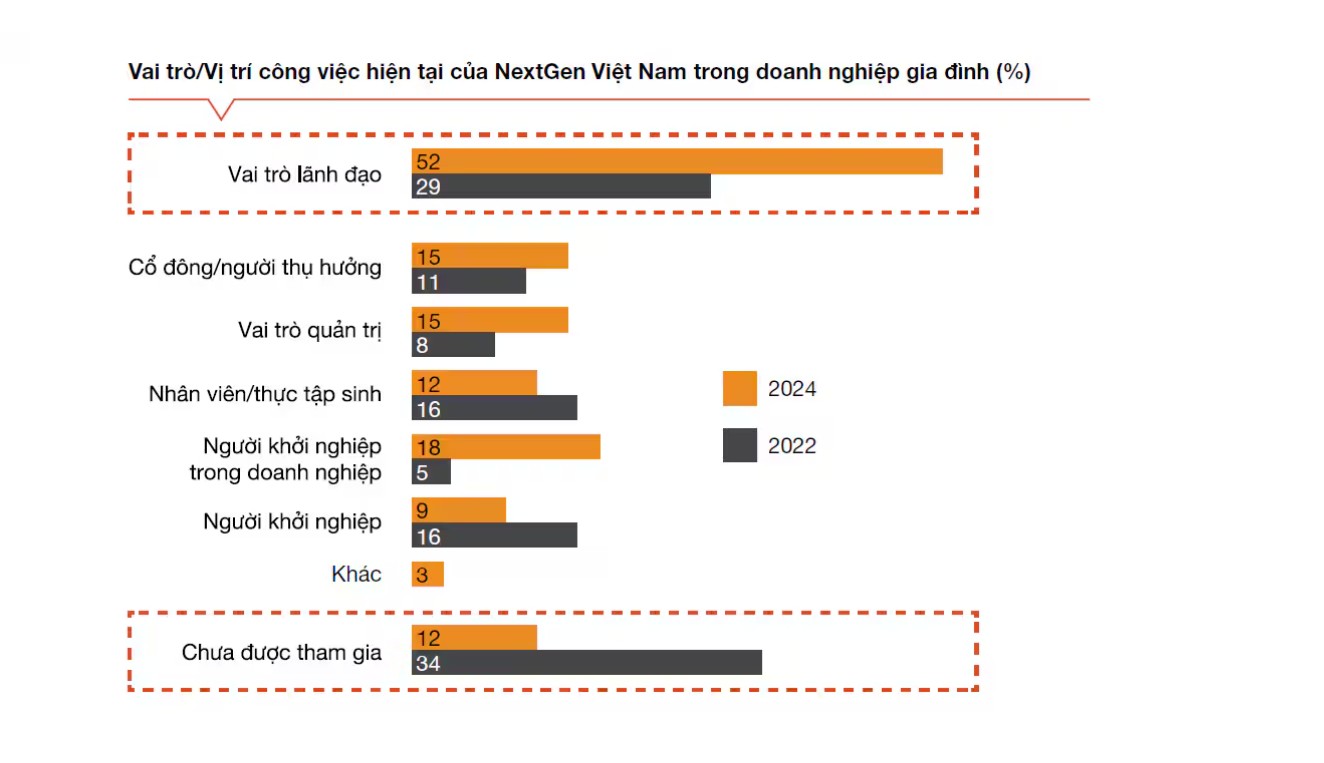
2024 PwC Global NextGen Survey
In early 2025, a high-profile event captured public and business attention: the wedding of Pham Nhat Minh Hoang, born in 2000, the second son of Pham Nhat Vuong, Chairman of Vingroup. Despite his youth, Minh Hoang, alongside his elder brother Pham Nhat Quan Anh (born in 1993), holds leadership positions in subsidiaries within the group’s ecosystem.
Minh Hoang is the legal representative of FGF Trading and Services Joint Stock Company, rebranded as Green Future in March, focusing on car rentals. Green Future plans to expand nationwide and enter the international market.
Another notable figure is Do Quang Vinh, born in 1991, the eldest son of Do Quang Hien, Chairman of T&T Group. Within the “Hien” family’s ecosystem, Vinh oversees finance as Vice Chairman of SHB Bank and Chairman of SHS Securities. His younger brother, Do Vinh Quang (born in 1995), chairs Vietravel Airlines and serves as Vice Chairman of T&T Group and Chairman of Hanoi FC. Aviation is a key focus for T&T’s diversification.
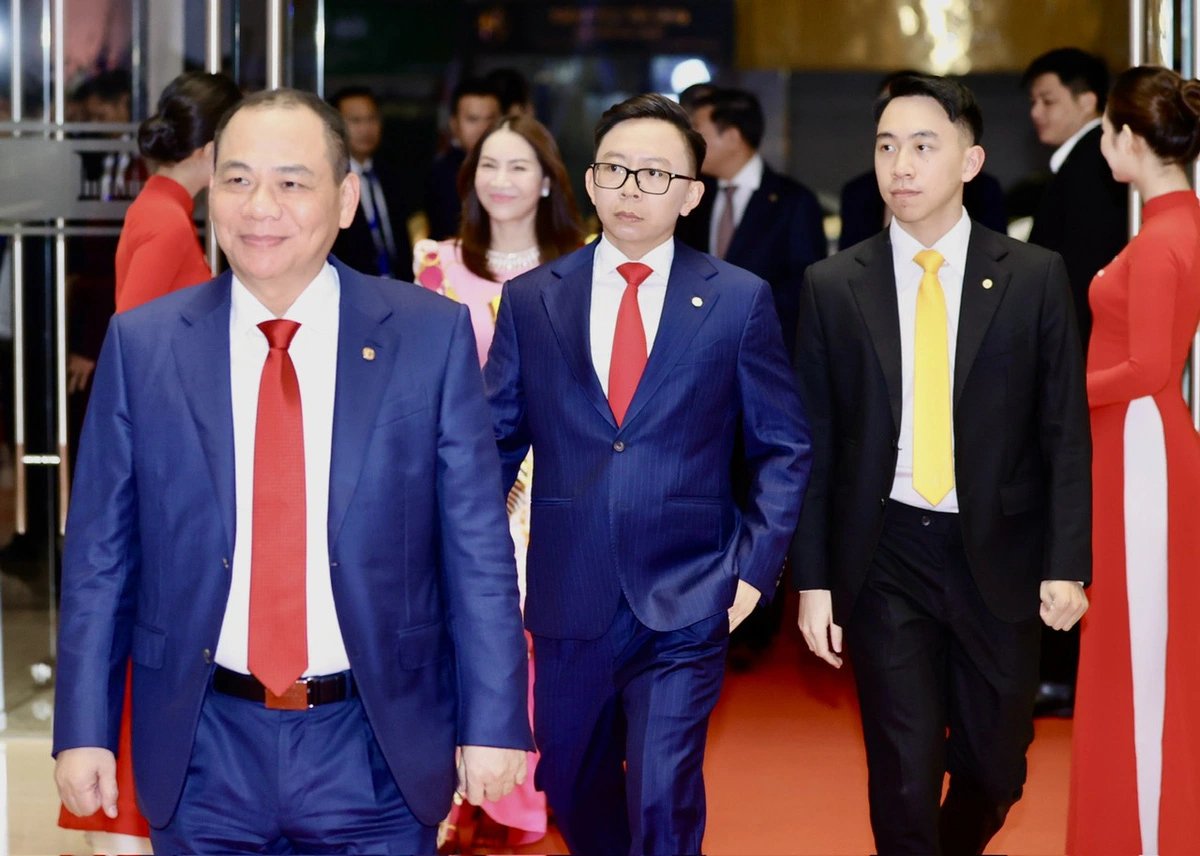
A rare photo of billionaire Pham Nhat Vuong with his sons, Pham Nhat Minh Hoang and Pham Nhat Quan Anh
Nguyen Ngoc My (born in 1991), daughter of Nguyen Tuan Hai, Chairman of Alphanam Investment Corporation, is renowned as a talented and beautiful heiress. She serves as Vice Chairwoman and CEO of Alphanam, second only to her father. She owns over 9.5 million shares, equivalent to 4.985% of the group. Her position mirrors that of her brother, Nguyen Minh Nhat (born in 1988). Previously, she founded S Design and served as CEO of Alphanam Real Estate.
In 2017, she was listed among Forbes Vietnam’s top 10 young female entrepreneurs and was the youngest on the list. In 2015, she featured in the 30 Under 30 list at just 24.
Another young leader is the son of Nguyen Thi Phuong Thao, Chairwoman of Sovico Group and a major shareholder in Vietjet and HDBank. Nguyen Phuoc Hung Anh Victor (born in 2002) is a founding shareholder of HDEX, a new financial arm within HDBank’s ecosystem.

Nguyen Ngoc My, daughter of Nguyen Tuan Hai, Chairman of Alphanam Investment Corporation
According to the 2024 governance report, Techcombank’s TCB shares have three major shareholders under 30: Ho Anh Minh, Ho Thuy Anh, and Ho Minh Anh, all children of Ho Hung Anh, Techcombank’s Chairman.
Ho Thuy Anh and Ho Anh Minh each own 344.7 million TCB shares (4.88% of capital), valued at VND 10,133 billion, up VND 1,600 billion since the year’s start. Ho Minh Anh, the youngest daughter, owns 144.1 million shares, worth VND 4,200 billion.
Ho Thuy Anh, born in 2001, is the youngest on the stock market with assets over VND 10,000 billion. She first acquired TCB shares in July 2021, investing VND 1,100 billion in 22.5 million units.
Ho Anh Minh, born on September 17, 1995, is CEO of Masterise Group, specializing in high-end real estate. He also holds 10% of 1Matrix, a blockchain research firm.
Vietnam’s NextGen in the AI Era
The 2024 PwC NextGen Survey highlights the critical role of Vietnam’s NextGen in shaping family businesses amid digital transformation. They are not just observers but active leaders, recognizing AI’s importance for future strategies. They are poised to drive business innovation and management.
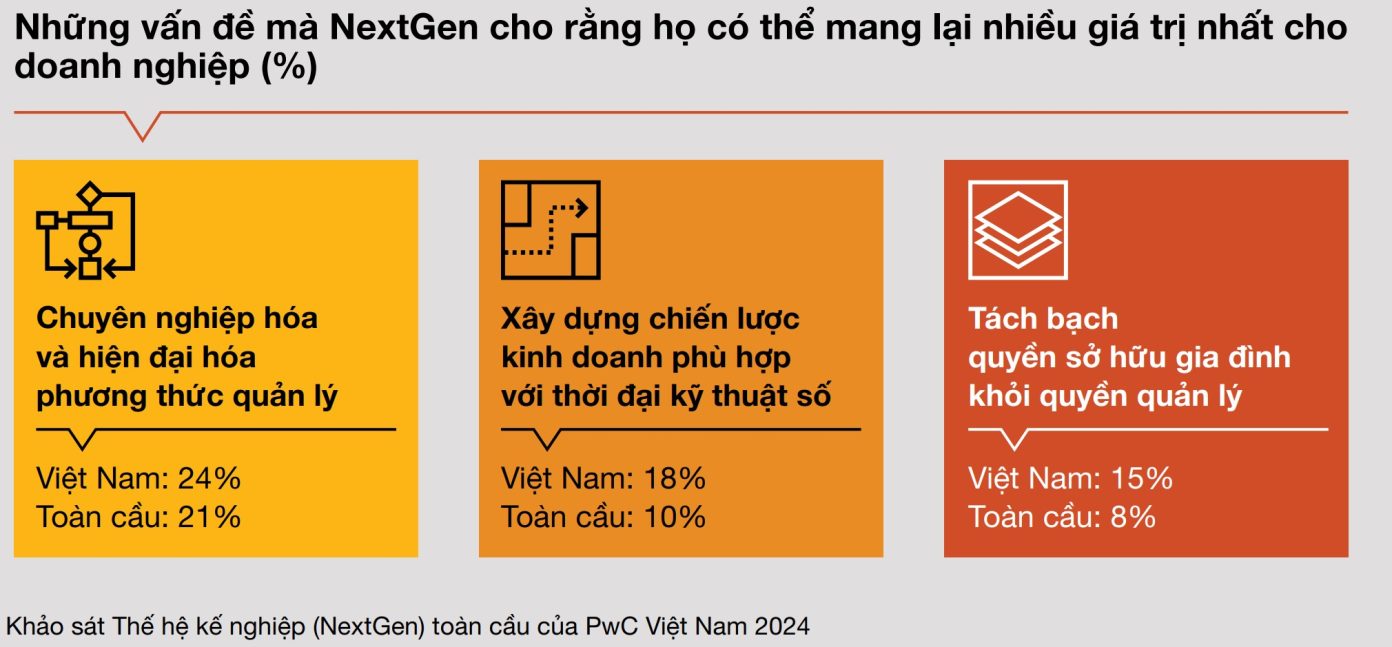
A common theme is the need for change. This generation prioritizes innovation alongside business growth, focusing on strategies to create value in the digital age. Top priorities for the next two years include business growth (39%), talent management (36%), and technology consolidation.
In 2025, amid technological advancements and Vietnam’s focus on a “new era” of private enterprise, NextGen faces both opportunities and challenges. Success will hinge on technology and creativity. NextGen views GenAI as a catalyst for transformation, enhancing productivity (39%), cost savings (39%), and customer experience (36%).
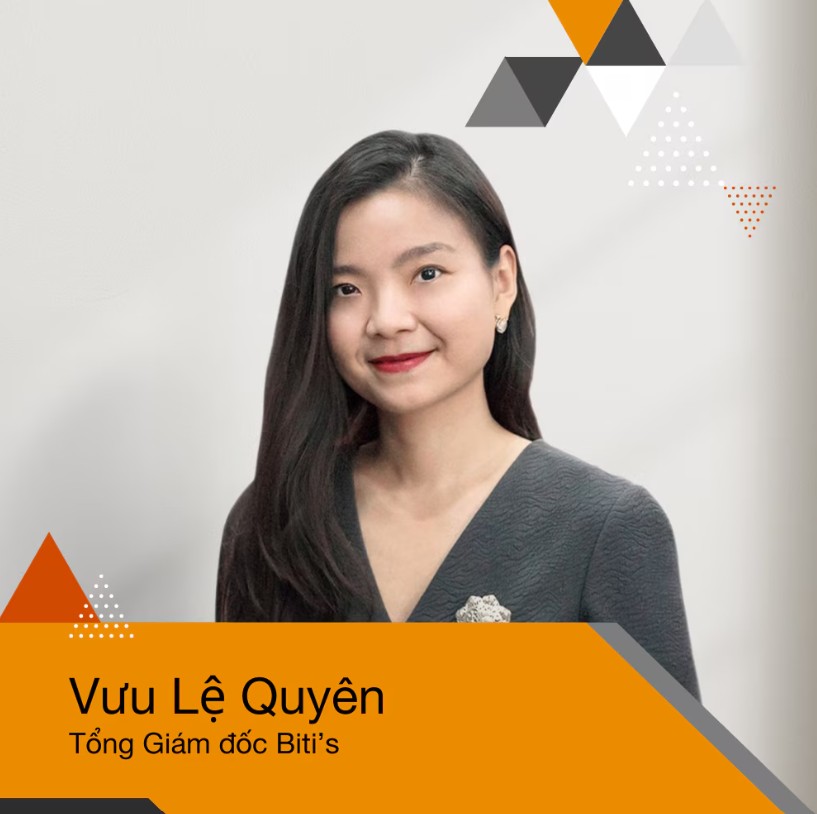
Vu Le Quyen, CEO of Biti’s
Biti’s, for instance, is experimenting with GenAI. “In a rapidly changing business and tech landscape, adaptability is key,” says Vu Le Quyen, Biti’s CEO. “By identifying gaps, assessing risks, and investing in competitive advantages, we can achieve long-term success. Our employees are our growth drivers.”
Interestingly, there’s a gap in digital perceptions between current and NextGen leaders. 42% of current leaders are optimistic about digital capabilities, compared to 27% of NextGen, reflecting differing priorities and understanding.
While the first generation (F1) relies on relationships and intuition, the second and third generations (F2/F3) focus on systems, technology, and clear processes. This shift is vital for sustainable growth and globalization.
Challenges for the Next Generation
Succession in Vietnamese family businesses is never easy. Amid expectations and pressure, young leaders must prove themselves as more than just “heirs.”
Over 76% of NextGen aim to make a significant impact, yet 62% struggle to gain trust and authority. PwC notes that most Vietnamese family businesses lack formal succession plans, leading to conflicts between generations.
The F1 generation, shaped by a “battlefield” mindset, relies on experience and relationships. In contrast, F2/F3, trained in data and technology, seek modern management models. This clash often leads to generational friction.
A UEH study reveals that over 60% of Vietnamese family businesses face leadership transition challenges due to trust issues. Conflicts arise around balancing innovation with tradition, as changes often distance businesses from founders’ styles.
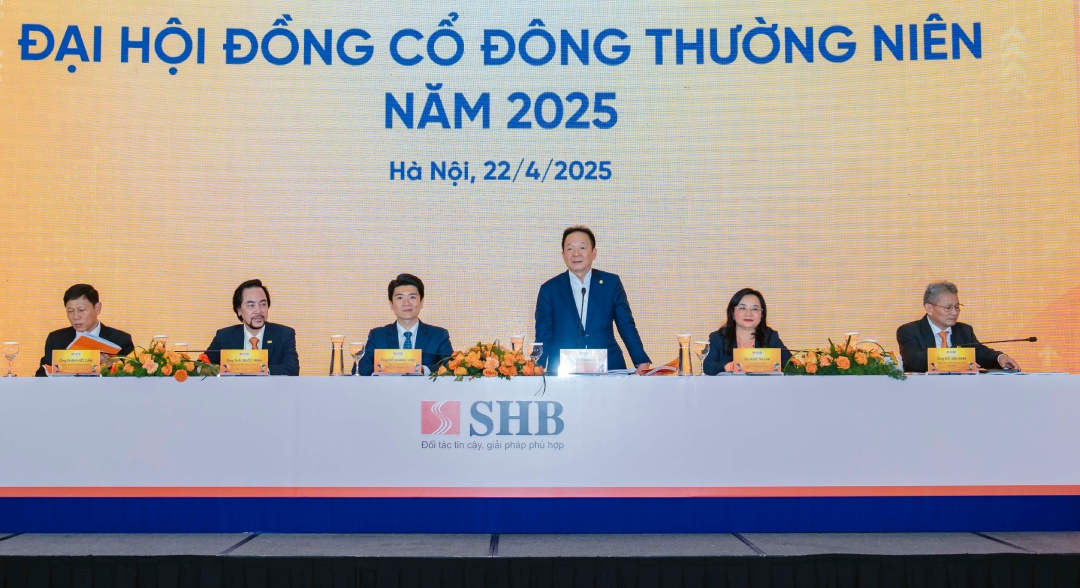
Do Quang Vinh (third from left) with Do Quang Hien at an SHB Bank shareholder meeting
Despite challenges, NextGen is reshaping Vietnamese businesses. They are professionalizing operations, standardizing management, and setting long-term visions. This generation is also transforming business culture, embracing foreign investment, hiring professional CEOs, and adopting international standards.
Examples include leaders at Son Kim Group and DHC Suoi Doi, who are diversifying into wellness and modern consumer sectors. This “legacy reinvention” leverages family foundations with global technology and vision.
According to KPMG Vietnam, businesses with proactive NextGen leadership grow 1.5–2 times faster than those without clear succession plans. This transition not only impacts individual companies but also shapes Vietnam’s private sector landscape.
As young CEOs embrace data, ESG, and transparency, international investor confidence in Vietnamese businesses grows. Their focus on sustainability aligns Vietnam with regional standards.
In essence, NextGen is catalyzing the evolution of Vietnam’s private sector from “family businesses” to “professional enterprises.” While the older generation paved the way with ambition, the new generation is expanding it with knowledge, data, and global vision. If successful, they will not only preserve legacies but also drive Vietnam’s economic development.
LC Foods Group and Citek Partner to Implement SAP Cloud ERP Digital Transformation Solution
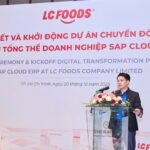
On October 20, 2025, LC Foods Joint Stock Company and Citek Technology Joint Stock Company officially signed an agreement, launching the SAP Cloud ERP (SAP S/4HANA Public Cloud) digital transformation project for enterprise management.
Official: FPT Logo to Feature on Chelsea’s 2025/26 Match Kits

Chelsea and FPT have collaboratively identified and crafted a comprehensive digital transformation roadmap. This strategic plan encompasses digital platforms, customer engagement strategies, operational enhancements, and the integration of cutting-edge emerging technologies.
Emerging Trends: Shifting Investment Focus Towards New Asset Classes
Hyundai Minh Tuan forecasts a diversification in asset allocation trends, with an increased focus on emerging asset classes. The anticipated shift in Vietnamese asset composition includes: a reduction in cash deposits, a rise in equities, bonds, and digital assets; real estate maintaining its dominance, and stable holdings in gold and precious metals.
Empowering Students Nationwide: Sacombank Launches ‘Digital Financial School’ Initiative

Targeting the dynamic, creative, and digitally adaptable young generation, Sacombank, in collaboration with the Central Committee of the Vietnam Students’ Association, officially launches the Digital Financial Information Portal “Green Youth – Act Fast” at www.thanhnienxanh.vn. This free online learning platform integrates financial knowledge, digital skills, and a green living mindset, empowering students on their journey of learning, growth, and contribution to the future.
No Notarization Required for Land Information Verification on VNeID

The C06 Department has confirmed that citizens only need to provide a copy of their certification and citizen identification card when requested by the Task Force, without the requirement of notarization.