According to the Minister of Home Affairs, the draft law has revised regulations to innovate the recruitment, employment, and management of civil servants based on job positions. This approach mandates that the recruitment, management, placement, and utilization of civil servants must be aligned with the requirements of the job position and the competence and efficiency of the civil servants in performing their duties. It eliminates the practice of conducting exams or evaluations for professional title promotions.
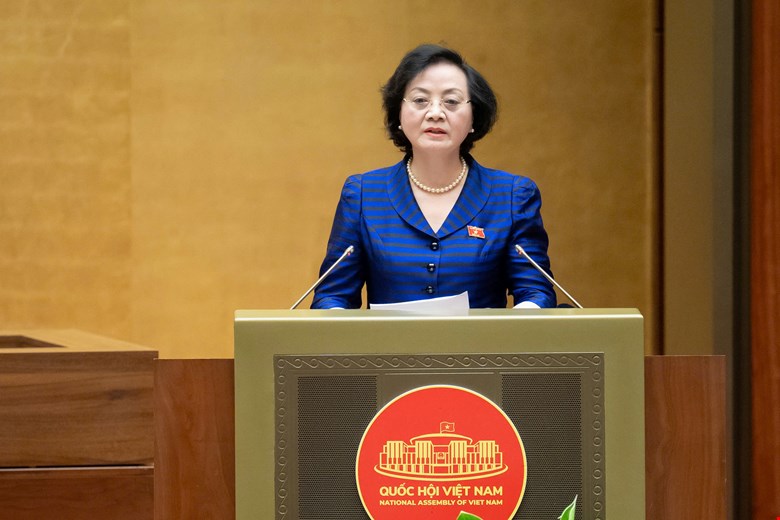
Minister of Home Affairs Pham Thi Thanh Tra presents the proposal at the morning session on October 22. Photo: Pham Thang
The draft law introduces a new approach to civil servant recruitment, emphasizing competitive exams, open and fair selection processes, and the acceptance of high-quality human resources. Public service units are empowered to choose recruitment methods that best suit their industry and operational model, moving towards a professional and modern governance structure. For civil servants transferring to new public service units, standard transfer procedures will apply.
The draft law expands the rights of civil servants by allowing them to sign contracts to perform professional activities at other public service units outside their current workplace or at non-public organizations, agencies, or units.
Minister Pham Thi Thanh Tra stated that civil servants in public science and technology organizations and public higher education institutions may participate in capital contributions, management, and operations of businesses. They can also work at companies established by their organizations to commercialize research results, provided they have approval from the organization’s leadership. For senior management, approval from higher authorities is required.
Presenting the review report, Mr. Hoang Thanh Tung, Chairman of the National Assembly’s Committee on Law and Justice, expressed the Committee’s general agreement with the shift to managing civil servants based on job positions, aligning with current public sector reform trends. The Committee urged the Government to ensure the development of job position lists is scientifically rigorous and of high quality.
Additionally, the Committee supported the proposal allowing civil servants to enter into labor or service contracts with other organizations or units, provided these do not conflict with their existing employment contracts or violate the law. This aims to leverage the professional expertise and experience of civil servants, enabling them to contribute to society and increase their legitimate income.
The Committee also endorsed the provision allowing civil servants in public science and technology units and higher education institutions to work at companies established by their units to commercialize research results, as agreed upon in their employment contracts.
During group discussions, Delegate Tran Van Tuan (Bac Ninh delegation) strongly supported the proposal allowing civil servants to sign contracts for professional activities at other public service units or non-public organizations. He noted that capable and qualified civil servants are enthusiastic about this provision, as it addresses the issue of low income for some civil servants. This change will enable them to earn additional income by working with other units.
Mr. Tuan also highlighted that this provision not only increases income for civil servants but also provides them with opportunities to contribute their skills and expertise to other public service units, thereby fostering national development.
Unchanged Civil Servant Salary Scale Pending Wage Reform

Under the proposed amendments to the Civil Servants Law, the salary policy based on job positions for civil servants will adhere to the current salary scale until the wage reform is implemented.
Chairman of the National Assembly: Implementing a Quarterly Performance Evaluation System for Civil Servants

The Chairman of the National Assembly emphasized that selecting officials must meet four key criteria: integrity, competence, dedication, and physical fitness. “The Party’s regulations mandate performance evaluations every three months, and civil servants are no exception. They must be assessed to determine whether they are fulfilling their duties or not, as a position in the system should not be a lifetime guarantee,” the Chairman stressed.
Streamlining Operations: Ho Chi Minh City Accepts Voluntary Resignations and Retrenchments
“The Chairman of the Ho Chi Minh City People’s Committee has requested that, from now until the completion of the reorganization of the apparatus in line with the Central Government’s orientation, all agencies and units temporarily halt the recruitment of civil servants, including those at the commune level. This also includes a pilot plan to hold competitive exams for leadership positions at the departmental level and equivalent in 2024.”
The Art of Restructuring: A Guide to Efficiently Merging Legislative Bodies

In the recently announced reorganization and streamlining of the political system’s apparatus, there are plans to reduce the number of National Assembly committees by four and eliminate one agency directly under the National Assembly Standing Committee.
Unlocking Institutional Bottlenecks: Navigating the Complexities for a Smoother Journey Ahead

Speaking at the 8th session of the 15th National Assembly on October 21, 2024, General Secretary To Lam expressed the view that institutional bottlenecks are the main hindrance to progress. He emphasized that addressing these institutional bottlenecks, starting with improvements in law-making, is an urgent task for the National Assembly.