





Following Ho Chi Minh City’s administrative boundary expansion, Can Gio is poised for a transformative shift, emerging as a new coastal growth hub for the city. To unlock its vast potential, a series of strategic transportation infrastructure projects are set to commence.
Can Gio Bridge
According to the Ho Chi Minh City Department of Construction, the Can Gio Bridge project is slated to break ground in 2026, pending the completion of investment procedures and land clearance.
Spanning approximately 7.3 km, the bridge includes a main section crossing the Soai Rap River and connecting roads at both ends. Designed with 4 vehicle lanes, 2 mixed lanes, and a 55-meter vertical clearance—equivalent to the Binh Khanh Bridge on the Ben Luc – Long Thanh Expressway—it promises to enhance connectivity.
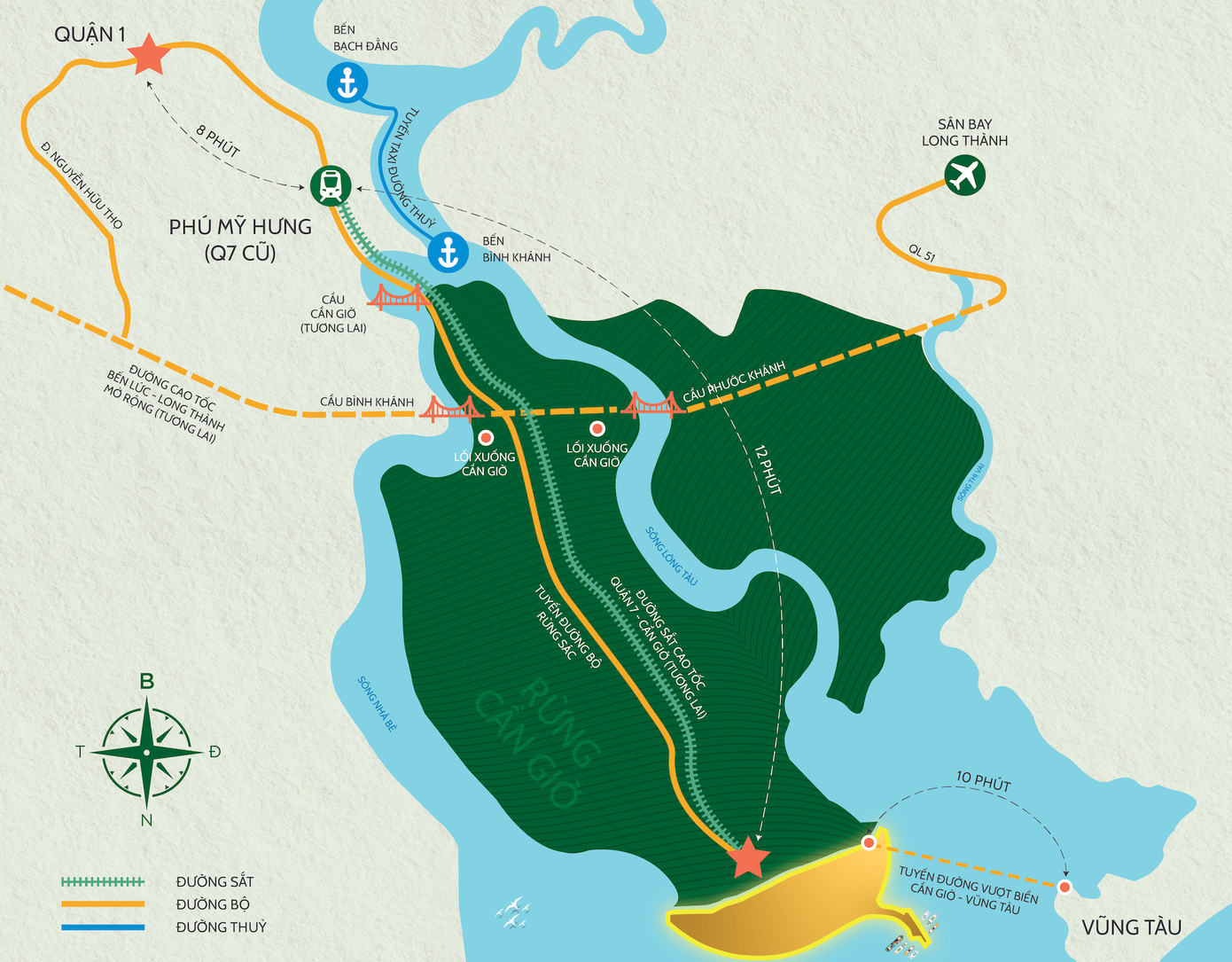
Location of the Can Gio coastal urban project and its transportation network. Image: Developer
With a preliminary investment of 11.087 trillion VND, Ho Chi Minh City will contribute over 5.2 trillion VND, while the remainder will be funded by investors. The project also includes three branch bridges: Song Cha, Tac Song Cha, and Rach Muong Ngang.
Upon completion in 2028, the Can Gio Bridge will replace the Binh Khanh ferry—currently the sole transport link between central Ho Chi Minh City and Can Gio—reducing travel time and boosting local economic and tourism growth.
Authorities are finalizing the adjusted Ho Chi Minh City Master Plan (2021-2040, vision to 2060), which will incorporate new projects, including the Can Gio Bridge.
Metro to Can Gio: Construction by Early 2026
At the recent ESG++ Megacity Forum, Ms. Phan Thien Ly, Sales Director of Vinhomes Green Paradise, announced that the high-speed metro line connecting central Ho Chi Minh City (former District 7) to Can Gio is expected to start construction by late 2025 or early 2026, with operations beginning in 2028.
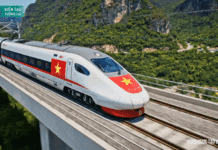
This 48.5 km elevated line will reduce travel time from central Ho Chi Minh City to Vinhomes Green Paradise (also known as the Can Gio coastal urban area) to just 12 minutes.
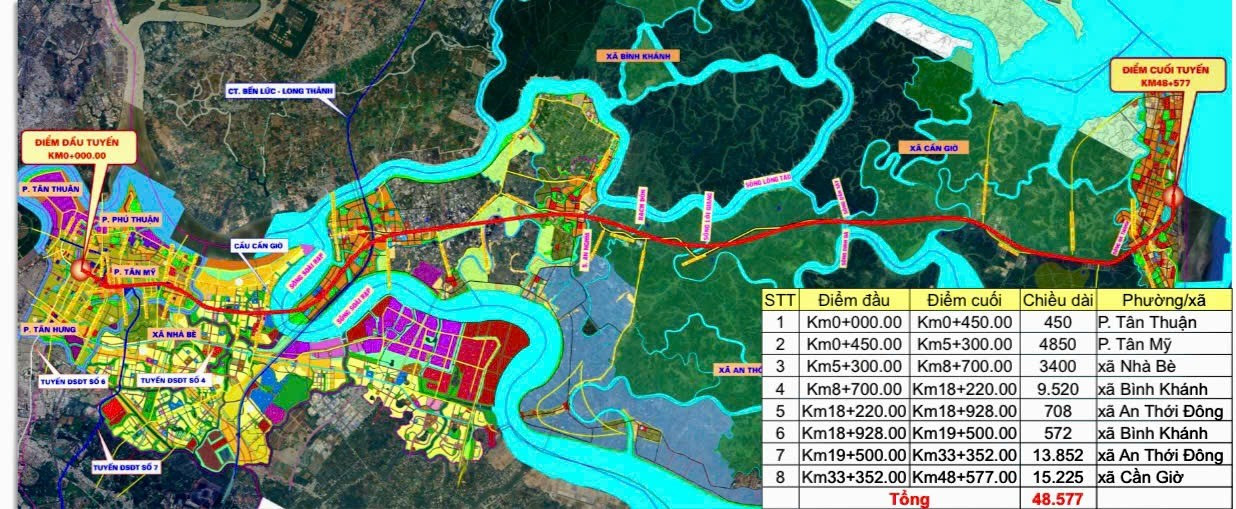
Route of the metro connecting central Ho Chi Minh City to Can Gio.
The line features two main stations (Tan Thuan and Can Gio) and a 39-hectare depot near the coastal urban area. Designed as a double-track system with a 1,435 mm gauge, it will operate at speeds up to 350 km/h—over three times faster than the Ben Thanh – Suoi Tien metro (110 km/h).
Proposed at a total investment of 2.93 billion USD (over 76 trillion VND), the project will be fully funded by the developer, with 15% equity and 85% loans. Land clearance costs of 7.6 trillion VND will be covered by the government.
2.969 Trillion VND for Ben Luc – Long Thanh Expressway Interchange with Rung Sac Road
On October 7, the Ho Chi Minh City Department of Construction submitted the Ben Luc – Long Thanh Expressway interchange with Rung Sac Road project to the city’s People’s Committee for approval. With a preliminary investment of 2.969 trillion VND, construction is set to begin in Q2 2026 and finish in 2028.
The interchange will feature a multi-level design with overpasses, underpasses, and a central roundabout. The expressway will add a new bridge section to complete 8 lanes and connect to Rung Sac Road. Rung Sac Road will include two underpasses for traffic between Rung Sac Road and Can Gio Bridge.
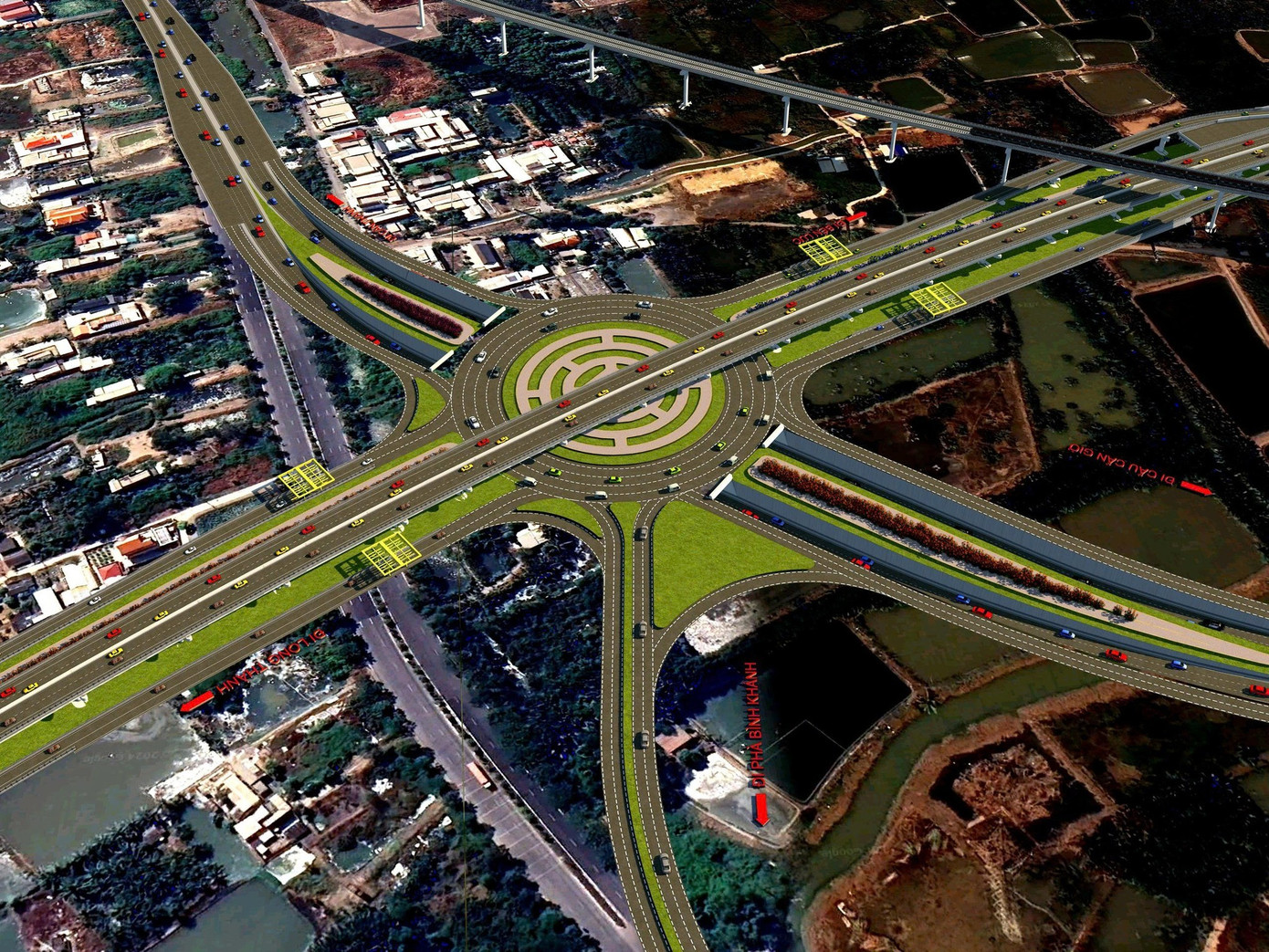
Rendering of the Rung Sac Road – Ben Luc – Long Thanh Expressway interchange. Image: Ho Chi Minh City Department of Construction
This project aims to strengthen regional connectivity, particularly between Can Gio, Ho Chi Minh City, Dong Nai, and Tay Ninh, while maximizing the Ben Luc – Long Thanh Expressway’s impact (expected completion in 2026). Once operational, it will reduce travel time from Can Gio to Long Thanh International Airport via National Highway 51, driving growth in southern Ho Chi Minh City.
Additionally, Vingroup has proposed a sea-crossing road linking Can Gio to Vung Tau. If approved, this route would cut travel time to just 10 minutes, enhancing connectivity and economic and tourism development in the expanded Ho Chi Minh City.
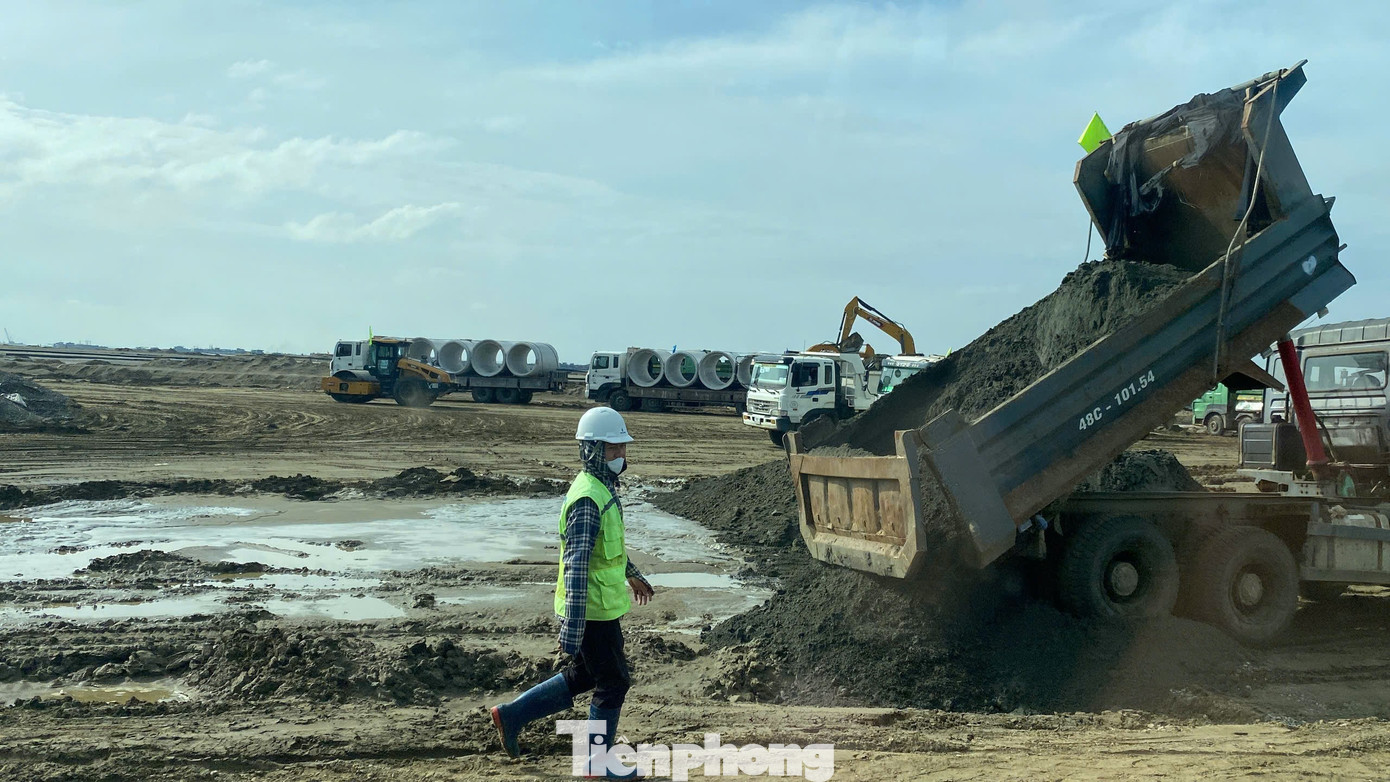
Construction site of the Can Gio coastal urban “mega-project”. Image: H.H
Revolutionary New Signal for Vingroup’s Proposal: Vietnam’s Most Advanced Sea Crossing, Set to Lead the Region

The Ho Chi Minh City Department of Finance has submitted a proposal to the city authorities regarding this project.
Ho Chi Minh City Authorities Mandate Completion of Electric Ride-Hailing Scheme by October 31
Ho Chi Minh City is accelerating its green transformation in transportation by increasing the adoption of electric vehicles, expanding charging station infrastructure, and preparing a comprehensive plan to transition all ride-hailing services to electric fleets.
Anticipated Completion and Operation of the Ben Thanh-Tham Luong Metro Line After 1,700 Days of Construction
Anticipated to break ground in April 2026, Metro Line 2 in Ho Chi Minh City is slated for trial runs by September 2030 and official operations in December 2030, with a total construction timeline of 57 months.
Astonishing Foundation Engineering Techniques Unveiled in Can Gio’s Revolutionary Coastal Megacity
The 2,870-hectare Can Gio coastal urban area in Ho Chi Minh City is a bustling hub of activity, with thousands of mechanized vehicles working day and night. This ambitious project employs a unique foundation treatment technology, ensuring a robust and innovative approach to its development.
Busting a Massive Counterfeit Perfume Ring: Tens of Thousands of Fake Luxury Fragrances Seized
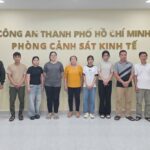
The syndicate, masterminded by Tho and Hien, meticulously self-taught the art of fragrance formulation, crafting counterfeit perfumes that mimic renowned luxury brands before distributing them across the market.