
















This was the recommendation of most delegates attending the seminar titled “Mitigating Pollution from Diesel Engine Vehicle Emissions: Current Situation and Solutions in Major Vietnamese Cities,” organized by the Vietnam Petroleum Institute (VPI) and PetroVietnam Fertilizer and Chemicals Corporation (PVFCCo Phu My, HOSE: DPM)—two member units of the Vietnam National Oil and Gas Group (Petrovietnam)—on October 27th in Hanoi.
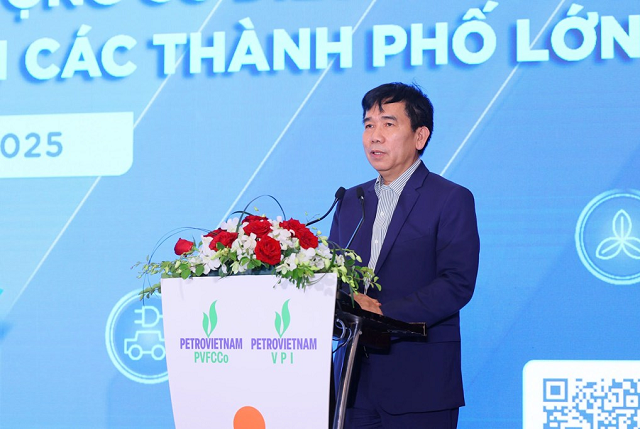
Petrovietnam Deputy General Director Le Xuan Huyen delivers the opening speech at the seminar. Photo: A.N/Bnews/vnanet.vn
|
In his opening remarks, Petrovietnam Deputy General Director Le Xuan Huyen stated that recent studies show severe air pollution, particularly fine particulate matter and NOx emissions, in major cities like Ho Chi Minh City and Hanoi. A significant cause of this pollution is vehicle emissions. A recent announcement by the World Health Organization (WHO) revealed that Hanoi’s air pollution levels are 5-6 times higher than permissible limits in certain areas, posing health risks.
Reducing NOx emissions—a key driver of fine particulate matter from diesel vehicles—is therefore urgent. Recognizing this, PVFCCo Phu My has successfully developed the DEF Phu My Xanh solution, which effectively reduces NOx. This solution meets international ISO 22241 standards for concentration and purity and has received SGS international quality certification, significantly contributing to reducing diesel emissions.

Dr. Pham Huu Tuyen, Deputy Director of the Research Center for Power Sources and Autonomous Vehicles, Hanoi University of Science and Technology. Photo: A.N/Bnews/vnanet.vn
|
Dr. Pham Huu Tuyen, Deputy Director of the Research Center for Power Sources and Autonomous Vehicles at Hanoi University of Science and Technology, proposed three globally adopted solutions to reduce harmful diesel emissions. These include structural solutions like exhaust gas recirculation (EGR), electronic fuel injection, and VVT-i. Additionally, the use of clean fuels such as biodiesel and bioethanol is being promoted to minimize environmental emissions. Notably, the Selective Catalytic Reduction (SCR) system using Adblue/DEF solutions can reduce emissions by over 90%, Dr. Tuyen noted.
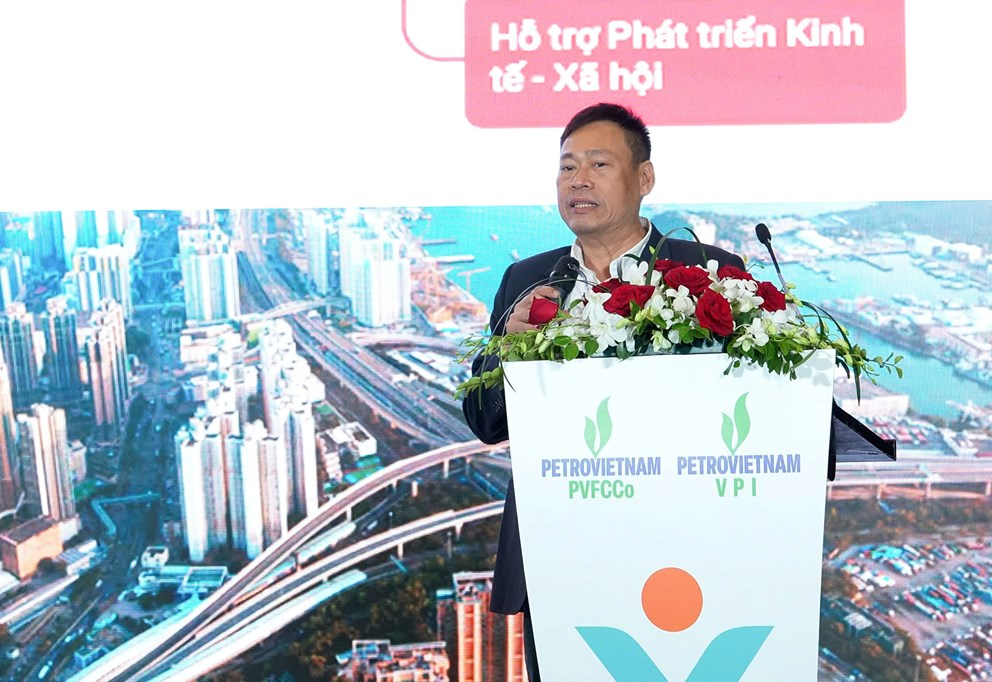
Dr. Nguyen Huu Luong, Vietnam Petroleum Institute (VPI). Photo: A.N/Bnews/vnanet.vn
|
Echoing this view, Dr. Nguyen Huu Luong of the Vietnam Petroleum Institute (VPI) added that Euro 5-6 and EPA 2010 emission standards require an 80-90% reduction in NOx. The SCR + DEF solution is currently the optimal choice, reducing NOx by 70-95%, improving engine efficiency by 3-5%, and saving fuel by 3-6%, while extending the lifespan of diesel vehicles.
However, based on global experience, implementing diesel emission reduction solutions like SCR + DEF requires clearer regulations on emission standards and stricter penalties for violations. Specific regulations on DEF quality and SCR systems are also essential. Policies to diversify DEF supply, develop distribution infrastructure, and enhance quality control at production, distribution, and secondary dealer levels are critical for effectively reducing NOx emissions, Dr. Luong suggested.

The DEF Phu My Xanh product attracts attention at the seminar. Photo: A.N/Bnews/vnanet.vn
|
According to Le Hoai Nam, Deputy Director of the Environmental Department at the Ministry of Agriculture and Environment, Vietnam’s current emission standards for vehicles are less stringent compared to regional and global standards. To address this, the Ministry recently issued Circular No. 06/2025/TT-BNNMT, along with the National Technical Regulation QCVN 85:2025/BNNMT on vehicle emissions. This regulation introduces five emission levels, one more than previous standards. The Ministry has also submitted a roadmap to the Prime Minister, which, if approved, will mandate stricter emission standards for vehicles based on their production year.
Based on actual measurements, current compliance with diesel emission standards is at levels 1 and 2. With the new roadmap targeting levels 4 and 5, vehicles will need to adopt advanced emission reduction technologies, such as DEF/Adblue catalytic solutions, to meet these standards, Mr. Nam emphasized.
The Vietnam Petroleum Association has proposed a roadmap to the Prime Minister for implementing Euro V diesel standards. However, Euro V diesel is currently distributed in only 2,400 central stores and is scarce in remote areas. The price difference between Euro V and Euro II diesel exceeds 400 VND/liter, making Euro V adoption challenging. The Association recommends enhanced communication involving scientists to encourage diesel vehicle owners to use NOx-reducing DEF solutions. Additionally, regulatory bodies like vehicle inspection agencies must actively enforce emission controls, especially for diesel vehicles, the Association urged.

Mr. Phan Cong Thanh, General Director of PVFCCo Phu My, speaks at the seminar. Photo: A.N/Bnews/vnanet.vn
|
Many delegates emphasized the need for Vietnam to establish national standards for diesel emission treatment solutions and production. Support from sustainable development funds, small and medium-sized enterprise funds, and other financial mechanisms is essential for companies to invest in effective emission reduction technologies. Subsidies from environmental budgets, land rent waivers, corporate tax exemptions, and import tax reductions for raw materials and machinery used in emission reduction products are practical measures to help Vietnam achieve its net-zero emissions goal by 2050.
On the corporate side, PVFCCo Deputy General Director Vu An highlighted that DEF Phu My, produced from urea, meets ISO 22241 international standards and is competitively priced compared to similar products. If emission standards are fully implemented in Vietnam by 2030, DEF demand could reach 70-100 thousand tons annually. With its current capacity, PVFCCo can meet domestic demand and continue exporting to Japan, South Korea, and Europe. The company is collaborating with the German Transport Association to certify DEF Phu My’s quality, facilitating exports to demanding global markets.
– 16:42 27/10/2025