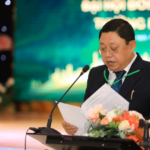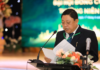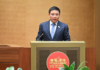








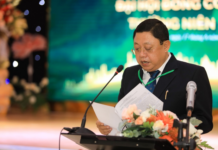





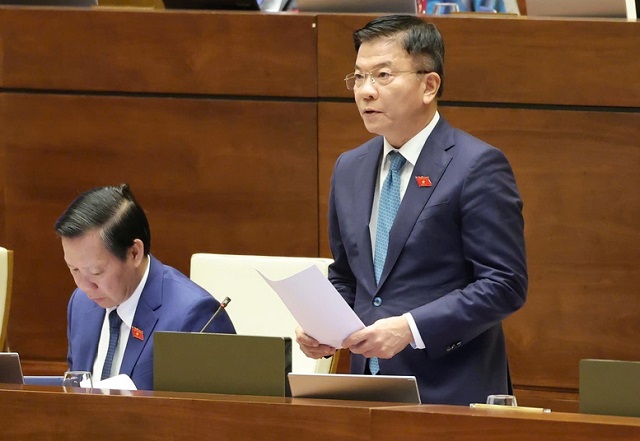
Deputy Prime Minister Le Thanh Long addressed the National Assembly on the afternoon of October 30, 2025 – Photo: VGP/Nhat Bac
|
On the afternoon of October 30, at the National Assembly Hall, Deputy Prime Minister Le Thanh Long delivered a speech as assigned by the Prime Minister. His address focused on clarifying three key issues concerning national budget revenue, expenditure, and public investment disbursement, which have garnered significant attention from National Assembly delegates, citizens, and voters nationwide.
Deputy Prime Minister Le Thanh Long stated that he would report to the Prime Minister, directing the Ministry of Finance and relevant agencies to seriously absorb and address the feedback. “Most importantly, we must implement feasible solutions to effectively manage the state budget, public investment, and public debt repayment.”
Budget Revenue Increases 1.36 Times, Public Debt Well Below Regulatory Limits
Deputy Prime Minister Le Thanh Long emphasized that despite extremely challenging circumstances, we have exerted maximum effort and determination to achieve and surpass all 12 key targets for the term. National budget revenue is estimated at 9.6 trillion VND, 1.36 times higher than the previous term, significantly exceeding the target of 8.3 trillion VND. This was accomplished while implementing tax exemptions, reductions, and deferrals totaling approximately 1.1 trillion VND, and increasing revenue and saving expenditures by 1.57 trillion VND.
The government has focused on implementing an expanded fiscal policy with clear priorities, ensuring effectiveness and harmonious coordination with proactive, flexible, and timely monetary policies. This has contributed to promoting growth. Public debt, government debt, foreign debt, and the state budget deficit have been well-controlled, remaining significantly below regulatory limits. Public debt has decreased from 44.3% of GDP in 2020 to approximately 35-36% in 2025 (with a limit of 60% of GDP). The average state budget deficit has reduced from 3.53% of GDP in the 2016-2020 period to 3.1-3.2% of GDP in this term.
Domestic Revenue from Production and Business Activities Increases by Approximately 11.1% – the Highest Target Ever
According to Deputy Prime Minister Le Thanh Long, amidst a highly volatile global situation with more challenges than opportunities, the preparation of the national budget revenue estimate has been conducted cautiously. This ensures national financial security and safety (keeping the state budget deficit, public debt, government debt, and foreign debt within safe limits as prescribed), while meeting the funding needs for development investment, human-centered expenditures, social welfare, national defense, security, and other urgent tasks (such as natural disasters and floods).
In implementation, the government has strongly directed revenue management to ensure accurate, sufficient, and timely collection. Efforts have been made to accelerate digital transformation, expand the application of electronic invoices, and intensify anti-tax evasion measures in e-commerce and service sectors (such as dining and hospitality).
Revenue from e-commerce in 2025 reached approximately 172 trillion VND, a 67% increase compared to 2024. New tax collection solutions for business households yielded 25.1 trillion VND in the first nine months of 2025 (a 29.6% increase compared to the same period in 2024), with an estimated full-year total exceeding 33 trillion VND. The total additional revenue for the 2021-2025 term reached 1.57 trillion VND, which has been utilized to increase spending on development investment, human resources (salary increases), national defense, security, and other critical urgent tasks.
In the 2021-2025 budget structure, revenue from production and business activities accounted for the majority at 62.5%, land use fees at 13%, and import-export taxes at 13.2% (compared to 61.7%, 10.1%, and 14.1% in the previous term, respectively). Regarding state budget expenditures, development investment accounted for 32-33%, and regular expenditures for 57-58% (compared to 28% and 63.2% in the previous term, respectively). For the 2026-2030 plan, development investment is expected to increase to 40%, and regular expenditures to approximately 50.7%.
“The 2026 national budget revenue estimate has been developed in alignment with the goals and tasks outlined in the Party and National Assembly resolutions. Domestic revenue from production and business activities is projected to increase by approximately 11.1%, the highest target ever, surpassing the economic growth target of 10%. This also considers the impacts of various factors on revenue from import-export, land, and resources,” Deputy Prime Minister emphasized.
Moving forward, the government will continue to direct the Ministry of Finance and relevant agencies to implement solutions enhancing information technology application and digital transformation. This includes improving analysis and forecasting to support the preparation of revenue estimates and the management of state budget revenue and expenditure.
Public Investment Disbursement Slow at the Beginning of the Year, Accelerating Towards the End
Deputy Prime Minister Le Thanh Long reported that public investment disbursement from the beginning of the year until October 23, 2025, totaled 465 trillion VND, reaching 51.7% of the plan assigned by the Prime Minister. The disbursement rate is equivalent to the same period in 2024 at 51.5%, but the absolute amount is approximately 115,658 billion VND higher (compared to 349,170 billion VND in the same period of 2024).
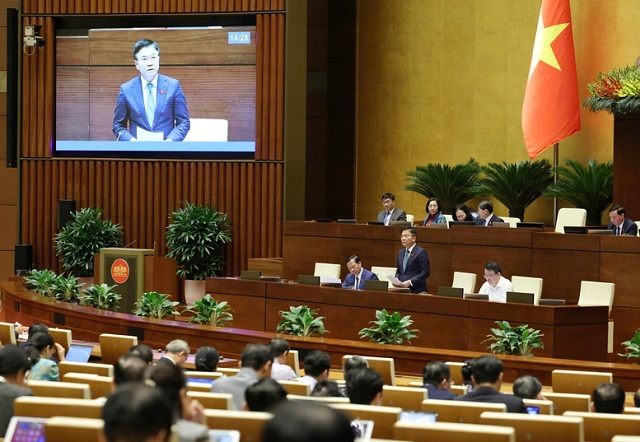
Deputy Prime Minister Le Thanh Long reported that since the beginning of the term, the Government and the Prime Minister have focused on strongly directing the acceleration of public investment disbursement from the start of the year – Photo: VGP/Nhat Bac
|
Overall, public investment disbursement tends to be slow at the beginning of the year and accelerates towards the end. This is due to contractors needing time to execute projects, accumulate sufficient volume for acceptance, and settle payments by year-end (during the term, disbursement in the first nine months typically ranges from 49-51%, while year-end disbursement reaches 91-95%).
Deputy Prime Minister Le Thanh Long stated that since the beginning of the term, the Government and the Prime Minister have focused on strongly directing the acceleration of public investment disbursement from the start of the year. This has been identified as a key political task for ministries, agencies, localities, and their leaders, who are held accountable. Since the beginning of 2025, the Government has organized four online conferences with ministries, agencies, and localities, issued eight directives and telegrams, and numerous documents to accelerate public investment disbursement. The Prime Minister, Deputy Prime Ministers, and Government members have regularly inspected sites, addressed bottlenecks, and urged implementation.
The Government has submitted to the National Assembly amendments to relevant laws to resolve public investment bottlenecks. This includes three submissions to approve regulations on separating land clearance into independent projects, promoting thorough decentralization and authorization for ministries and localities, and shifting public investment management from “ex-ante” to “ex-post” checks across three main groups: (i) Decentralizing authority for assigning and adjusting public investment plans; (ii) Decentralizing authority for approving investment policies and decisions; (iii) Decentralizing authority for extending disbursement deadlines and capital allocation periods. Additionally, efforts have been made to review and promptly address difficulties and obstacles in legal provisions within the National Assembly’s jurisdiction under Resolution No. 206/2025/QH15.
However, public investment disbursement has been slow in some areas and times, falling short of requirements, as noted by National Assembly delegates. This is due to various objective and subjective reasons. The scale of public investment in 2025 is approximately 900 trillion VND, a 33% increase compared to 2024 (678 trillion VND). Some agencies and localities lack sufficient implementation capacity, are not proactive, and exhibit responsibility avoidance (despite the same legal framework, some perform well while others do not). Although the Public Investment Law allows separating land clearance into independent projects, implementation still faces challenges (such as failing to reach agreements with residents, delayed land handover, difficulties in determining land origins, and complex land recovery procedures).
According to the Deputy Prime Minister, in response to feedback from National Assembly delegates, the Government will direct ministries, agencies, and localities to urgently address the aforementioned limitations and shortcomings. They are determined to achieve a 100% public investment disbursement rate for 2025, as planned by the Prime Minister (5-6% higher than the average of previous years). This includes continuing to review and improve legal regulations, enhancing the operations of working groups, accelerating land clearance, construction, and addressing bottlenecks to improve investment preparation and implementation quality. Strict adherence to the amended Public Investment Law will be enforced, with severe consequences for cases affecting disbursement, including personnel transfers and accountability for leaders.
“In addition to the above issues, the Government will continue to direct ministries, agencies, and localities to study, absorb, and fully address the concerns raised by delegates. This will involve proposing solutions to successfully achieve socio-economic development goals and financial-budgetary tasks in the new phase,” Deputy Prime Minister Le Thanh Long emphasized.
– 16:45 30/10/2025
Vietnam’s Economy Demonstrates Resilience, Overcoming Major External Shocks, Prime Minister Affirms
Speaking at the National Assembly Hall on October 30th, Prime Minister Pham Minh Chinh emphasized that over the past five years, we have achieved remarkable accomplishments. Our economy has demonstrated remarkable resilience, successfully weathering significant external shocks.
Deputy Prime Minister Le Thanh Long Inspects Progress of Two Major Healthcare Projects in Ninh Binh

Deputy Prime Minister Lê Thành Long has urged the acceleration of construction progress to ensure the second facilities of both Bạch Mai Hospital and Việt Đức Hospital are operational by November 30th.
Early Job Position Identification, Salary Adjustments, and Allowances for Commune-Level Officials
Addressing the two-tier local government model, the National Assembly delegate urged prompt determination of job positions, salary adjustments, and allowances for commune-level officials and civil servants.
“Delegate Tran Hoang Ngan Urges Immediate Submission of Emergency Financial Package to Address Storm and Flood Damage”
Natural disasters are wreaking havoc across numerous regions, inflicting significant damage. According to delegate Trần Hoàng Ngân, an urgent financial package is imperative to address and mitigate the devastating aftermath.
Urgent Solutions Needed to Curb Polluting Vehicles in Major Cities Like Hanoi and Ho Chi Minh City
The Supervisory Delegation proposed a solution during the National Assembly session to address environmental pollution in major cities such as Hanoi and Ho Chi Minh City.