















Today (October 30), the National Assembly continued its plenary discussions on socio-economic conditions, financial budgeting, economic restructuring, and addressing challenges arising from the ongoing reorganization of administrative apparatuses.
Firm Measures to Correct Market Valuations in Gold and Real Estate
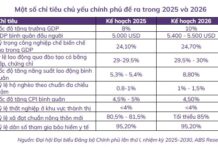
During the afternoon session on October 29, Delegate Trịnh Xuân An (Đồng Nai Province) acknowledged that Vietnam has overcome numerous challenges and achieved most of its five-year plan targets. By 2025, growth is projected to reach 8% or higher, placing Vietnam among the region’s top performers.
To achieve double-digit growth, Delegate An emphasized the critical need to maintain macroeconomic stability—the foundation for sustainable development, social stability, and investor confidence. He stressed, “Macroeconomic stability must be preserved under all circumstances.”
To ensure this, the government must harmonize fiscal and monetary policies, stimulating growth while proactively managing inflation and exchange rates. Inflation control should address long-standing issues in the gold and real estate markets, correcting their valuations to prevent erosion of public trust in the VND and speculative real estate bubbles.
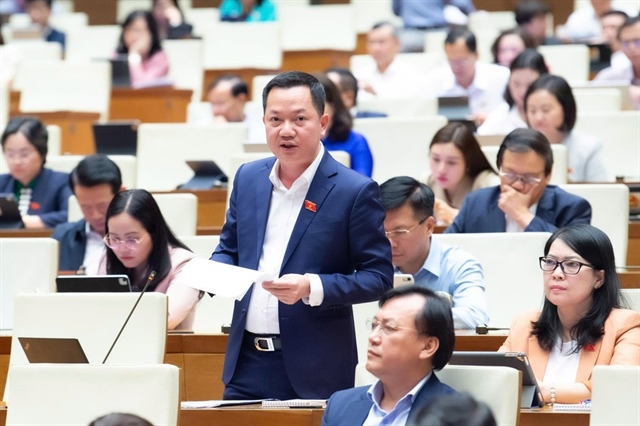 Delegate Trịnh Xuân An (Đồng Nai Province). Photo: QH |
Delegate An also highlighted the importance of pairing macroeconomic stability with social welfare and equity. Workers must earn fair wages to keep pace with rising living costs.
“The government should set clear targets and incentivize businesses to develop social housing, affordable homes, and worker dormitories, particularly in industrial zones like Đồng Nai,” he added.
While public investment remains a key driver of social investment, Delegate An called for its restructuring to improve disbursement efficiency. He supported the proposal to limit central budget projects to 3,000, suggesting further reductions to prioritize strategic infrastructure initiatives.
“The government should shift to output-based public investment models, replacing the current fragmented annual disbursement approach,” he recommended.
Delegate An also urged the development of new growth drivers, emphasizing that double-digit growth requires innovation, technology, and digital transformation, not just investment and labor expansion.
“Digital, green, and knowledge-based economies should be the new pillars for sustainable growth. The government must establish legal frameworks for carbon credit markets, circular economies, renewable energy, and eco-industrial parks,” he stated.
Urgent Legalization of the Hanoi Convention Provisions
Addressing endogenous strength, Delegate An stressed the need to bolster domestic capabilities for sustainable growth. He advocated for empowering businesses of all sizes, shifting from regulatory oversight to supportive partnerships.
He also linked economic development to national security, urging the government to integrate economic growth with defense, green diplomacy, and science-technology diplomacy. This includes modernizing defense-economic zones, investing in defense industries, and enhancing cybersecurity.
“Cyberspace must be cleansed of illegal activities, abuse of power, and lawlessness. The Hanoi Convention on cybercrime prevention should be urgently legalized to enforce its provisions,” he noted.
Concluding, Delegate An stated that the goal of 10%+ growth by 2026 symbolizes trust, innovation, and unity. With steadfast policies in macroeconomic stability, institutional reform, and innovation, Vietnam can enter a new decade of rapid, sustainable growth.
NGUYỄN THẢO
– 06:00 30/10/2025
SHB Unveils Plan to Boost Capital to VND 53,442 Billion

SHB (Saigon-Hanoi Commercial Joint Stock Bank) is set to seek shareholder approval via written consent for a proposed charter capital increase of VND 7,500 billion.
Driving Domestic Commerce: The Engine for Sustainable Growth

Amidst global uncertainties, domestic demand stands as the cornerstone of Vietnam’s economic resilience, ensuring sustained growth, social welfare, and consumer confidence, according to Bùi Nguyễn Anh Tuấn, Deputy Director of the Domestic Market Management and Development Department (Ministry of Industry and Trade).
Empowering Remote Cooperatives: Global Sales as a Digital Transformation Success Story

A recent survey by the Vietnam Cooperative Alliance revealed that the digital transformation rate among cooperatives nationwide stands at a mere 32%.
Vietnam’s Economy Demonstrates Resilience, Overcoming Major External Shocks, Prime Minister Affirms

Speaking at the National Assembly Hall on October 30th, Prime Minister Pham Minh Chinh emphasized that over the past five years, we have achieved remarkable accomplishments. Our economy has demonstrated remarkable resilience, successfully weathering significant external shocks.
Prime Minister: All Obstacles in Two-Tier Government Operations Must Be Resolved by End of 2025

On the afternoon of October 29th, Prime Minister Phạm Minh Chính chaired a government meeting to discuss the implementation progress of Central Committee and National Assembly resolutions regarding the organization and operation of two-tier local governments.