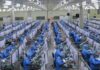











Ho Chi Minh City’s import-export activities maintain their upward trend. (Photo: TTXVN)
|
Ho Chi Minh City’s economy in the first 10 months of 2025 has shown several bright spots. However, to achieve the 8.5% GRDP growth target for the year, the city needs to vigorously activate three key drivers: consumption, exports, and public investment.
This notable information was highlighted at the socio-economic meeting for the first 10 months of 2025, held by the Ho Chi Minh City People’s Committee on October 31st.
According to Mr. Hoang Vu Thanh, Deputy Director of the Ho Chi Minh City Department of Finance, the city’s economy continued its positive recovery across most sectors in the first 10 months of 2025.
Specifically, the total retail sales of goods and service revenue reached over 1,740 trillion VND, a 15% increase compared to the same period last year. Import-export activities maintained their growth momentum, with exports estimated at 76.23 billion USD, up 4.87%, and imports at 80.87 billion USD, up 5% year-on-year.
Notably, the tourism sector saw a strong rebound, with total revenue reaching 208,066 billion VND in the first 10 months, a 22.4% increase compared to the same period. International visitor arrivals exceeded 6.58 million, up 17.7%. The merger immediately leveraged the prominent coastal tourism advantages of the former Ba Ria-Vung Tau region, with Vung Tau being honored as “Asia’s Leading Coastal Tourism Destination” for the first time.
The Industrial Production Index (IIP) rose by 7.5%; all four key industries experienced growth, with mechanics increasing by 18.3%, food and beverages by 8.3%, and electronics and IT by 6.5%.
Foreign direct investment (FDI) reached 7.23 billion USD, a 28.6% increase year-on-year. Meanwhile, capital mobilization and credit outstanding grew by 9.31% and 9.79%, respectively, compared to the end of 2024, indicating stable capital flow within the banking system.
State budget revenue is estimated at 652,509 billion VND for the first 10 months, equivalent to 97.2% of the central allocation and 93.6% of the City People’s Council’s estimate, up 15.5%. Domestic revenue remains a highlight, with a 10-month cumulative estimate of 468,399 billion VND, reaching 98.5% of the estimate and 122.5% of the same period, with 16 out of 18 revenue items meeting or exceeding the progress.
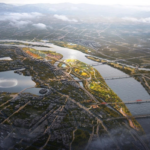
According to the Ho Chi Minh City Department of Finance, this result is mainly due to the surge in land use fees and land rent. Notably, the Can Gio coastal urban area project contributed 21,700 billion VND in land use fees and 5,655 billion VND in land rent.
Additionally, digital transformation, digital infrastructure development, and investment environment improvement continue to be promoted, strengthening the foundation for long-term growth.
However, Ho Chi Minh City’s economy also faces some challenges. According to the Ho Chi Minh City Department of Finance, the number of newly established enterprises decreased by 6.4%, while the number of dissolved enterprises increased by 39.4%, and the number of temporarily suspended enterprises rose by 11.2%.
Particularly, public investment disbursement as of October 24, 2025, reached only 52.7% of the plan, still slow compared to requirements, demanding significant efforts in the last two months. Moreover, administrative procedures related to land at the commune level remain problematic due to incomplete organizational restructuring and overlapping assigned tasks.
It is estimated that to achieve the 8.5% GRDP growth target for the year, Ho Chi Minh City’s economic growth in Q4 2025 needs to reach 12.4%.
 Residents of Ho Chi Minh City shopping for essential consumer goods. (Photo: My Phuong/TTXVN)
|
Mr. Nguyen Khac Hoang, Head of Ho Chi Minh City Statistics, believes this is a significant challenge, especially as two-thirds of the city’s growth drivers—exports and public investment—are facing difficulties.
Statistical data shows that Ho Chi Minh City’s exports in the first 10 months increased by only 4.9%, and imports by 5%, much lower than the national average (exports up 16%, imports up 18.8%).
According to Mr. Hoang, this is because the structure of Ho Chi Minh City’s exports differs from the national average. While the country saw strong growth in agricultural products and electronics, these are not the city’s strengths. Therefore, the city needs to develop a specialized topic to re-evaluate the market and export products, expand new markets, and diversify the product structure.
Regarding public investment, the disbursement progress remains low. To achieve 100% of the assigned target, public investment disbursement in Ho Chi Minh City must reach an average monthly increase of 24% in the last two months. This is considered highly challenging. The city needs specific solutions for each project, closely monitoring implementation progress.
The manufacturing sector, despite recording a positive signal with a 10.1% increase, 3.6 percentage points higher than the overall industry growth, still faces pressure from two centrally regulated sectors: electricity production decreased by 32.2%, reducing the industrial production index by 1.5 percentage points, and crude oil extraction decreased by 3.7%, further reducing it by 1.8 percentage points. These two sectors are expected to significantly impact the city’s industrial growth and GRDP in the final months of the year.
To achieve the 8.5% GRDP growth target for the year, Mr. Nguyen Khac Hoang, Head of Ho Chi Minh City Statistics, believes that consumption remains the most important pillar in the current period. Therefore, solutions should focus on vigorously implementing year-end promotion programs, expanding the scale across new economic spaces, covering both urban and suburban areas. Encouraging businesses to promote e-commerce and multi-channel sales will stimulate total demand and faster goods circulation. This will maintain the cycle of “consumption-production-income-consumption again.”
Additionally, the city needs to accelerate public investment disbursement, resolve obstacles related to procedures and land to expedite capital disbursement in the last two months. Exploiting public assets, especially in prime locations with profit potential, is seen as a solution to increase revenue and generate additional capital for development investment.
Concluding the conference, Mr. Nguyen Van Tho, Standing Vice Chairman of the Ho Chi Minh City People’s Committee, stated that in the last two months of the year, Ho Chi Minh City will focus all efforts to accelerate and ensure the completion and exceeding of socio-economic development targets for 2025.
The focus will be on accelerating public investment disbursement—the main short-term growth driver. The Ho Chi Minh City People’s Committee leaders require investors and project management boards to closely monitor progress, decisively resolve obstacles related to land, procedures, and construction materials, and strictly control the progress of key projects, especially transportation and urban infrastructure.
Simultaneously, the city will strengthen support for businesses to maintain production, resolve difficulties related to capital, taxes, and administrative procedures; implement policies to reduce costs, stimulate investment and consumption. The city will promote year-end promotion programs, fairs, and festivals, combined with trade and tourism promotion, market expansion, and ensuring the supply of goods for the Lunar New Year, maintaining price stability. It will also attract more FDI and domestic investment, shorten licensing and project approval processes, and approve specific land prices to quickly bring resources into exploitation, increasing budget revenue./.
H.Chung
– 13:31 31/10/2025
Ho Chi Minh City’s Department of Construction Updates on Tidal Surge Developments and Response Measures
Over the past period, as forecasted by the Southern Regional Hydro-Meteorological Center, the combination of the Northeast Monsoon and tidal cycles has caused an unusually high sea level rise. This resonance resulted in a tidal peak of +1.82m, surpassing the Level III alert threshold of +1.6m, leading to flooding in many low-lying areas across Ho Chi Minh City.
Eight New Bridges to Connect Dong Nai and Ho Chi Minh City
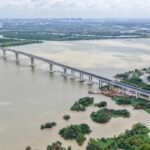
To strengthen transportation connectivity between the two localities and the Southeast region, Ho Chi Minh City and Dong Nai Province have agreed to jointly invest in the construction of eight new bridges.
Ho Chi Minh City Generates Over VND 27,000 Billion from Land Use Fees and Rentals in Can Gio Coastal Urban Development Project
Over the past 10 months, Ho Chi Minh City has seen a remarkable surge in revenue from land use fees, particularly driven by the Can Gio Coastal Urban Area project.
“Upcoming Fierce Auction in Thu Thiem: 3,790 Once-Stalled Apartments Set to Spark a Battle Among Real Estate Titans Son Kim Land, Sunshine, and Bcons Land”
After four unsuccessful auctions, Ho Chi Minh City is set to relaunch the bidding process for 3,790 Thu Thiem resettlement apartments. This time, the participation of industry giants such as Son Kim Land, Sunshine, and Bcons Land has captured the keen interest of investors.
Ho Chi Minh City Calls Out Delayed Projects, Demands Strict Action
Ho Chi Minh City has mandated that all departments, sectors, and investors accelerate the disbursement of public investment capital, with a particular focus on delayed projects such as the Dinh River embankment, Ring Road 2, and Ring Road 4.