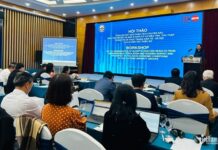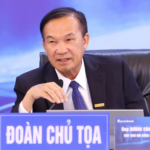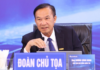


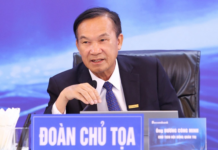








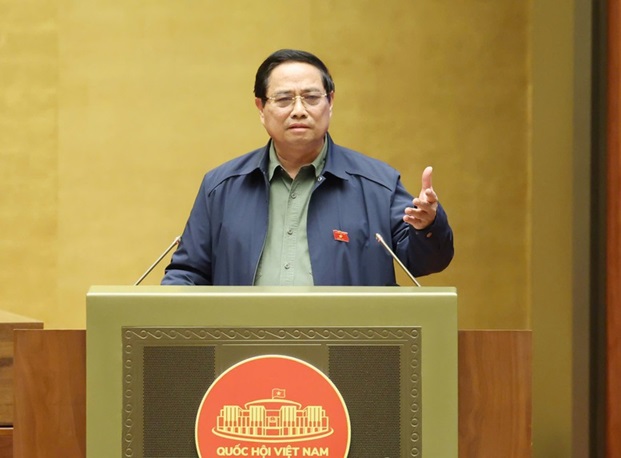
On October 30th, Prime Minister Pham Minh Chinh addressed the National Assembly, highlighting Vietnam’s remarkable achievements over the past five years. Despite numerous challenges, the economy has demonstrated resilience, successfully weathering significant external shocks. (Photo: VGP/Nhật Bắc)
|
In the afternoon of October 30th, the National Assembly continued its plenary session, discussing budget reports. This marked the conclusion of a two-day deliberation on socio-economic issues, the state budget, and reports from various agencies, including the Government.
A Legacy of Pride
Prime Minister Chinh reflected on the past five years, acknowledging the constant interplay between opportunities and challenges, with the latter often prevailing. Despite these hurdles, Vietnam has made significant strides.
As a developing nation with a transitioning economy, Vietnam’s scale remains modest, and its openness makes it vulnerable to external shocks. Yet, over the past five years, the economy has proven its resilience, successfully navigating major external challenges.
This resilience has led to macroeconomic stability, controlled inflation, and sustained growth. Key balances have been maintained: revenue covers expenditure, exports meet imports, food production meets demand, energy supplies are sufficient, and the labor market adapts to change. Budget deficits are lower than previous terms, and public debt, foreign debt, and government debt have all decreased. Living standards have improved, with Vietnam’s happiness index rising 39 places since the beginning of the term. National defense and security capabilities have been strengthened.
“Never before have we invested so much in enhancing our defense capabilities,” the Prime Minister stated. “We have domestically produced several weapons, showcased in the September 2nd parade, including some only manufactured by 4-5 countries globally. This is a source of great national pride.” Vietnam is building a revolutionary, regular, and increasingly modern armed force.
Social welfare spending has also reached unprecedented levels, with 1.1 million billion VND (approximately 17% of GDP) allocated during the COVID-19 pandemic to support 68 million people.
“These achievements are a testament to the tireless efforts of the entire political system, the people, and businesses, under the wise leadership of the Communist Party of Vietnam, the Central Committee, the Politburo, the Secretariat, and General Secretary Nguyen Phu Trong, along with the support of the international community,” the Prime Minister emphasized.
These accomplishments, he added, are truly valuable and fundamental, achieved amidst adversity. They empower Vietnam to be self-reliant, self-sufficient, and strategically autonomous, fostering confidence and momentum for a new era of building a prosperous, civilized, and happy socialist nation.
The Prime Minister acknowledged remaining challenges, as highlighted by National Assembly deputies, and pledged to address them with feasible solutions and adequate resources.
Resolving Long-Standing Issues
A key achievement of this term, the Prime Minister noted, has been the decisive resolution of long-standing projects. This has freed up resources for development, including the turnaround of 12 loss-making projects, progress on critical energy projects, and the restructuring of four weak banks, including SCB. Efforts are underway to review and address nearly 3,000 projects with a total capital of millions of billions of VND and hundreds of thousands of hectares of land.
In infrastructure, Vietnam is on track to exceed its target of 3,000 km of expressways and 1,700 km of coastal roads by 2025.
The Prime Minister highlighted the improvement in the ICOR (Incremental Capital-Output Ratio), which has fallen from 10-11-12 to 6-7. This reflects efforts to address key issues: inefficient investment, scattered projects, and delays. This term has seen the revival and completion of numerous projects, including Song Hau 1, Long Phu 1, Thai Binh 2 power plants, Van Phong 1 BOT, Nghi Son Refinery, O Mon Gas-fired Power Plant, and Block B gas field.
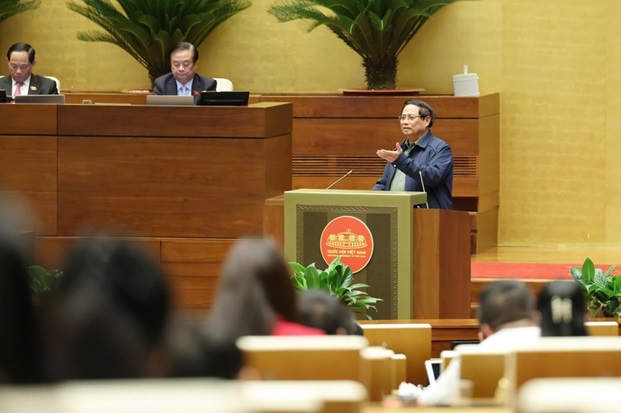
Prime Minister Chinh also addressed two specific issues of concern to deputies: public investment and the state budget estimate, as reported by Deputy Prime Minister Le Thanh Long. (Photo: VGP/Nhật Bắc)
|
Ensuring Fiscal Balance and National Financial Security
Prime Minister Chinh then addressed two specific concerns raised by deputies: public investment and the state budget estimate, as reported by Deputy Prime Minister Le Thanh Long.
Slow disbursement of public investment, he acknowledged, remains a challenge for the entire political system, despite investment being a key driver of growth (both public and private).
This term has seen a 55% increase in public investment capital to 3.4 million billion VND, while the number of projects has been reduced from 12,000 to 4,700 after three rounds of cuts. This consolidation allows for focused resource allocation, enabling the construction of new expressway systems in the Mekong Delta, the North, and the Central regions, as well as the expansion of existing ones. Investments have also been made in seaports, the Lao Cai – Hanoi – Hai Phong railway, and the North-South high-speed railway.
This has contributed to GDP growth exceeding the National Assembly’s target of 6.5-7% per year (2.55% in 2021 due to COVID-19, and an average of 7.2% from 2022-2025).
“The National Assembly and the Government have worked to remove obstacles to public investment, but some institutional barriers have taken 3-4 years to resolve,” the Prime Minister noted.
He cited land clearance and resettlement as the most challenging aspects of public investment. Previously, resettlement and ensuring people’s livelihoods were prerequisites for project implementation. “It took until October 2024, after three submissions to the National Assembly, to resolve these issues,” he explained.
Another example is the previous restriction on transferring investment capital between projects and localities. “We hadn’t fully grasped the concept that roads belong to the nation, not just the localities they pass through,” he said. This issue has also been addressed.
However, he acknowledged that progress in removing obstacles has not met public expectations. Efforts will continue to address land-related legal issues and streamline local governance, while ensuring that decentralization is accompanied by resource allocation, capacity building, and enhanced oversight.
Localities like Dak Lak, Thai Binh, Ninh Binh, and Binh Phuoc have demonstrated confidence in managing infrastructure projects as investors.
The Prime Minister also acknowledged the challenges posed by objective factors like pandemics, floods, and storms. “While we must overcome these challenges, we also need to empathize with investors facing these difficulties,” he said.
Regarding the second concern, the budget estimate, the Prime Minister emphasized the importance of ensuring revenue covers expenditure while maintaining national financial security. This requires increased investment in development, social welfare, national defense, and addressing unforeseen events like pandemics and natural disasters. He recalled previous terms when budget resolutions were needed to halt projects.
This term’s budget prioritizes three areas: investment in people and recurrent expenditure, ensuring national defense capabilities, and guaranteeing social welfare, especially during crises.
The Prime Minister stressed the need to generate sufficient revenue to cover these expenditures. The past term has successfully met critical spending needs. Insufficient revenue would lead to deficits and increased debt.
He highlighted the Government’s effective use of increased revenue and savings to achieve its goals, from social welfare to development investment and national security. This includes policies like tuition waivers, school meal subsidies, border school construction, housing improvements, and salary reforms.
The Prime Minister affirmed that the Government has adhered to the National Assembly’s objectives and that all budget adjustments have been approved by the Assembly and aligned with risk management principles.
“As deputies have proposed, we will consider and seek approval for an earlier salary increase next year,” he said. He also emphasized the need for more realistic budget estimates, as suggested by deputies.
Looking ahead to 2026, the Prime Minister acknowledged the ambitious growth targets of 8% in 2025 and double-digit growth thereafter. However, he expressed confidence in achieving these goals, citing Vietnam’s history of resilience and innovation.
“Our people thrive under pressure, turning challenges into opportunities. This has been proven time and again,” he stated.
He outlined a development strategy focused on “going deep into the earth, reaching out to the sea, and soaring into the sky,” emphasizing the untapped potential of the seabed, underground resources, and space. This includes exploiting the eight layers of resources within Vietnam’s 1 million square kilometers of maritime territory, an area three times the size of its landmass.
The Prime Minister identified six pillars of Vietnam’s strength: national unity, Party leadership, historical and cultural heritage, the people’s role in history, the armed forces, and the spirit of self-reliance.
Recent resolutions by the Party Central Committee and the Politburo emphasize these directions, based on science, technology, innovation, and digital transformation. This involves mobilizing the entire nation, with the state playing a facilitating role, businesses leading the way, and public-private partnerships driving development for a prosperous and happy people.
The Prime Minister also discussed macroeconomic policies, highlighting the potential of monetary policy and the need to revitalize traditional growth drivers (investment, consumption, exports) while promoting new ones (digital economy, green economy, creative economy).
“The goals are challenging, but achievable with scientific and practical foundations. With the current momentum, the Party’s leadership, the Government’s unity, the National Assembly’s support, the people’s expectations, and international backing, we must move forward, not backward,” he concluded, reiterating a sentiment he has expressed repeatedly.
– 20:48 30/10/2025
Prime Minister: All Obstacles in Two-Tier Government Operations Must Be Resolved by End of 2025
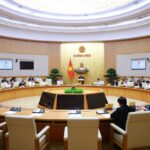
On the afternoon of October 29th, Prime Minister Phạm Minh Chính chaired a government meeting to discuss the implementation progress of Central Committee and National Assembly resolutions regarding the organization and operation of two-tier local governments.
Who Owns the Pullman Hotel in Hanoi?

In late 2012, Pullman Hanoi officially opened its doors, marking 13 years of operation to date.
Record-Breaking Unrecorded Sales of VHM Reach 223.9 Trillion VND by End of September
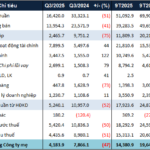
According to the consolidated Q3/2025 financial report, Vinhomes JSC (HOSE: VHM) recorded a net revenue of VND 51.1 trillion and a net profit of nearly VND 14.4 trillion in the first nine months of the year.
Resident Deposits in Credit Institutions Reach 8 Quadrillion Dong
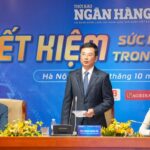
Data from the State Bank of Vietnam reveals that, to date, resident deposits in credit institutions have reached approximately 8 quadrillion VND, marking a nearly 13% increase compared to the same period last year.
Eximbank Credit Grows by 8.51%, Pre-Tax Profit for 9 Months Reaches VND 2,049 Billion

Eximbank is embarking on a transformative journey, poised to establish a robust foundation for sustainable growth and solidify its position within Vietnam’s financial and banking ecosystem.