


















Deputy Prime Minister Tran Hong Ha has signed Decision No. 2404/QD-TTg on October 29, 2025, approving the adjustment of the railway network planning for the 2021-2030 period, with a vision to 2050. This adjustment includes modifications and additions to the planned network.
Notably, for new railway lines, the plan adjusts the name, scale, and investment timeline for the high-speed North-South railway axis and adds the Hanoi – Quang Ninh high-speed railway line.
Additionally, the plan adjusts the scope and scale of seven routes: Yen Vien – Pha Lai – Ha Long – Cai Lan, the eastern ring road of Hanoi, Nam Dinh – Thai Binh – Hai Phong, Vung Ang – Mu Gia, Bien Hoa – Vung Tau, Ho Chi Minh City – Can Tho – Ca Mau, and Da Nang – Kon Tum – Gia Lai – Dak Lak – Dak Nong – Binh Phuoc.
The scale and investment timeline for two routes, Lao Cai – Hanoi – Hai Phong and Ho Chi Minh City – Loc Ninh, are adjusted, along with the investment timeline for three routes: Hanoi – Dong Dang, Hai Phong – Ha Long – Mong Cai, and Thap Cham – Da Lat.
The Thu Thiem – Long Thanh route is removed from the national network and reclassified as an urban railway managed by Ho Chi Minh City and Dong Nai.
The addition of the Hanoi – Quang Ninh route strengthens connectivity in the key northern economic region, linking the national political and administrative center with major industrial, port, and tourism hubs. This aligns with the goal of developing a high-speed railway system and modernizing transportation infrastructure by 2050.
The railway line will reduce travel time to Quang Ninh to approximately 30 minutes.
The Hanoi – Quang Ninh railway is not a new project but an extension of the Yen Vien – Pha Lai – Ha Long – Cai Lan line approved in 2004 with a total investment of over 7.6 trillion VND. Construction halted in 2011 due to reduced public investment, with only 56% completed. Since 2023, local authorities and ministries have advocated for its revival, now aligned with the national high-speed railway strategy.
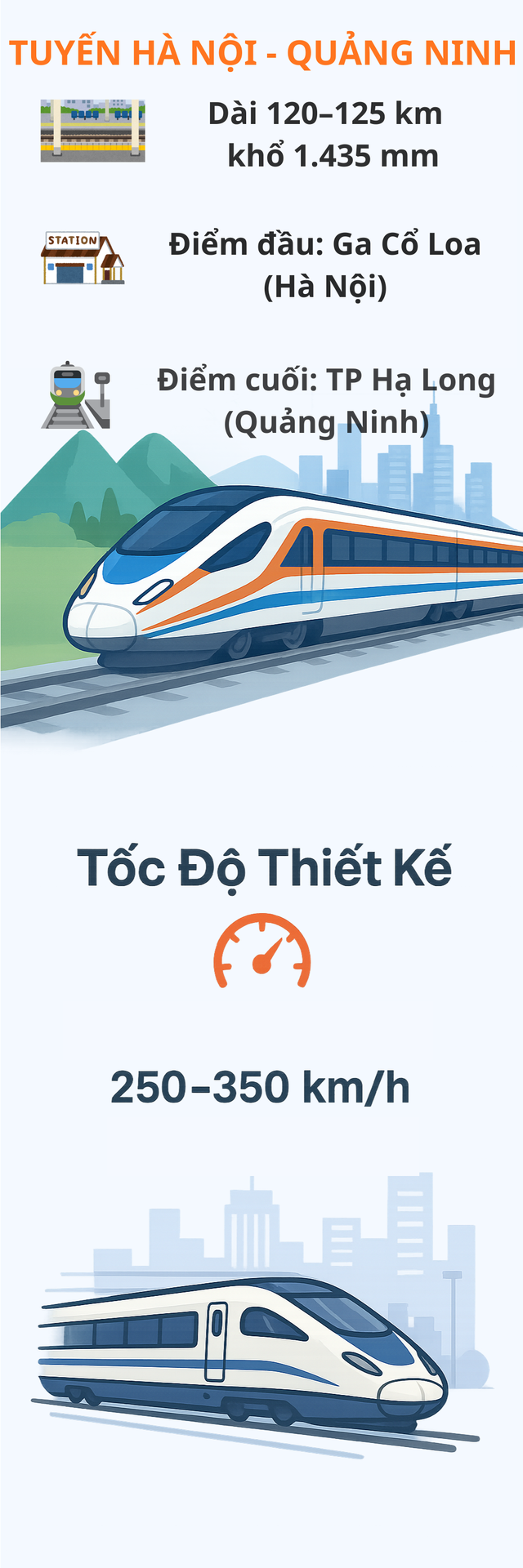
According to Vingroup’s proposal, reviewed by the Ministry of Construction and Vietnam Railways, the Hanoi – Quang Ninh high-speed railway will span 120-125 km, with a 1,435 mm gauge, electrification, and speeds of 250-350 km/h. The route may start at Co Loa or Yen Vien (Hanoi) and end at Ha Long (Quang Ninh).
The line is expected to have four main stations: Co Loa, Gia Binh, Yen Tu, and Ha Long. If the Yen Vien route is chosen, an additional station will be added, enhancing connectivity and development in surrounding areas.
The total investment is estimated at $5.4 billion (over 133 trillion VND), requiring approximately 300 hectares of land, with completion targeted before 2035.
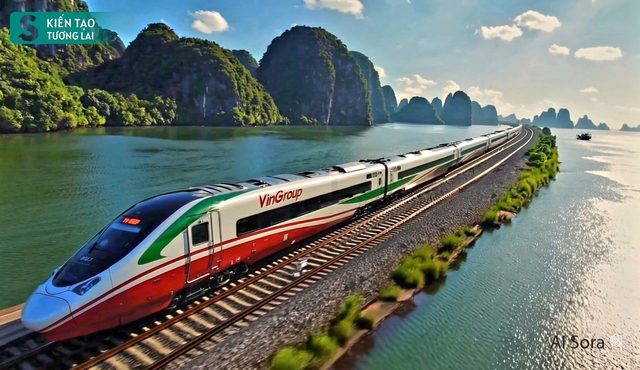
AI-generated illustration of the future Hanoi – Quang Ninh railway line
The existing Yen Vien – Pha Lai – Ha Long – Cai Lan line will be repurposed for freight transport, separating passenger and cargo flows to improve regional efficiency. This aligns with the government’s multi-modal infrastructure planning by 2030.
The project is currently in the pre-feasibility study phase. Issues related to funding, PPP mechanisms, land clearance, and urban infrastructure connectivity will be reviewed by relevant ministries before submission to the government in 2026-2030.
Transportation experts highlight that the Hanoi – Quang Ninh route reflects a modern urban development vision for the Hanoi – Hai Phong – Quang Ninh economic triangle. The high-speed railway will reduce travel time between the two locations from over 2 hours to approximately 30 minutes, fostering logistics, industry, tourism, and satellite urban development along the northern corridor.
“The Hanoi – Quang Ninh railway will also connect to Gia Binh Airport, creating a multi-modal system (air-rail-road) that reduces transport costs and boosts international trade,” stated the Investment Guide, citing Vietnam Railways leadership.
Revised Title:
Optimizing Vietnam’s Railway Network Master Plan: 2021–2030 Framework with Vision to 2050

Deputy Prime Minister Trần Hồng Hà has signed Decision No. 2404/QĐ-TTg dated October 29, 2025, approving the adjusted master plan for the railway network for the period 2021–2030, with a vision toward 2050.
Revised Title:
Approval of Railway Planning Adjustment: Thu Thiem – Long Thanh Route Transformed into Urban Rail Line

In accordance with the decision to approve the adjusted Railway Network Plan for the 2021-2030 period, with a vision to 2050, the Thu Thiem – Long Thanh railway line will not be included in the planning and will be transformed into an urban railway. Ho Chi Minh City and Dong Nai are responsible for updating their provincial plans and related schemes accordingly.
The Most Complex Interchange on Ring Road 3 Set for Technical Completion by Late 2025, Boosting Southern Regional Trade Connectivity

The imminent completion and expansion of large-scale infrastructure projects in eastern Ho Chi Minh City are poised to catalyze socioeconomic growth and invigorate the region’s real estate market.
Vingroup Launches Vinmetal Steel Company with $430 Million Charter Capital: Meet the Two Co-Founders
On October 6th, Vingroup announced the establishment of VinMetal Joint Stock Company, marking its official entry into the metallurgy industry and further expanding its existing industrial-technology pillar.
Collaborating with Hanoi: Unlocking Opportunities in China’s Largest Automotive Hub

As the youngest among Vietnam’s four centrally governed cities, it boasts the largest administrative and population scale, coupled with immense potential for growth.