
















On the morning of November 4th, the National Assembly continued its 10th session by reviewing the draft amended Construction Law, accompanied by a detailed report on its appraisal.
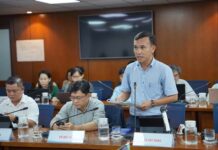
Presenting the proposal, Minister of Construction Tran Hong Minh highlighted that the revised Construction Law has been streamlined into 8 chapters and 97 articles—a reduction of 71 articles compared to the current law. The focus is on outlining fundamental principles and matters within the National Assembly’s jurisdiction.
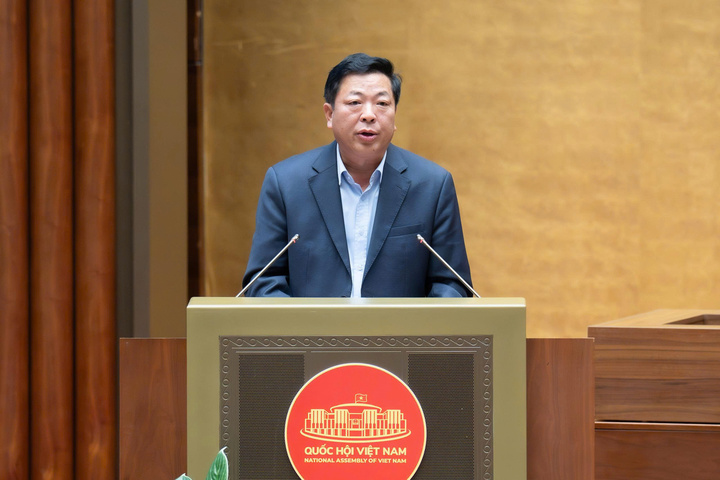
Minister of Construction Tran Hong Minh presenting the proposal. (Photo: National Assembly Media)
Maximizing Efficiency in Construction Permitting
Notably, the draft law significantly reduces and simplifies administrative procedures related to investment project development, appraisal, and construction design approval.
Adhering to the principle of single administrative control, construction management authorities will oversee each project or structure only once, from preparation to commencement.
Projects with feasibility studies approved by construction specialists are exempt from obtaining a construction permit.
Minister Minh emphasized that the amendments aim to simplify permit conditions, procedures, and timelines, enabling full online processing and minimizing approval times to a maximum of 7 days.
According to the draft, construction permits are mandatory before starting any project, except in the following cases:
State-secret projects; emergency constructions; special public investment projects; projects under special investment procedures; temporary structures as defined; constructions on land designated for defense or security purposes; projects approved by the Prime Minister, central political bodies, Supreme People’s Court, Supreme People’s Procuracy, State Audit, Presidential Office, National Assembly Office, ministries, government agencies, or central organizations of the Vietnamese Fatherland Front and socio-political entities; projects spanning multiple provinces; urban or rural infrastructure aligned with approved technical plans; and constructions along non-urban routes compliant with urban or rural planning laws.
Expanding Permit Exemptions
The revised law broadens permit exemptions, ensuring that each project undergoes only one administrative review from preparation to commencement, thereby streamlining processes.
Exemptions apply to projects appraised by construction specialists, including public, PPP, large-scale business investments, or those impacting community safety. Additional exemptions cover offshore constructions, airports, aviation facilities, non-regulated advertising structures, passive telecom infrastructure, projects with approved feasibility studies, rural residential buildings under 7 stories, and internal renovations not affecting structural safety or functionality.
Remaining projects will be managed through the construction permit process.
Reducing Costs for Citizens and Businesses
Nguyen Thanh Hai, Chair of the Committee on Science, Technology, and Environment, supported the exemptions, noting their alignment with Party policies to reduce administrative burdens and costs for citizens and businesses.
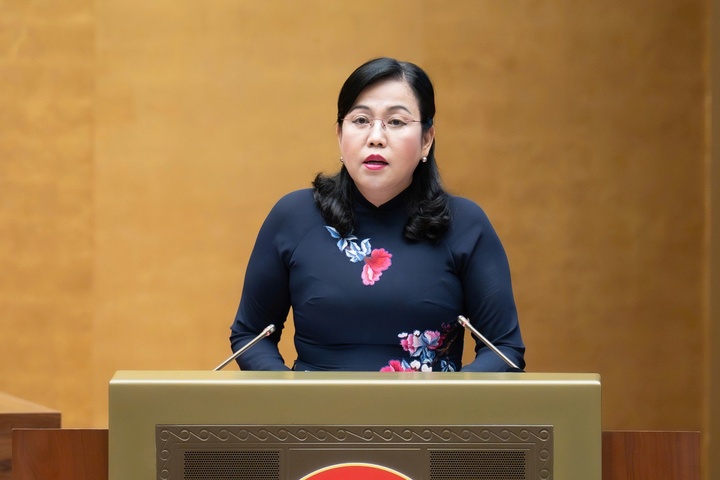
Chair Nguyen Thanh Hai presenting the appraisal report. (Photo: National Assembly Media)
However, she cautioned that exemption criteria must be carefully defined to prevent unintended administrative complexities or secondary permits.
Additionally, exempt projects lack legal grounds for property certification, necessitating amendments to related laws to protect citizen rights.
The Committee recommends retaining permits for high-risk structures like factories, rental apartments, and community centers, suggesting usage permits before operation.
The draft lacks provisions for addressing violations in permitted projects, such as design deviations or unauthorized changes. The Committee urges clear legal mechanisms to prevent normalization of violations.
Finally, the draft should clarify online permitting procedures to enhance public accessibility.
BIDV and WMI Partner to Develop International Standard Private Banker Team

Recently, the Bank for Investment and Development of Vietnam (BIDV) and the Wealth Management Institute (WMI) of Singapore—a leading regional and international training organization in wealth management and private banking for high-net-worth individuals—officially signed a strategic partnership agreement.
Bibica Confectionery to Delist Its Shares from the Stock Market

Last September, Bibica convened an extraordinary shareholders’ meeting, approving the deregistration of certain business lines and the revocation of its public company status.
Why Vietnam’s GDP Growth Miracle Surpasses Global Precedents: Insights from Prof. Tran Dinh Thien
For the first time in history, Vietnam has set a target of double-digit growth over the next five years—an ambition that, according to Associate Professor Dr. Trần Đình Thiên, is “unfeasible not only for Vietnam but for the entire world.” However, he believes that by daring to innovate in institutional frameworks and regional development thinking, the “Resolution Quartet” will pave the way to turn the seemingly impossible into reality.
EuroCham: Vietnam Sustains Steady Recovery Momentum

According to the European Chamber of Commerce in Vietnam (EuroCham), Vietnam remains a rare bright spot, sustaining a steady recovery despite global volatility.
Prime Minister Pham Minh Chinh Highlights Achievements in ‘Reorganizing the Nation’

Referring to the two-tier local government system operational since July 1, Prime Minister Pham Minh Chinh emphasized that this marks a significant achievement following the “reorganization of the nation.” We have swiftly transitioned, leveraging digital transformation, to shift from management to fostering development and serving the people.