Contributing to the draft documents for the 14th National Congress of the Party, Deputy Chair of the National Assembly’s Committee on Culture and Society, Nguyen Thi Mai Hoa, proposed the inclusion of a “happiness index” in the draft Political Report. The Party’s ultimate goal is to achieve independence for the nation and freedom and happiness for the people.
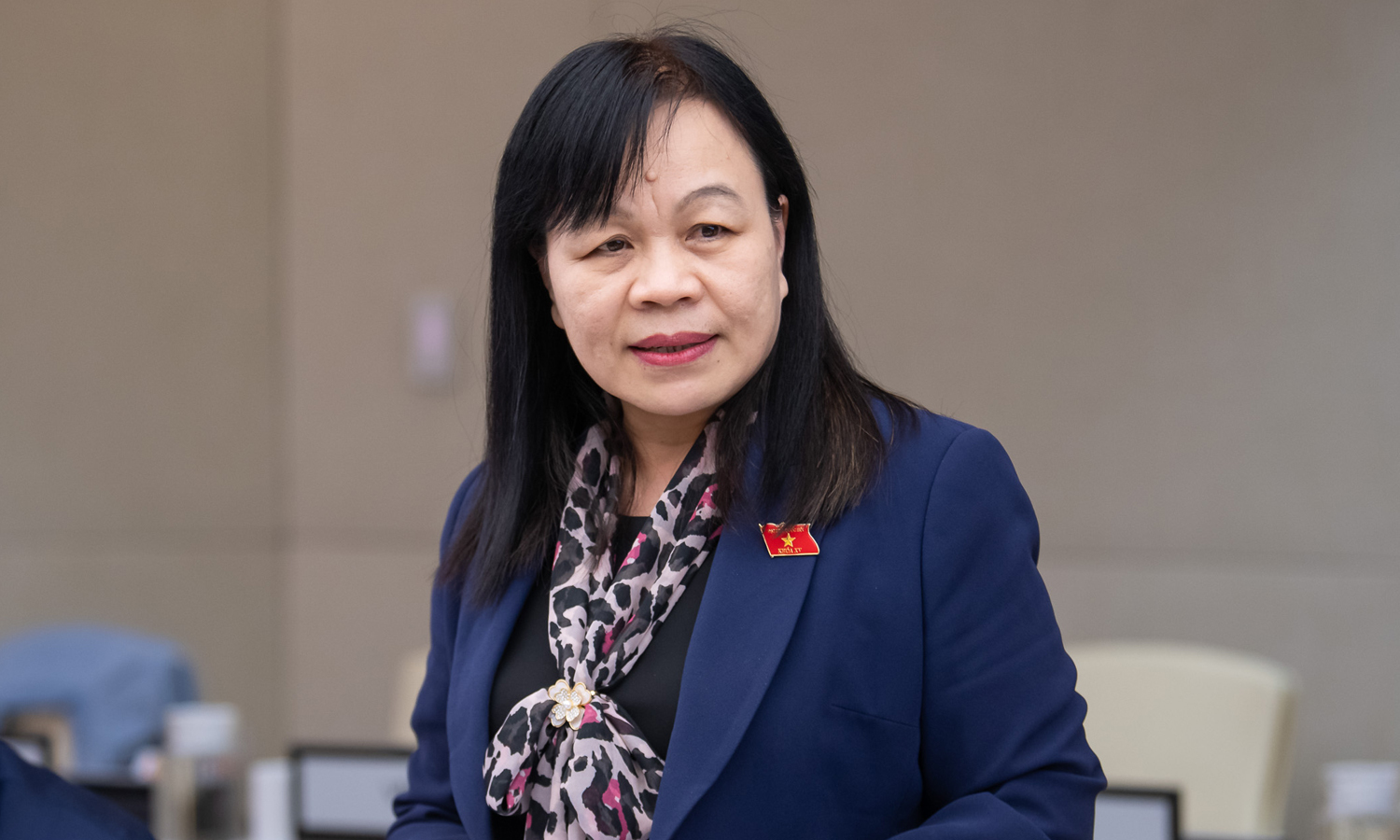
Deputy Chair of the National Assembly’s Committee on Culture and Society, Nguyen Thi Mai Hoa. (Photo: quochoi.vn)
”
Vietnam’s happiness index has seen remarkable progress in recent years. From 2020 to 2025, we climbed 37 places, with a significant rise in the happiness index in the past few years. Compared to other countries in the region, Vietnam ranks second in happiness, just behind Singapore.
“, said Ms. Hoa.
The delegate noted that the draft Political Report has mentioned the happiness index and set the goal for the next term as:
“Promoting rapid and sustainable national development, enhancing the quality of life and happiness of the people.”
The development objectives also include:
“For a peaceful, independent, democratic, prosperous, civilized, and happy Vietnam.”
However, the Deputy Chair of the Committee on Culture and Society pointed out that the goals, targets, and task groups are still general, lacking clear criteria to define the level of happiness and the happiness index for individuals, communities, and families.
Therefore, Nguyen Thi Mai Hoa requested the Document Editorial Team to further clarify the tasks and solutions for building a happy life for the people.
”
We should focus on establishing specific indices for satisfaction levels—satisfaction with oneself, one’s family, and the community: villages, communes, neighborhoods, and workplaces. When these indices show that people are content in their relationships, we will have a happy nation.
“, the delegate stated.
Beyond individual happiness, Ms. Hoa emphasized the importance of building happy families. While income may increase and living amenities become more abundant, if relationships within families and communities are unsatisfactory, true happiness remains elusive.
”
Happy schools, for instance, should address issues like school violence and the culture of interaction between teachers and students, parents and educators.
We need to focus on creating safe, happy environments. Happiness in the workplace is also crucial. If organizations set goals for a happy work environment, it will greatly motivate employees to unite, care for one another, and contribute more.
“, Ms. Hoa added.
Developing Primary Healthcare as the Foundation
In the same discussion, National Assembly Deputy Tran Khanh Thu (Hung Yen Province) noted that the draft Political Report aims for a Human Development Index (HDI) of approximately 0.78 by 2026-2030.
The draft also emphasizes building an equitable, high-quality, efficient, and sustainable healthcare system. It focuses on enhancing disease prevention, diagnosis, and treatment, effectively controlling epidemics, and implementing the National Target Program on healthcare, population, and development. The goal is to improve the quality and efficiency of the healthcare service network from central to local levels to meet evolving health trends.

National Assembly Deputy Tran Khanh Thu. (Photo: quochoi.vn)
”
Over the past term, significant progress has been made in cultural, human, and social development, particularly in social welfare and improved living standards. The healthcare system and public health services have seen positive developments, with enhanced quality and effective epidemic control.
“, Ms. Thu assessed.
To achieve the goal of providing every citizen with a free annual health check-up by 2026 and basic free healthcare under health insurance by 2030, Ms. Thu believes that developing primary healthcare is essential. Therefore, investment in primary healthcare must be focused and prioritized, particularly for health stations and basic multidisciplinary hospitals.
Ms. Tran Khanh Thu suggested that health stations should be equipped with better infrastructure to strengthen their role in providing initial healthcare management for the community. This includes ensuring proactive disease prevention and free treatment services.
”
I propose that the draft documents explicitly address this issue. It is necessary to consolidate the primary healthcare system and standardize health station models across localities following administrative reorganizations.
Health stations must be capable of conducting health screenings for local residents and ensuring sufficient state budget resources to fulfill this task by 2026.
“, Ms. Thu concluded.