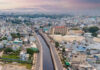








The transformation of Hanoi’s western region begins with Thang Long Boulevard, a pivotal artery that has become the backbone of connectivity. Alongside this, a series of ring roads and overpasses have been continuously constructed and completed in recent years.
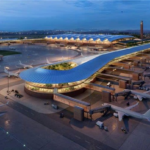
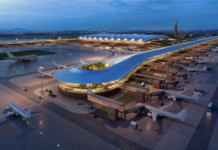
Among these, the multi-level intersection project between Ring Road 3.5 and Thang Long Boulevard stands out as a “super intersection” with a total investment of 2.384 trillion VND. The project commenced in April 2025 and has already achieved over 40% progress, entering the phase of constructing a 1km-long underpass tunnel combined with four turbine branches. This infrastructure not only alleviates congestion at the western gateway but also enhances connectivity between Bac An Khanh and My Dinh via Ring Road 3.5, expected to be fully completed by the end of 2025.
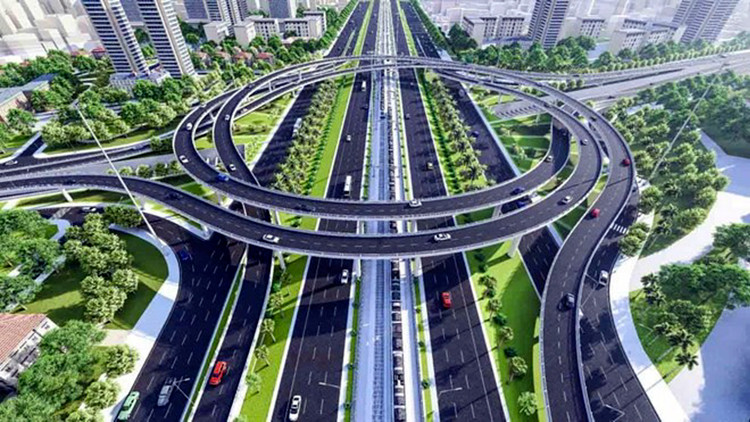
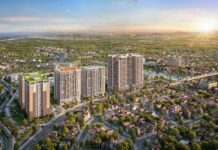
Rendering of the multi-level intersection between Ring Road 3.5 and Thang Long Boulevard.
Once the multi-level intersection between Ring Road 3.5 and Thang Long Boulevard is completed, it will seamlessly connect the entire Ring Road 3.5. This connectivity not only resolves traffic congestion but also provides a significant boost to the real estate market in the An Khanh area, turning it into a prime investment hotspot in western Hanoi.
In addition to this intersection, the Van Cao – Ngoc Khanh – Lang – Hoa Lac metro line 5 is set to break ground in December 2025, with a total length of over 38km (including 6km underground, 2km elevated, and 30km at ground level) and a total investment of approximately 61.9 trillion VND. This metro line will directly connect the western area to central Hanoi and satellite urban areas, while promoting a Transit-Oriented Development (TOD) model to create green, smart urban zones along the route.
Alongside transportation infrastructure, high-tech zones like Hoa Lac, Hanoi National University, the new Central Children’s Hospital, and the new Obstetrics and Gynecology Hospital are being developed along Thang Long Boulevard. Coupled with tens of thousands of billions of VND in FDI capital, the western region is emerging as a new economic and social growth hub for the capital.
As central Hanoi becomes increasingly congested, the western region, with its trillion-VND infrastructure and vast green spaces, is attracting thousands of affluent families. This area is rapidly becoming the new destination for successful households.
According to Batdongsan.com.vn, over the past two years, searches for villas in the western region have increased by 180%, with 70% of buyers belonging to the high-income segment earning over 100 million VND per month. Low-rise villas, in particular, remain a favorite among Hanoi’s wealthy. While older low-rise villas enjoy high liquidity, new projects are selling out within weeks of launch.
Once-popular villa communities like Splendora, Nam An Khanh, Geleximco, and Duong Noi, which dominated the market over a decade ago, are now being continuously developed and occupied. Many older villas are being purchased at double their original price, renovated in resort-style designs, and readied for occupancy.
Meanwhile, new villa communities are emerging at a rapid pace. In 2024, the Cam Garden Urban Area gained popularity with its tropical garden villa design, while in late 2025, An Khanh Economy – the newest entrant – stands out with its “affordable luxury villa” model.
Mr. Phan Nam, Director of a real estate agency in the An Khanh area, notes that in recent years, investors have shown a strong interest in western Hanoi’s real estate. Due to the limited supply of new villas, townhouses, and shophouses in the central area, even previously less populated urban areas like Kim Chung Di Trach, Nam An Khanh, and Lideco have seen significant price increases. Over the past five years, prices have tripled.
“In particular, Bac An Khanh Urban Area, considered the heart of An Khanh with its excellent planning, consistently leads in price growth, often 30% higher than surrounding villa areas,” Mr. Nam asserts.
Seizing on current market demand, several real estate companies are planning to launch projects to attract investment. However, very few new units are entering the market in 2025. New supply is expected only in 2026, but in limited quantities.
Evaluating An Khanh’s planning, Mr. Nguyen Van Dinh, Vice Chairman of the Vietnam Real Estate Brokerage Association, highlights its strategic location at the western gateway and its well-organized infrastructure, among the best in the capital. Bac An Khanh, in particular, is highly valued due to its proximity to My Dinh.
With its breakthrough infrastructure, expansive land reserves, and interconnected villa ecosystem, western Hanoi, especially the An Khanh area, is becoming a new magnet for the affluent. With the upcoming Hoa Lac metro line and numerous new projects, the shift toward the western region shows no signs of slowing down.
Revitalizing Vintage Apartments: Overcoming the Challenge of Selling Aged Condos
Over the past period, condominium prices have continued to rise, yet liquidity has somewhat stagnated. This is primarily due to the fact that condominium prices have become excessively high, making it challenging for genuine residents to afford them.
₫6 Billion Still Falls Short for Buying an Apartment in Hanoi
Owning a 2-bedroom apartment in the city center for just 6 billion VND seems like a dream come true, but the reality is far more challenging than it appears.
How Rising Savings Interest Rates Impact the Real Estate Market
Recently, numerous banks have begun raising deposit interest rates, a move that is expected to impact homebuyers, businesses, and the real estate market.
Reining in the Surging House Prices: Urgent Solutions for a Cooling Market
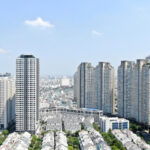
The Vietnam Association of Realtors (VARS) emphasizes that to ensure sustainable growth in the real estate market without excessive risk, it is crucial to implement measures that curb the rapid rise in housing prices. The most critical solution lies in unlocking a sufficient supply of affordably priced housing. When the supply is ample, market prices will naturally stabilize, aligning with the true balance of supply and demand.
Vietstock LIVE #21: Riding Stocks, Holding Land, or Hoarding Gold for the Year-End Wave?

What will the economic landscape of Vietnam and the world look like in the final months of 2025? As investors adopt a cautious approach to capital allocation, which asset class—stocks, real estate, or gold—will emerge as the optimal investment channel to capitalize on the year’s remaining opportunities? Tune in to Vietstock LIVE #21, streaming live at 3 PM on Friday, November 14, 2025, for expert insights and answers to these critical questions.