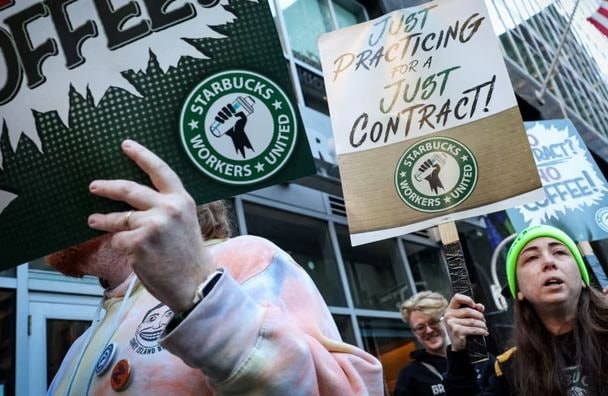
The annual “Red Cup Day,” where customers receive reusable red cups with their holiday drinks, has become the focal point of a massive strike. Over 1,000 employees across approximately 65 U.S. stores have walked off the job in what’s being called the “Red Cup Rebellion,” according to Starbucks Workers United, the union representing baristas. This marks one of the largest open strikes in recent history, strategically timed for a day when stores are typically packed and revenues soar.
Baristas report exhaustion due to chronic understaffing, especially during promotions when customer traffic spikes without a corresponding increase in staff. The union accuses Starbucks of stalling contract negotiations for over a year, despite more than 550 stores voting to unionize nationwide.
Workers’ demands are straightforward: improved staffing, higher wages, stable schedules, and resolution of labor law violations filed with the National Labor Relations Board (NLRB). Many employees describe Red Cup Day as the “most chaotic day of the year,” emphasizing their need for basic working conditions to perform their jobs effectively.
Timing the strike on Red Cup Day was deliberate. As one of Starbucks’ largest marketing campaigns, kicking off the holiday season, the free red cups draw long lines across states, creating immense pressure on staff. The widespread closures or minimal staffing immediately captured national media attention, with The Guardian calling it an effort to “maximize pressure at the company’s weakest point.”
“Our union baristas are deeply committed to their work and will do whatever it takes to secure a fair contract and end Starbucks’ unfair labor practices,” said Michelle Eisen, a 15-year barista and spokesperson for Starbucks Workers United. “We want Starbucks to succeed, but rebuilding the company and bringing customers back starts with listening to and supporting the baristas who deliver the Starbucks experience.”
Starbucks countered that the strike impacted less than 1% of its 10,000+ U.S. stores. A company representative told Reuters that Red Cup Day had a “strong start,” with many stores exceeding sales expectations. Starbucks also highlighted that average employee earnings, including benefits and tips, can reach $30/hour, and claimed only 4% of its workforce is unionized, insisting negotiations are ongoing “in good faith.”

Starbucks spokesperson Jaci Anderson expressed disappointment: “We’re dismayed that the Workers United union, representing just 4% of our partners, voted to strike instead of returning to negotiations. When they’re ready, we’re here to talk.”
Anderson added that any contract must reflect Starbucks’ industry-leading retail jobs, offering over $30/hour on average with benefits for hourly workers. “People love working here—partner engagement is up, turnover is half the industry average, and we receive over 1 million job applications annually. Customers can trust our partners will serve them across our 10,000+ company-operated and 7,000 licensed stores this holiday season, regardless of union plans.”
Tensions between Starbucks and the union aren’t new. Since 2021, when the first Buffalo, NY store unionized, lawsuits alleging retaliation, unlawful terminations, and anti-union interference have plagued the company. While the strike’s short-term business impact may be minimal due to limited store participation, brand damage is significant. The iconic Red Cup campaign, synonymous with holiday cheer, now features baristas picketing with “No Contract, No Coffee” signs. Viral boycott calls could have longer-term effects.
For U.S. labor movements, this signals a shift. Strikes in the hard-to-unionize service sector are rising. Starbucks workers’ three-year campaign against a global consumer giant shows rapidly evolving worker advocacy. Younger baristas, mostly Gen Z, are increasingly organizing to confront corporate giants for better conditions.
Sources: The Guardian, The NY Times