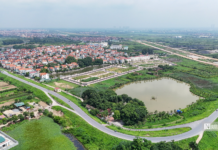
Over a decade ago, the idea that Bac An Khanh would become the “capital” of Hanoi’s elite seemed far-fetched. The region, located just 15 kilometers west of the city center, was once characterized by vast rice fields, dusty red roads during the dry season, and modest fibro-cement houses. Today, standing on the Thang Long Avenue overpass, a modern urban landscape unfolds below. Dozens of brightly lit high-rise apartments, red-tiled villas nestled among lush greenery, wide internal roads, and the shimmering LED lights of shopping centers paint a picture of transformation.
An Khanh has not only reinvented itself but has also become a symbol of sustainable urban development, instilling pride in those who have witnessed its journey. In 2013, Bac An Khanh still resembled a typical suburb: sparse population, reliance on motorbikes for transportation, and the nearest convenience being a roadside market. Thousands of villas in areas like Splendora, Geleximco, Nam An Khanh, and Duong Noi lay abandoned.
In just the past five years, the landscape has changed dramatically. Splendora completed its first phase with over 1,000 villas and townhouses, while urban areas like Geleximco, Nam An Khanh, Duong Noi, and Bac An Khanh have begun to fill with residents. Vinhomes Smart City, Vietnam’s first “smart city,” has welcomed tens of thousands of inhabitants.
A recent survey reveals that villa prices in the An Khanh area have nearly tripled in the last five years, the highest increase among Hanoi’s suburban areas. Once a land “only for rice cultivation,” Bac An Khanh now boasts sprawling villa communities with a construction density of just 30-35%, leaving ample space for greenery, lakes, and public amenities.
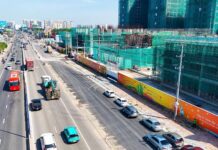
Infrastructure has also seen continuous investment. Following the completion of Thang Long Avenue, the 3.5 ring road is gradually connecting the entire route. Le Quang Dao Road has been officially opened, and the Le Trong Tan overpass has commenced construction. In the near future, Metro Line 5 (Hoa Lac – Noi Bai) with an underground station at Splendora will significantly reduce travel time to the city center.
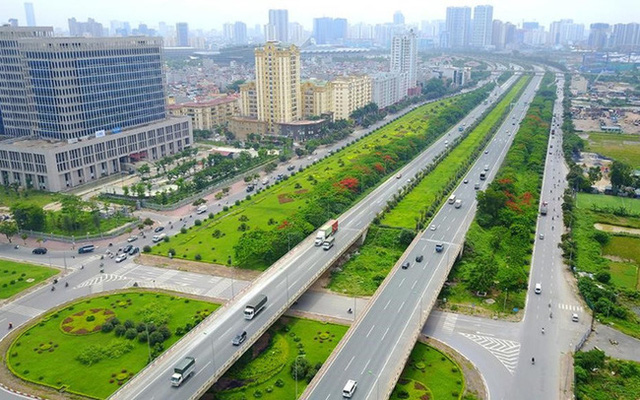
Western region infrastructure continues to surge.
Additionally, international schools, shopping centers like Aeon Mall Le Trong Tan, and Vincom Mega Mall Smart City have created a self-contained ecosystem where residents can meet all their needs—from education and healthcare to shopping and leisure—without leaving the urban area.
Amid established giants, new urban projects are emerging. An Khanh Economy, spanning 5 hectares, is set to launch later this year. With its rapid construction pace—land titles issued within 12 months—the project is becoming a top choice for those eager to join the western region’s growth without prolonged waiting.
Following this project, by 2026, An Khanh is expected to welcome new developments from existing projects like Nam An Khanh, Ha Do Charm Villa, and Mai Land. According to Nguyen Ngoc, Director of a real estate agency in Geleximco, prices for new townhouses and villas could reach 300 million VND per square meter.
Beyond low-rise segments, An Khanh will also see new apartment complexes after over 50 towers in Vinhomes Smart City sold out. Specifically, the HH3 mixed-use plot, featuring high-end apartments, offices, hotels, commercial services, and public facilities, has been rezoned for six towers ranging from 31 to 40 floors.
In essence, An Khanh in particular and the western region in general represent more than just the transformation of a land. From the once-vast rice fields, a thriving ecosystem has emerged, redefining urban living in Hanoi.
Van Phu Unveils 125-Hectare Tourism Urban Mega-Project in Dong Nai
In its quest to solidify its position as a pioneering real estate brand, Van Phu continues to expand its footprint in the Southern region with the Dai Phuoc Tourism Urban Area. This ambitious development comprises two key projects, Dai Phuoc River and Phong Phu Riverside, spanning a total area of approximately 125 hectares.
Vingroup’s $10 Billion Mega Project Joins the Global Race for ‘7 Wonders Cities of the Future’

On the morning of November 3rd, Vingroup announced the submission of its application for the ‘7 Wonders Cities of the Future’ competition.
Unveiling Đại Phước: Văn Phú’s 120-Hectare Tourism Urban Area Transforms Đồng Nai

The Van Phu-developed Dai Phuoc Urban Tourism Area project is poised to become a pioneering smart, human-centric, and culturally rich urban service and tourism hub at the eastern gateway of Ho Chi Minh City, solidifying its reputation as a leading real estate brand.
The World is Set to Vote for the Next “Urban Wonder”—What’s Vietnam’s Potential?

The New7Wonders Foundation, renowned for recognizing Ha Long Bay as one of the “New 7 Wonders of Nature,” has officially launched its global campaign, “7 Wonders Cities of the Future.”
Ecopark Pioneers Sustainable, Model Urban Development in the Central Highlands
In a market where provincial investors are wary of projects entangled in legal complications or suspended planning, Ecopalace Đắk Lắk, a flagship urban development by Ecopark Group, stands out as a beacon of reliability. With its meticulously designed master plan, transparent legal framework, and readiness for significant investments, it emerges as the trusted exception in an uncertain landscape.