On November 15th, Prime Minister Phạm Minh Chính, Head of the Government’s Steering Committee for Science, Technology (ST&I), Innovation, Digital Transformation, and Project 06, chaired the 5th meeting of the Steering Committee.
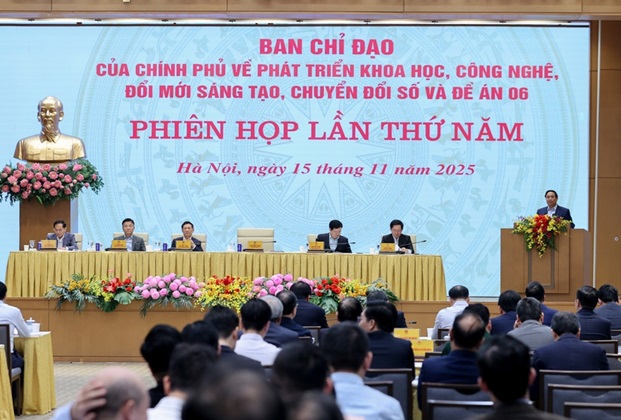
Prime Minister Phạm Minh Chính delivers concluding remarks at the 5th meeting of the Government’s Steering Committee for ST&I, Innovation, Digital Transformation, and Project 06 – Photo: VGP/Nhật Bắc
|
Digital product exports reach US$142 billion
Since the beginning of the year, the Government has submitted 19 draft laws and 10 resolutions to the National Assembly related to ST&I, innovation, and digital transformation, along with 4 laws on organizational structure and civil service.
At the 10th session, the Government presented 9 draft laws to the National Assembly for consideration and expected approval, all directly related to the development and application of ST&I and digital transformation.
In October 2025, the Government issued 10 decrees directly related to ST&I, innovation, and digital transformation, bringing the total to 22 decrees in 10 months.
Regarding the budget, approximately VND 25 trillion has been allocated for ST&I, innovation, and digital transformation in 2025. The National Assembly has approved the resolution on the central budget allocation for 2026, including funding for ST&I. The Prime Minister announced plans to allocate around VND 95 trillion for this sector in 2026.
The Prime Minister has approved 11 strategic technology groups and 35 strategic product groups, with 6 strategic technology products set for immediate implementation in 2025. The National Innovation Portal and the ST&I Transaction Floor have been launched, and Vietnam maintains its 44th position out of 139 countries in the Global Innovation Index for 2025.
Digital infrastructure has received significant investment and development. Vietnam ranks 13th globally in internet speed, with 39.5% of the population covered by 5G. A 3,900 km undersea fiber-optic cable connecting Vietnam to Singapore has been completed, and several AI data center projects are underway (e.g., VinAI, FPT, Viettel, VNPT, CMC). Plans for a Super Data Center in Ho Chi Minh City are also in progress.
The digital technology industry continues to play a pivotal role. According to the Ministry of ST&I, in the first 10 months of 2025, the digital technology industry’s revenue exceeded VND 4 trillion, a 52.4% increase year-on-year. Digital product exports reached US$142 billion, up 27%.
Tax administration, electronic invoicing, and cashless payments have shown significant progress. Over 315,000 businesses and households use electronic invoices generated from cash registers, totaling 3.58 billion invoices. Tax revenue from e-commerce reached VND 152 trillion, a 64% increase. VND 32.9 trillion was disbursed for social welfare, and VND 177 billion was donated via VNeID to support storm-affected communities.
The two-tier local government e-governance system is operating effectively, with public services becoming more data-driven and citizen-centric.
Numerous initiatives have been successfully implemented to support economic and social development. Notably, over 132.4 million bank accounts and 1.4 million customer records have been verified using chip-embedded ID cards. 66.7% of hospitals nationwide and 74% of provincial public hospitals have adopted electronic health records. 5.2 million Party member cards with chips have been issued, and VNeID offers 50 services with 1.5 million daily accesses. Public feedback on the 14th Party Congress draft documents was collected via VNeID, with 5.4 million responses. The Central Digital Signature Platform on VNeID and the “Digital Lifelong Learning” platform, which has trained 203,000 learners and reduced training costs by 80%, have also been launched.
Since 2025, 741 administrative procedures (APs) have been decentralized from the central to local levels, and 1,007 APs and 222 business conditions have been streamlined. The Prime Minister has approved plans to simplify 3,071 APs and 2,269 business conditions related to production and business activities.
High-quality human resource development and attraction have been prioritized, including the selection of chief engineers, digital transformation workforce support, and the integration of innovation and AI into university curricula. Nearly 50 international cooperation agreements in ST&I, innovation, and digital transformation have been signed.
6 key tasks for the upcoming period
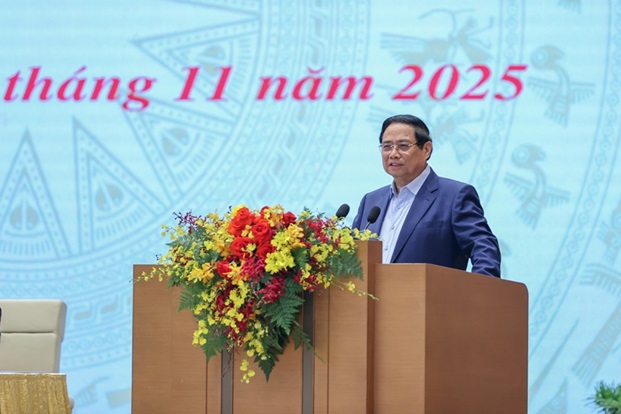
The Prime Minister outlines 6 key tasks for the upcoming period – Photo: VGP/Nhật Bắc
|
Despite these achievements, the Prime Minister highlighted delays in implementing various programs, plans, and projects. Progress in developing and completing national and sectoral databases remains uneven.
Digital infrastructure development lags behind economic growth and potential. Remote areas face challenges in accessing stable internet, and many information systems and databases lack connectivity, data sharing, and integration.
Budget allocation and disbursement, though improved, remain inconsistent across levels and sectors. There is a shortage of high-quality human resources, particularly in AI, big data, and cybersecurity. Policies to attract experts domestically and internationally are insufficient.
Coordination among ministries, sectors, and localities in implementing the Steering Committee’s tasks is limited, with data sharing and system connectivity remaining fragmented in some areas.
The Prime Minister attributed these issues to insufficient political determination, fear of failure, and reluctance to take responsibility for new initiatives. Many policies and mechanisms are outdated and fail to keep pace with technological advancements and practical needs.
Implementation efforts are often disjointed, lacking clear task assignments and coordination. Accountability and discipline are weak, and key performance indicators (KPIs) are not in place to monitor and evaluate task completion.
Social resources and public-private partnerships are underutilized in ST&I, innovation, and digital transformation efforts. Some entities still operate with an administrative mindset rather than a data-driven governance approach.
The Prime Minister urged ministries, sectors, and localities to address these shortcomings with a spirit of honesty, effectiveness, and accountability.
The guiding principles include clear communication, strong political commitment, decisive action, and task completion with defined responsibilities (6 Clears: person, task, timeline, accountability, authority, and product). Citizens must be at the center, participating in and benefiting from the outcomes. ST&I, innovation, and digital transformation are foundational, with effectiveness as the measure. Incompetent officials must be replaced.
The approach emphasizes avoiding perfectionism, seizing opportunities, and ensuring “2 Nos” and “3 Yeses”: benefiting the state, businesses, and citizens while preventing corruption and asset loss.
Key targets for 2025, preparatory for 2026, include completing overdue tasks, especially database development, and achieving 80% digital administrative procedure (AP) completion by 2025.
General directives for the upcoming period: Ministries, sectors, and localities must effectively implement Resolution 57, Plan 02, and directives from Party General Secretary Tô Lâm, along with National Assembly and Government resolutions. ST&I, innovation, and digital transformation should be rapid, sustainable, and secure, shifting from passive to proactive citizen-centric governance.
The Prime Minister outlined 6 key tasks:
First, all ministries, sectors, and localities must complete their databases by 2025, ensuring accuracy, completeness, cleanliness, functionality, uniformity, and interoperability.
Second, improve legal frameworks for a business-friendly environment. Collaborate with the National Assembly on 8 draft laws at the 10th session and promptly issue implementing decrees.
Third, develop shared, modern digital infrastructure, especially at the grassroots level (communes, wards, and special zones), including electricity and telecommunications. Unused infrastructure should be repurposed, and new infrastructure should be invested in transparently to prevent corruption.
Fourth, allocate sufficient human resources for digital transformation, particularly at the grassroots level. Promote the “Digital Lifelong Learning” movement and community digital technology teams to drive nationwide digital transformation.
Fifth, ensure data security, privacy, and safety for all.
Sixth, implement real-time KPIs to monitor ST&I, innovation, and digital transformation progress across ministries, sectors, and localities.
Develop a Government Resolution on Digital Citizens, Digital Society, and Digital Government
The Prime Minister also outlined specific focus areas:
Ministers, heads of sectors, and local leaders must demonstrate accountability and commitment, ensuring 2025 task completion. Written commitments on timelines and responsibilities should be submitted to the Central and Government Steering Committees.
Accelerate policy reviews and improvements, issuing necessary decrees aligned with new laws. Amend legal documents to support digital transformation.

The Prime Minister urges the swift development and issuance of the Digital Transformation and Data Strategies – Photo: VGP/Nhật Bắc
|
The Prime Minister called for the urgent development and issuance of the Digital Transformation and Data Strategies (Ministries of Agriculture, Health, Culture, Sports, Tourism, and the Government Inspectorate to finalize by November 25, 2025). Pilot database quality assessments in 2025 and fully implement from 2026.
To streamline APs, ministries must review and standardize online public service procedures to reduce document requirements and citizen burdens.
The Ministry of Justice will lead the development of a Resolution on data-driven AP simplification based on Conclusion No. 07-TB/CQTTBCĐ.
Conduct comprehensive reviews of online public service provision and database management by December 2025, ensuring compliance with data laws, connectivity mandates, and the National Data Architecture Framework.
Ministries and localities must amend 322 legal documents as approved, remove barriers to non-location-based APs, and achieve 100% online business-related APs and location-independent provincial APs.
For ST&I, innovation, and digital transformation, the Ministry of ST&I will submit a National Program for Strategic Technology Products in 2025, develop monitoring indicators, and propose support for global digital enterprises. Telecom providers must expand 5G coverage, and the Starlink project should be implemented by 2026 (targeting 500,000 subscribers).
The Ministry of Public Security will develop VNeID features for National Assembly and People’s Council elections, accelerate National Data Center No. 1, and propose National Data Center No. 2. A Government Resolution on Digital Citizens, Digital Society, and Digital Government will be completed by December 15.
The Ministry of Home Affairs will coordinate two-tier local government digitization.
The Ministry of Construction will support 6 centrally-governed cities in developing Smart City projects by December 2025 and implement “Smart Border Gates” to enhance trade efficiency and combat smuggling.
The Ministry of Education will create digital lifelong learning records integrated with degree databases, digitizing all degree data by Q1 2026.
The Ministry of Health will develop a national electronic health record and medical record plan by 2025, with clear targets for citizen coverage and data interoperability.
The State Bank and commercial banks will implement a VND 500 trillion credit program for strategic digital infrastructure, ensuring funds are used effectively.
The Ministry of Finance will propose financial mechanisms to prioritize funding for key projects like National Data Centers and strategic technology initiatives.
Ministries and localities must register for funding and promptly execute tasks, particularly database development.
The Prime Minister directed the Ministry of ST&I to prepare for the Steering Committee’s 2025 year-end meeting.
– 15:15 15/11/2025
Secretary General To Lam Meets with Luxshare-ICT Group Leadership (China)

On the afternoon of November 15th, at the Communist Party of Vietnam’s Central Headquarters, General Secretary Tô Lâm received Mr. Wang Laisheng, Vice Chairman of Luxshare-ICT Group, China.
VietinBank Targets 2025 Pre-Tax Profit of VND 32,500 Billion, Poised to Enter Gold Market
At the investor conference held on the afternoon of November 13, 2025, Vietnam Joint Stock Commercial Bank for Industry and Trade (VietinBank, HOSE: CTG) forecasted a stable Net Interest Margin (NIM) with potential improvement by the end of 2026. Additionally, the bank identified emerging business segments, including the National Gold Trading Platform and digital assets, as key strategic focuses.
31 Years of Sowing Trust, Reaping Happiness: MB Bank’s Remarkable Journey

Reflecting on over three decades of growth, Military Commercial Joint Stock Bank (MB) takes pride not only in its economic achievements but also in its unwavering commitment to building a happier nation.
Sacombank Honored as “Best FX Bank in Vietnam” by Euromoney for the Third Consecutive Year

Euromoney’s Awards for Excellence stand as one of the most prestigious global accolades in the financial and banking sectors. For over three decades, these awards have celebrated the achievements of more than 600 leading banks and financial institutions worldwide, recognizing their outstanding business performance, exceptional adaptability, and groundbreaking innovation.
Techcombank’s Journey: A Defining Tale of a Vietnamese Brand Rising to Regional Prominence

Soaring 7 ranks, Techcombank (Vietnam Technological and Commercial Joint Stock Bank) solidifies its position among Vietnam’s Top 5 most valuable brands within the prestigious Brand Finance ASEAN 500, a global leader in brand valuation.