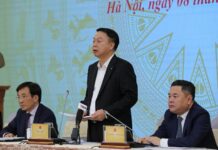
















On November 14th, continuing the 10th session agenda, the National Assembly (NA) heard Minister of Construction Tran Hong Minh, authorized by the Prime Minister, present the Investment Policy Report for the Gia Binh International Airport Construction Project.
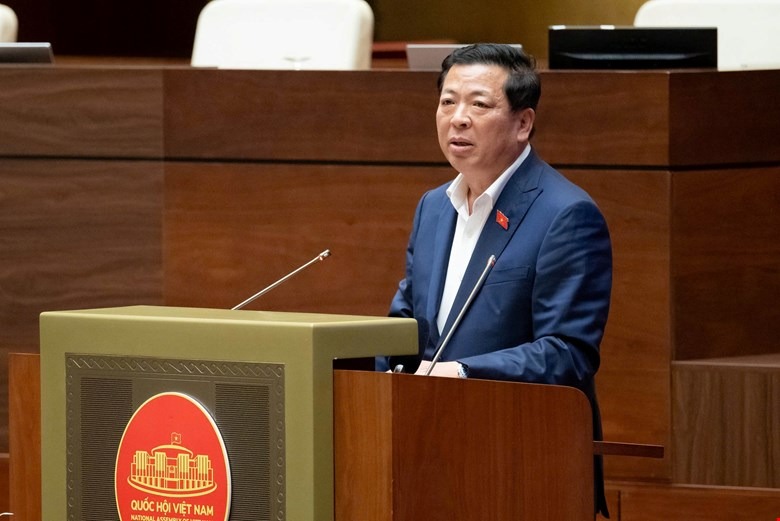
Minister of Construction Tran Hong Minh delivers the report. Photo: Pham Thang
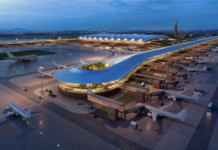
According to the Government’s summary report, Gia Binh International Airport, located in Bac Ninh province, plays a crucial role in fostering a new growth pole east of Hanoi. It addresses the growing air transport demands of the Northern Key Economic Region, alleviates pressure on the overburdened Noi Bai Airport, and supports its expansion limitations.
The development of Gia Binh International Airport represents a strategic, breakthrough initiative, contributing to the restructuring of the Capital Region’s aviation network into a successful “dual-hub” model adopted by major global cities.
Gia Binh International Airport will serve as a strategic complement to Noi Bai International Airport, leveraging spatial advantages, connectivity, and infrastructure. It will drive growth in industries like logistics, e-commerce, tourism, and services, while also strengthening national defense, security, and hosting major events like the 2027 APEC Summit.
Gia Binh International Airport to Achieve 5-Star International Standards, Serving 30 Million Passengers Annually
Gia Binh Airport will be constructed to international standards, becoming a smart, green, sustainable, and world-class next-generation airport. It will meet socio-economic development needs, support dual-use operations, ensure national security and defense, and accommodate major events like the 2027 APEC Summit. The airport aims for a 5-star international airport service rating from Skytrax, ranking among the top 10 globally, and an Airport Service Quality (ASQ) award from the Airports Council International (ACI). It aspires to be the Northern Gateway, a regional passenger and cargo hub, and a maintenance, repair, and overhaul (MRO) center for the Asia-Pacific region.
The project will adhere to ICAO 4F standards, handling 30 million passengers and 1.6 million tons of cargo annually by 2030, and 50 million passengers with 2.5 million tons of cargo by 2050.
The Government’s report outlines plans for two parallel runway pairs, each with two runways spaced 1,800 meters apart for independent operations, optimizing air traffic management. Runway lengths will range from 3,500 to 4,000 meters, accommodating all modern wide-body aircraft. Four parallel taxiways, connecting taxiways, and rapid exit taxiways will also be constructed.
By 2030, an apron with 83 parking stands will be built near the VIP terminal, passenger terminal, cargo terminal, and maintenance hangar. By 2050, the apron will expand to 123 stands.
The passenger terminal, designed to Skytrax’s 5-star standards, will optimize functionality and space, efficiently serving high passenger volumes. Phase one (by 2030) will cover 350,000 m², expanding to 460,000 m² by 2050. The VIP terminal will be a separate 5,900 m² facility.
The cargo terminal will span 11 hectares by 2030 and expand to 26 hectares by 2050. Gia Binh Airport will integrate seamlessly with national, regional, and provincial transport networks, directly connecting to Hanoi via highways, urban rail, and national railways.
The project requires approximately 1,884.93 hectares of land, affecting around 7,100 households and 118 organizations. Twenty-five historical sites within the project area will need relocation.
Total investment is estimated at VND 196,378 billion, with VND 141,236 billion for phase one (2025-2030) and VND 55,142 billion for phase two (2031-2050). Funding will come from investor equity and legal capital mobilization.
Phase one (2025-2030) includes constructing essential facilities for the 2027 APEC Summit by 2027, and completing remaining phase one works by 2030 to handle 30 million passengers and 1.6 million tons of cargo annually. Phase two (2031-2050) will expand capacity to 50 million passengers and 2.5 million tons of cargo annually.
To meet these requirements, the Government requests the National Assembly’s approval of the Gia Binh International Airport investment policy and special support mechanisms. The Government will oversee the investor’s timely, high-quality, and compliant project implementation.