















How is the Gold Exchange Platform Implemented?
According to the Foreign Exchange Management Department of the State Bank of Vietnam, the pilot implementation roadmap for the gold trading platform in Vietnam is expected to go through three phases. The initial phase focuses on physical gold products and operates solely within the domestic market, without connecting to global models.
Participants in the first phase include banks and enterprises with approved import quotas. Subsequent phases will introduce gold bars and, eventually, derivative products.
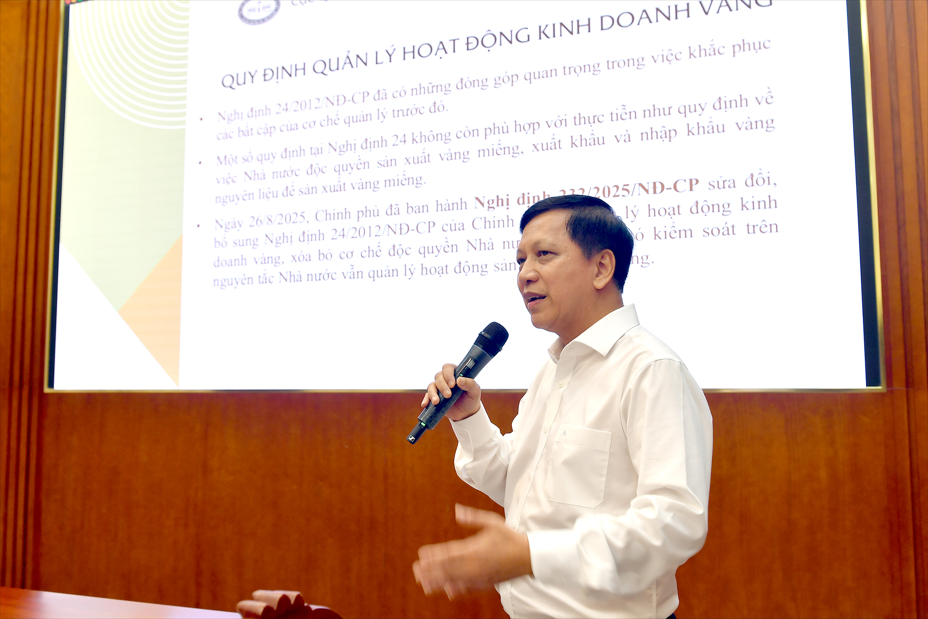
Mr. Đào Xuân Tuấn, Director of the Foreign Exchange Management Department, State Bank of Vietnam, at a gold exchange seminar held in October.
Discussing global gold exchange models, Mr. Nguyễn Xuân Thành, Senior Lecturer at the Fulbright School of Public Policy and Management, noted that the UK and Switzerland focus on developing wholesale physical gold markets. London, in particular, leverages its connection to gold mining markets, supplying physical gold to the US, primarily through OTC transactions.
In Asia, Mr. Thành highlighted Japan’s Tokyo Commodity Exchange, which connects with China, and Singapore’s SBMA, a non-profit organization facilitating physical gold trading in bars and coins.
However, Mr. Thành believes that the development experiences of these advanced economies are not suitable for Vietnam.
“To establish a gold exchange, it’s essential to determine the level of capital and gold-related liberalization. Countries can organize physical gold and derivative exchanges only when two conditions are met: a highly convertible and liquid currency, and less stringent licensing requirements,” Mr. Thành explained.
He cited Singapore as an example, where gold exchanges do not require licenses. Instead, entities establishing gold exchanges must be active in gold trading and comply with anti-money laundering regulations. Additionally, gold exchanges do not need approval from the Ministry of Finance. Consequently, in markets with restricted currency convertibility and licensing quotas, gold trading primarily occurs via OTC.
Mr. Thành suggested that the Shanghai Gold Exchange (SGE) is the most suitable model for Vietnam. Established in 1999, the SGE has two primary missions: ensuring all imported gold is traded uniformly according to international standards and mobilizing gold held by the public.
According to Mr. Thành, the goal of mobilizing public gold is similar to Turkey’s objective when it established its exchange, with an estimated 3,500 tons of gold held by citizens.
“In my assessment, China faced challenges in developing its market due to the absence of derivative product trading on the exchange. My proposal is that a physical gold exchange is the first appropriate step for Vietnam’s current conditions,” Mr. Thành stated.
The Gold Exchange is Not a “Magic Wand”
Assoc. Prof. Dr. Ngô Trí Long, an economic expert, analyzed that prolonged gold price surges, significant discrepancies with international markets, and persistent gold-holding sentiments among the public are not merely short-term supply-demand issues.

Assoc. Prof. Dr. Ngô Trí Long, Economic Expert.
Mr. Long emphasized that when information is distorted, expectations can be exaggerated, and international fluctuations are immediately amplified domestically, impacting exchange rate management, interest rates, and macroeconomic stability. Establishing a gold exchange is not about “opening another marketplace” but building a market infrastructure where benchmark prices are formed transparently, transactions are cleared safely, data is recorded in real-time, and regulators have evidence-based monitoring and intervention tools. This transforms gold from an “unmeasurable variable” into a manageable one, supporting macroeconomic stability.
Mr. Long recalled Vietnam’s experience with spontaneous gold exchanges between 2006 and 2009. The lack of a robust legal framework, widespread leverage, fragmented product standards, and weak oversight created systemic risks. The government’s 2010 decision to halt these activities was necessary to safeguard financial stability, paving the way for Decree 24/2012, which centralized gold trading management. The “stabilize first, market later” approach closed risky channels, restored market order, and allowed time to upgrade legal, technological, and payment infrastructures.
“Today, the foundational conditions have changed. Real-time payment systems, widespread digital identification, mature digital infrastructure, and advanced data analytics capabilities have emerged. Risk management and cybersecurity are also highly standardized. This presents an ‘opportunity window’ to revisit the gold exchange concept with a modern infrastructure design mindset, rather than repeating past leveraged exchange models,” Mr. Long said.
According to Mr. Long, a gold exchange is a stabilization tool, not a source of volatility. It is not a “magic wand” that solves all problems overnight. However, if implemented correctly through a three-phase roadmap with disciplined data management, real-time monitoring, and transparent communication, the gold exchange will act as a shock absorber for the economy. It will narrow price gaps, shift hoarding behavior to controlled trading, and provide regulators with a digital dashboard for a historically opaque market.
Balancing Cash Flow and Growth Targets: Achieving Over 10% Expansion

Balancing cash flow to meet the projected 10% growth demand by 2026 will pose a significant challenge for policymakers.
Vietnam’s National Assembly Targets Over 10% GDP Growth in 2026, Aims for Per Capita GDP of $5,400–$5,500

This morning, during the 10th Session of the 15th National Assembly, the National Assembly voted to adopt the Resolution on the Socio-Economic Development Plan for 2026. With 429 out of 433 participating delegates (90.51%) voting in favor, the National Assembly officially approved the Resolution on the Socio-Economic Development Plan for 2026.
Vietnam: Asia’s Rising Star

Over the past five years, Vietnam’s economy has demonstrated remarkable resilience in the face of global shocks, consistently maintaining one of the highest growth rates in the world.
Vietnam’s National Assembly Sets Ambitious 10%+ Economic Growth Target for 2026
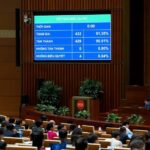
On November 13th, with an overwhelming majority of 429 out of 433 votes in favor, the National Assembly adopted a resolution outlining the socio-economic development plan for 2026. This ambitious plan sets a target growth rate of 10% or higher, marking a significant stride towards economic advancement.
Prime Minister: Ensuring Citizens Don’t Face Delays or Extra Costs When Accessing Social Housing

Prime Minister emphasizes three critical objectives in the development of social housing.