












Master Planning of Two Metro Lines in Northeastern Ho Chi Minh City
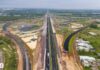
According to the comprehensive master plan for Ho Chi Minh City’s railway network, the former Binh Duong area will have two metro lines prioritized for investment before 2035: Line 1 (New Binh Duong City – Suoi Tien) and Line 2 (Thu Dau Mot City – Ho Chi Minh City).
Specifically, Metro Line 1 (New Binh Duong City – Suoi Tien) spans a total length of 32.43 km, including a 29.01 km main elevated line and a 3.42 km depot connection. The project starts at the New City Center in Phu Hoa Ward, Thu Dau Mot City, former Binh Duong, and ends at Suoi Tien Bus Station (connected to HCMC’s Metro Line 1) in Binh Thang Ward, Di An City, former Binh Duong. It features 19 elevated stations and one depot in Phu Chanh Ward, Tan Uyen City (former).
The total investment is estimated at VND 46,725 billion (approximately USD 1.77 billion). On August 16, the HCMC People’s Committee designated the Urban Railway Management Board as the investor to prepare for this metro line’s development.
Metro Line 2 (Thu Dau Mot – Ho Chi Minh City) stretches 21.87 km, entirely elevated, starting from Station S5 on Metro Line 1 in Phu My Ward (former Thu Dau Mot City), passing through Binh Hoa Ward, and ending in Vinh Phu Ward (former Thuan An City), connecting with HCMC’s Metro Line 3 at Hiep Binh Phuoc (former). This line includes 13 elevated stations and shares a depot with HCMC’s Metro Line 3.
Future plans include extending the line to Binh Duong Ward, linking with Metro Line 1, and further connecting to Chon Thanh (Dong Nai) and Hoa Lu Border Gate. Running parallel to National Highway 13 and the HCMC – Chon Thanh – Hoa Lu Expressway (CT30), this metro line will form a seamless regional transportation axis. The total investment is projected at VND 59,968 billion (approximately USD 2.27 billion).
| Criteria | Metro Line 1 (New Binh Duong City – Suoi Tien) | Metro Line 2 (Thu Dau Mot – HCMC) |
|---|---|---|
| Length | 32.43 km (29.01 km main line; 3.42 km depot connection) | 21.87 km |
| Route | New Binh Duong City to Suoi Tien Bus Station | From Station S5 on Metro Line 1 to Vinh Phu Ward, connecting to HCMC’s Metro Line 3 |
| Line Type | Entirely elevated | Entirely elevated |
| Number of Stations | 19 elevated stations | 13 elevated stations |
| Depot | 1 depot in Phu Chanh Ward | Shared depot with HCMC’s Metro Line 3 |
| Total Investment | VND 46,725 billion (≈ USD 1.77 billion) | VND 59,968 billion (≈ USD 2.27 billion) |
In addition to these two prioritized metro lines, the northeastern region of HCMC is witnessing several infrastructure projects. Notably, the expansion of National Highway 13 to 60 meters with 10 lanes from Binh Trieu Bridge to the former Binh Duong boundary will commence in Q4/2026 and complete by 2028. With a total investment of nearly VND 21,000 billion, this project directly connects to Hang Xanh and central HCMC.
HCMC has also proposed expanding the Xo Viet Nghe Tinh and Dinh Bo Linh routes (VND 10,000 billion) to ensure seamless integration with National Highway 13. Another key project is the Ring Road 3, with an investment of VND 75,378 billion, expected to partially open this year and fully complete by June 2026, connecting HCMC’s inner city with surrounding areas.
Real Estate Market Benefits from Infrastructure Development
Even before the investment in Metro Lines 1 and 2 in former Binh Duong, several real estate projects have emerged around these routes. For instance, S P Setia’s Setia Edenia project is set to launch later this year. Located in central Lai Thieu, adjacent to Metro Line 1 at Cau Ong Bo intersection, it offers quick access to Pham Van Dong – Thu Duc City (former). The project is near Lotte Mart, Becamex International Hospital, international schools, Aeon Mall, Song Be Golf Course, and major industrial zones.
In the northeastern area along National Highway 13, Phat Dat’s La Pura project is also introducing a new sub-zone to the market this year. Other projects like The Emerald Garden View, Lavita Thuan An, Green Tower, Midori Park The Ten, The Habita, and The Gio are also located near Metro Lines 1 and 2.
With the early investment in these northeastern metro lines, a “front-running” mindset is emerging. Investors are flocking to the area in search of opportunities.
Ms. Tuyet Nga, a property agent in the area, notes that investors have valid reasons for front-running metro developments. Metro infrastructure typically creates three layers of impact on property prices. First, expectations arise during the approval phase. Second, products are restructured as projects shift to compact urban models, optimizing walkable distances and enhancing ground-level amenities. Finally, pricing is determined by operational efficiency, where “distance in minutes” outweighs “distance in kilometers,” ensuring properties near stations maintain higher prices than other areas.
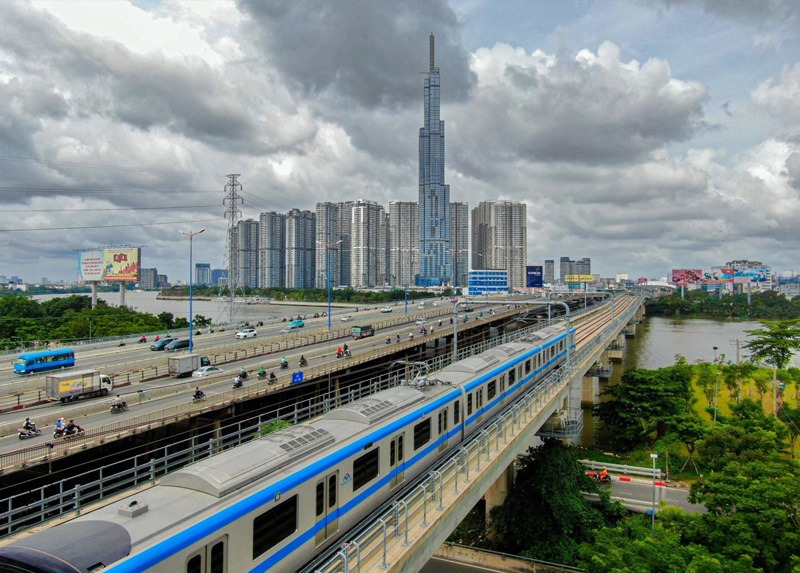
Historically, properties near metro lines have benefited from price increases.
Historically, real estate price surges are directly linked to infrastructure, particularly metro developments.
A 2025 Knight Frank study in Riyadh (Saudi Arabia) found that property prices within a 15-minute walk of metro stations increased by 78%, compared to just 22% in more distant areas. In Singapore, prices within 400 meters of the Circle Line rose approximately 15% after its 2012 launch, while Bangkok saw increases of 7-21%, depending on proximity to stations.
In Vietnam, the “metro effect” is evident in urban property values. Savills reports that in Hanoi, apartment prices within 500 meters of the Cau Giay – Nhon metro line increased by over 40% in one year. In HCMC, projects along Metro Line 1 saw price increases of 35-70%. Specifically, Masteri Thao Dien’s prices rose from VND 35-39 million/m² (2015) to VND 69-75 million/m² by Q2/2024.
In 2020, before Metro Line 1 (Ben Thanh – Suoi Tien) along Hanoi Highway began operations, property prices ranged from VND 45-80 million/m². By early 2025 (post-metro operation), prices along Hanoi Highway surged to VND 90-130 million/m², nearly doubling pre-metro levels and increasing almost fivefold since 2010. Nearly a year after the metro’s launch, prices around Hanoi Highway continue to rise, especially in former Thao Dien and An Phu wards.
Thus, from project commencement to completion (3-5 years), property price increases around key infrastructure range from 50-60%. This “formula” for price growth along major infrastructure axes has been consistently demonstrated in the real estate market.
Airports, Seaports Boom Propel Top 4 GRDP Province into “Golden” Cycle, Unveiling 2 Most Investable Hotspots

Nestled within the economic powerhouse of Southeast Vietnam’s “Golden Triangle,” this province boasts an impressive GRDP of 609 trillion VND.
Proposed Capital Increase for Bến Thành – Tham Lương Metro Line to VND 52 Trillion

The proposed investment for the 11-kilometer railway line has been revised upward from 47.890 trillion VND to 52.047 trillion VND. This adjustment accounts for expanded construction scope, technology upgrades, and inflationary impacts.
Free Health Insurance for Students and Seniors Over 65 in Ho Chi Minh City

At its 5th session on November 14th, the Ho Chi Minh City People’s Council passed a resolution outlining financial support for health insurance premiums for both seniors and students residing in the city. This initiative allocates nearly 2 trillion VND to provide free health insurance coverage for over 2 million students and more than 530,000 individuals aged 65 and above.
Ho Chi Minh City Aims to Complete 232 km Metro Network by 2030
Ho Chi Minh City aims to complete 232 kilometers of Metro by 2030. The entire political system is focused on accelerating progress, mobilizing additional resources, and expanding land funds through the Transit-Oriented Development (TOD) model.
Ho Chi Minh City Expands Special Incentive Policy, Offering 1 Billion VND in Rewards

The Ho Chi Minh City People’s Council has unanimously approved a special incentive policy to attract top experts, scientists, and talented individuals across the city following its consolidation.