


















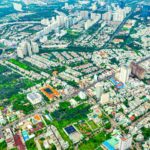
Proposed riverside square in Thu Thiem with sunken terraces serving as temporary water reservoirs. Photo: LE VU |
Mini Solution
Four consecutive storms in September 2025 caused severe consequences for many localities, including urban flooding. Despite not being directly affected by the storms, heavy rainfall exacerbated Ho Chi Minh City’s persistent flooding issues.
Recently, the Thu Duc Infrastructure Development Center proposed an underground reservoir measuring 70 x 50 x 5.2 meters beneath the Linh Tay Sports Complex football field at 16 Tran Van Dua Street. Constructed from Cross-wave modular hollow plastic panels, it can hold water equivalent to 650 large tanker trucks. The project includes a settling tank, pumping station, and drainage systems. After construction, the football field will be restored for continued use.
Dr. Vu Thi Hong Nhung from RMIT University suggested shifting from “flood prevention” to “living with water.” She proposed implementing small and medium-sized water retention parks in flood-prone areas like Thu Thiem, Thu Duc, and along the Nhieu Loc-Thi Nghe Canal.
|
Dr. Vo Kim Cuong, former Deputy Chief Architect of Ho Chi Minh City: Flood control solutions must be tailored to each area’s drainage design. If the drainage system is inadequate, water storage solutions should be explored. |
In Thu Thiem, a riverside square with sunken terraces capable of holding 5,000-10,000 cubic meters of water is proposed. During dry periods, it serves as a recreational space; during heavy rain, it becomes a temporary reservoir. One-way valves will prevent tidal surges, ensuring surrounding safety.
In Thu Duc, school sports fields or parks can be redesigned with a 0.5-meter depression, similar to Copenhagen’s “Cloudburst” model, to temporarily retain water.
Parking lots can feature a dual-mode design: a central depression for water storage, equipped with sensors and pumps for rapid drainage within 30-90 minutes. This solution, tested in Rotterdam, is feasible with water level sensors and electronic warning signs for drivers.
Along canals like Nhieu Loc-Thi Nghe, “rain gardens” with bio-swales and flood-tolerant plants can retain water locally, reducing pressure on existing drainage systems, similar to China’s “Sponge City” concept.
Dr. Vo Kim Cuong emphasized that flood control solutions must align with each area’s drainage design. If drainage is insufficient, water storage solutions are necessary. Small retention ponds are particularly useful during heavy rainfall, though their effectiveness is limited by their need to maintain water for aesthetics.
Underground reservoirs, while optimal, face challenges in cost and technical complexity. Their load-bearing structures must be robust to utilize surface space, and construction costs exceed those of conventional or natural pond modifications.
In the Larger Context
As an early advocate for “living with water” in Ho Chi Minh City, Dr. Vo Kim Cuong stressed that this approach must be integrated into the comprehensive planning of the expanded metropolis.
Flooding in Ho Chi Minh City stems from: intensified tidal surges due to climate change and rising sea levels; reduced groundwater absorption from urbanization; loss of natural water retention areas; and outdated, delayed drainage projects.
Flood control must adhere to key principles. First, urbanization reduces land permeability and natural drainage, so new urban areas must compensate by creating additional water spaces. Second, Ho Chi Minh City needs a new flood control plan within its post-merger master plan, considering both flood-prone and non-flood-prone areas, as well as natural reserves like Can Gio Forest. Collaboration with Dong Nai and Long An is essential for integrated planning along the Saigon, Dong Nai, and Xoai Rap rivers.
The reestablishment of the Department of Planning and Architecture is advantageous for flood control efforts. As the “designer” of the metropolis, the department must ensure infrastructure meets residents’ needs, basing plans on current conditions and future socioeconomic projections. Integrating flood control into this “larger equation” will ensure effectiveness and direction.
Khanh Nguyen
– 07:00 18/11/2025
International Financial Center Poised to Spark New Surge in Ho Chi Minh City’s Central Real Estate Value
According to Prof. Dr. Trần Đình Thiên, former Director of the Vietnam Institute of Economics, the development of an International Financial Center (IFC) in Ho Chi Minh City is not merely an economic project but must be regarded as the city’s new “nucleus of accumulated energy.”
Unlocking Progress: Anticipating Resolution 98 Amendments to Address Five Major Bottlenecks

The policies outlined in the revised Draft Resolution 98, once approved, will not only eliminate barriers and unlock resources but also catalyze institutional and socio-economic momentum, empowering Ho Chi Minh City to forge its unique path forward.
TT AVIO: The Ultimate All-in-One Lifestyle Hub in Eastern Ho Chi Minh City

When a home transcends being merely a place to return to, becoming instead a sanctuary for health, a haven for the soul, and a space that seamlessly integrates work, rest, experiences, and connections within its own grounds, its value far exceeds that of an ordinary apartment.
Good News for Residents of Old and Grade D Apartments in Ho Chi Minh City
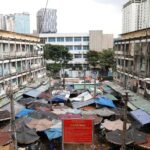
Unveiling the architectural and planning benchmarks for 19 aging apartment complexes in Ho Chi Minh City has been a highly anticipated development for both residents and businesses alike.
Ho Chi Minh City’s Hottest Residential Hub: Spotlight on Vinhomes, Masterise, and Gamuda’s Prime Projects
The eastern regions of Thu Duc, former Districts 2 and 9, along with the former District 7 and Nha Be, have emerged as the hottest spots in the apartment market.