











These days, Tan Dinh Market (Tan Dinh Ward, Ho Chi Minh City) is bustling with visitors, especially tourists. However, instead of rejoicing, many vendors are anxious as they struggle to transition from lump-sum tax to electronic invoicing by January 1, 2026.
Navigating the Electronic Invoicing Maze
Ms. Nguyen Thi Thoa, a dry food vendor, shared that she started issuing electronic invoices in June but still feels very uncertain. Each time she issues an invoice to a walk-in customer, she must open the app on her phone and cross-reference her handwritten notes. “To issue one electronic invoice, I have to follow 21 steps, taking over 2 minutes.
I hope the regulations can be simplified to suit the current skill level of vendors. Previously, paying lump-sum tax was straightforward. For incoming goods, I just kept the receipts, added fees and taxes, then sold them, with most customers not requesting invoices. I’m extremely worried because many aspects are beyond my understanding. My biggest fear is making a mistake and violating the law,” Ms. Thoa expressed.
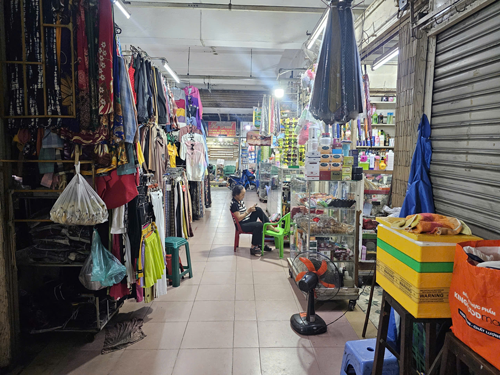
Many vendors and businesses are struggling with the new tax regulations set to take effect. Photo: LE TINH
Sharing similar concerns, Mr. Tran Binh Nguyen, owner of a children’s clothing stall, mentioned that his family has been operating in the market for 30 years and is accustomed to the lump-sum tax system. Now, switching to self-declaration means higher taxes and more paperwork, making it very challenging for his family and other vendors. He suggested that tax authorities provide detailed guidance on inventory and allow adjacent businesses to file jointly. “My family has three adjacent stalls but must file separately, which is very inconvenient,” he said.
Additionally, traditional market business models differ significantly from online channels but must compete directly on price. Therefore, he proposed that the government reduce the tax rate from the current 1.5% of revenue to 0.8% to ease the burden on vendors. Apart from taxes, businesses also bear costs such as stall fees, employee wages, utilities, waste management, and app fees.
Ms. Doan Thi My Chi, owner of a fabric stall, is also struggling with tax reporting and hopes for further guidance. She also wishes to pay taxes based on profit rather than a percentage of revenue but is hesitant to register as a business due to limited space in the market and the inability to hire an accountant.
Regarding the 1.5% tax rate, Ms. Chi believes it is only suitable for low-value items, not high-value goods. For example, silk fabric for ao dai, typically purchased at VND 150,000 per meter and sold at VND 160,000 per meter, excludes costs like rent, staff, fees, and inventory. A 1.5% tax on revenue is excessive and could lead to losses. Increasing prices to offset taxes is not feasible due to competition from other sellers, especially online.
Finding the Right Approach
In reality, transactions in traditional markets, eateries, and convenience stores often rely on familiarity and verbal agreements, with most incoming goods lacking proper invoices. The few available receipts are usually handwritten notes from wholesale markets or regular suppliers, which do not meet current tax management requirements and could expose businesses to legal risks.
Ms. Nguyen Thi Kieu, owner of a mi Quang stall in Ho Chi Minh City, shared that 95% of her ingredients are purchased from wholesale markets or small vendors without invoices. Essential items like noodles, meat, vegetables, and spices rarely come with invoices; if they do, an additional 8% tax is added.
“During operations, urgent purchases of items like vegetables, rice paper, or noodles often arise, and almost no one provides invoices. Clearer guidance is needed to ensure compliance. Adjusting prices based on new input costs might affect competitiveness. So, what’s the right approach?” Ms. Kieu wondered.
Sharing similar concerns, Ms. Nguyen Hong Thai, a clothing vendor at a traditional market in Ho Chi Minh City, mentioned that wholesale suppliers rarely provide invoices, only for very large orders. For inventory purchased months ago, paper invoices are often lost or only handwritten notes remain, making it difficult to prove origin.
“To issue an outgoing invoice, an incoming invoice is required. But for old inventory, what can be used for verification? Suppliers won’t reissue them. In such cases, I don’t know how to handle it,” she questioned.
Beyond the lack of documentation, many older business owners face significant challenges with electronic invoicing apps. They worry about input errors affecting revenue or how to handle returns. The complexity of digital tools makes the transition to electronic invoicing feel “beyond their capabilities.”
Given these challenges, many vendors suggest maintaining the lump-sum tax system for small businesses and older individuals, reducing paperwork and stabilizing operations. Errors can still be addressed according to regulations without placing excessive pressure on business owners. “The new tax system might be reasonable for small businesses with annual revenues of VND 300–400 million. However, flexible implementation and clear guidance are essential for smooth adaptation,” suggested Mr. Nguyen Thanh Cong, a fashion business owner.
Mr. Do Duy Thanh, an expert in the food and beverage (F&B) industry, noted that the lump-sum tax system has been in place for 40 years. Transitioning to self-declaration and actual revenue-based taxation is a significant change, not just a policy shift. Therefore, providing businesses with time to adapt and the necessary tools for compliance is crucial.
Mr. Thanh proposed extending the support period for businesses by 3–6 months to facilitate adaptation. During this time, errors should be corrected through guidance rather than penalties.
Additionally, applying a family circumstance deduction for business owners is essential. “Currently, salaried employees enjoy this benefit, but business owners, who directly labor and bear risks, do not. This creates a sense of imbalance and reduces compliance motivation,” he said.
(To be continued)
Prime Minister Directs Support for Businesses
The Government Office has issued Document No. 11154 conveying Prime Minister Pham Minh Chinh’s directive to address challenges faced by businesses. Specifically, the Prime Minister tasked the Ministry of Finance with collaborating across sectors to urgently research and advise on comprehensive tax policy improvements for individuals and businesses.
The government leader also instructed the Ministry of Finance to implement synchronized measures supporting businesses in transitioning to corporate models, ensuring effectiveness and avoiding superficial or trend-driven approaches. Ministries, sectors, and localities are required to coordinate with the Ministry of Finance in policy development and promptly report emerging challenges for resolution or submission to competent authorities.
M.Chien
Exploiting the Transition for Fraud
Exploiting the struggles of vendors and businesses transitioning to self-declared tax filing, scammers posing as tax officials have emerged to defraud victims.
A vegetable vendor at Thu Duc Market (Ho Chi Minh City) reported losing over VND 150 million after receiving a call from a scammer impersonating a tax official, claiming she needed to complete tax procedures to avoid legal violations. The scammer requested a Zalo friendship, guided her through online procedures, and stole a large sum from her account.
A similar incident occurred at Nguyen Tri Phuong Market (Dien Hong Ward, Ho Chi Minh City). Ms. Dam Van, Deputy Head of the Market Management Board, shared that scammers posing as tax officials visited vendors, demanding tax procedure compliance. “Fortunately, vendors alerted the management board, preventing losses,” Ms. Van said.
Small businesses are also targets. Mr. Nguyen Hoang Huy, a household goods seller in Ho Chi Minh City, recounted a recent encounter with a scammer claiming to be a tax official, urging him to settle taxes for 2025 in preparation for the 2026 transition. The scammer threatened penalties or criminal charges for non-compliance and requested a Zalo friendship for online guidance. Suspicious, Mr. Huy contacted his assigned tax officer and confirmed it was a scam.
More alarmingly, some businesses received counterfeit tax notices with authentic-looking details. Upon verification, tax authorities confirmed the documents were fake. These incidents have left many vendors anxious and hesitant to engage with new tax regulations and information.
Ho Chi Minh City Downtown Condo Prices Surge 200% in a Decade

Real estate experts reveal that apartment prices in Ho Chi-H Minh City’s central districts have surged by nearly 200% over the past decade, with some projects now commanding prices as high as 450 million VND per square meter.
Ho Chi Minh City Aims to Raise Over VND 100 Trillion from Auctioning 85 Land Plots

Between 2026 and 2030, Ho Chi Minh City plans to auction 85 land plots covering approximately 435 hectares, aiming to generate over 100 trillion VND for the city’s budget.
How Solaria Rise Captivates Both Modern Homeowners and Savvy Investors

Despite their diverse ages, backgrounds, and life experiences, the stories of Ms. Phan Thị Thùy Dung, Mr. Nguyễn Lê Hoàng Việt, Mr. Lâm Thuận Phong, and Ms. Lý Hoàng Thủy share a common thread: they all chose Solaria Rise as the destination to bring their vision of a peaceful and fulfilling home to life.
Ho Chi Minh City Real Estate Boom: Flood of Listings, But Crowded Market Doesn’t Guarantee Sales

As the year draws to a close, the real estate market enters its peak season, unsurprisingly flooding the scene with a wave of new projects. Yet, in an era where savvy buyers reign supreme, a bustling marketplace no longer guarantees sales success.
Revitalizing Ho Chi Minh City: 19 Aging Apartments Slated for Redevelopment, Investors Sought

The following residential buildings, which have been deemed unsafe following inspections, are slated for relocation: 47 Long Hưng, 40/1 Tân Phước, 170-171 Tân Châu Street, 155-157 Bùi Viện Street, 11 Võ Văn Tần Street, Trúc Giang, Vĩnh Hội, Tôn Thất Thuyết, and Hoàng Diệu. However, the demolition process for these properties remains incomplete.