In the context of major urban centers, particularly Ho Chi Minh City (HCMC), undergoing significant transformations with strategic initiatives in planning and infrastructure development, the Transit-Oriented Development (TOD) model has emerged as a crucial approach. TOD aims to create modern, sustainable living spaces while efficiently utilizing urban land resources. At the seminar titled “The Journey to Realizing TOD Cities in Vietnam: Opportunities and Challenges” held on the morning of November 19, 2025, experts emphasized that TOD is not just a planning trend but also a catalyst for restructuring the real estate market. It demands synchronized legal frameworks, integrated planning, and effective capital mobilization mechanisms.
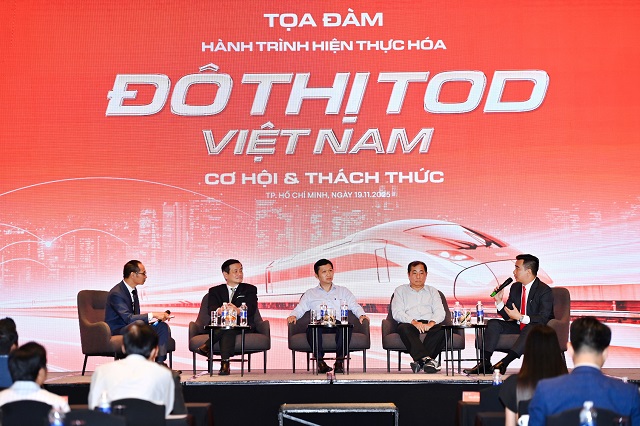
Experts discuss at the seminar “The Journey to Realizing TOD Cities in Vietnam: Opportunities and Challenges” on November 19, 2025.
|
TOD: An Inevitable Trend in the New Era
Speaking at the seminar, Dr. Nguyễn Văn Đính, Vice Chairman of the Vietnam Real Estate Association (VNREA), highlighted that 2025 is a pivotal year for the real estate market. Numerous new laws are taking effect, establishing a more transparent and modern legal framework. Coupled with significant resolutions and administrative reorganizations, Vietnam is poised to create megacities and new urban governance models. VNREA identifies TOD as an inevitable trend, requiring synchronized planning, transparent mechanisms, and close collaboration among the government, experts, and businesses to drive infrastructure and urban development aligned with real needs.
Echoing this view, Mr. Phạm Lâm, Chairman of the Board and CEO of DKRA Group, noted that administrative boundary adjustments are ushering in a new development phase. However, they also pose challenges regarding housing accessibility as property prices rise. Post-merger planning and transportation infrastructure will play a critical role in expanding development spaces. Future urban trends must shift decisively toward public transportation, enabling residents to access housing and workplaces within broader areas, ranging from 50 to 200 km, without relying on private vehicles. This model not only reduces traffic congestion and pollution but also fosters a new lifestyle for residents.
TOD’s Impact on Real Estate Market Restructuring
Mr. Võ Huỳnh Tuấn Kiệt, Director of Residential Project Marketing at CBRE Vietnam, observed that the Southern real estate market is entering a phase of robust restructuring, particularly as HCMC evolves into a megacity post-merger, with TOD serving as the primary development orientation.
According to CBRE’s Q3 2025 report, there is a clear polarization. While the old HCMC central area faces a scarcity of new supply, the new HCMC landscape appears brighter with significant additions from merged regions like Bình Dương and Bà Rịa – Vũng Tàu. Mid-range projects priced below 60 million VND/m² along major transportation axes account for 75% of the new supply in the Southern region. The expanded boundaries position HCMC as a megacity with over 20 million inhabitants and vast development spaces. Regional connectivity infrastructure, including Ring Roads 3 and 4, highways, and metro lines, serves as the backbone for housing, commercial, and logistics growth. HCMC’s primary prices remain lower than Hanoi’s, offering mid-term growth potential, while demand for expert housing continues to expand.
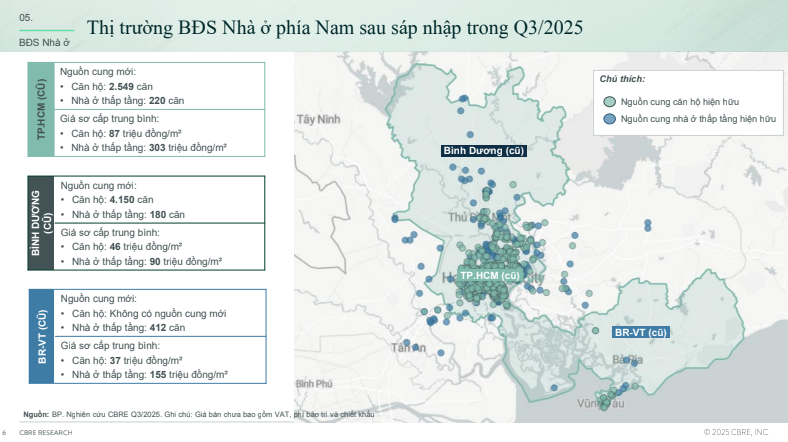
Experts predict that in the coming years, the market will shift significantly toward suburban megacities, where infrastructure is well-developed and suitable for compact urban development under the TOD model. Developers will focus on large-scale townships, green-smart designs, and multifunctional complex models. Buyers are becoming more rational, prioritizing transparent legal frameworks, reputable brands, and comprehensive amenity ecosystems.
The TOD model is seen as a turning point, transitioning cities from “sprawling and motorcycle-dependent” to “compact and metro-connected,” forming satellite centers and increasing property values around stations due to high pedestrian traffic and higher planning indicators. For TOD to operate effectively, CBRE representatives stressed the need for a transparent legal framework at the 1/500 scale, an authoritative TOD Steering Committee, and stable land clearance funding.
Legal Frameworks and Integrated Planning: The Key to TOD Success
Dr. Architect Ngô Viết Nam Sơn emphasized that the TOD model can only be effective when implemented on a foundation of clear legal frameworks and integrated planning from the outset. He noted that land on both sides of metro lines requires transparent legal mechanisms to support compensation, land clearance, and urban redevelopment.
Dr. Sơn observed that HCMC and Hanoi have long planned in a single-sector manner—building metros first and considering urban development later. As HCMC aims to expand its urban rail network to over 1,000 km, multi-sector integration and public-private partnerships (PPPs) are becoming urgent. TOD not only optimizes land use and reduces reliance on private vehicles but also creates a pedestrian-friendly, convenient living ecosystem.
Legally, Dr. Sơn identified this as the “biggest bottleneck” since TOD influences areas within 800-1,200 meters of metro stations. Without mechanisms for compensation and land value sharing, cities struggle with land handover, hindering TOD formation. He proposed that subsequent metro lines be planned with a TOD mindset from the beginning. Additionally, he suggested extending the metro line from Bến Thành to Cần Giờ to create a “coastal TOD urban strip” and planning Ring Road 4—connected to the Cái Mép – Thị Vải port cluster—as a closed TOD-logistics axis, driving urban-industrial-port development across the Southeast region.
Opportunities and Challenges in Implementing TOD in HCMC
During the panel discussion “TOD Cities – From Planning to Market,” experts affirmed that TOD implementation in HCMC is timely. Mr. Nguyễn Tất Thắng, Deputy Head of Technical Infrastructure Planning at the HCMC Department of Planning and Architecture, acknowledged that challenges in implementing Metro Line 1 were necessary for refining the legal framework for urban rail systems. He noted that Resolution 38/2025/NQ-HĐND, adopted by the HCMC People’s Council, has established a critical legal foundation for urban rail and TOD development.
According to the Department, HCMC is reviewing and leveraging land around metro lines. Metro Line 1 includes over 160 hectares in Thủ Đức City suitable for TOD development. The city is also studying areas within 500-1,000 meters of Metro Line 2 to optimize land use. TOD urban projects along Ring Road 2 and the Bến Thành – Tham Lương route are expected to complete procedures for groundbreaking by late 2025.
From an economic perspective, Dr. Đinh Thế Hiển predicted that over the next decade, the HCMC megacity will experience significant population growth, driving demand for integrated TOD urban areas. Metro Line 1 has already demonstrated this trend, with property values around the line rising due to genuine housing demand.
Dr. Ngô Viết Nam Sơn stressed the importance of selecting the right investors and ensuring synchronized implementation for the metro planning system. He noted that HCMC operates as a multi-centered model, requiring priority for lines directly connecting to Bình Dương, Bà Rịa – Vũng Tàu, and Cần Giờ to form a regional TOD network. Mr. Phạm Lâm added that TOD development demands clear regional strategies, linked to major transportation axes like metros and high-speed railways. Even stations along the North-South high-speed railway could become nuclei for new TOD clusters.
In summary, the TOD urban model is not only an inevitable trend but also an opportunity for HCMC and Vietnamese cities to leap forward in this new phase. The insights and recommendations from this event will significantly help authorities, businesses, and investors shape appropriate strategies, effectively utilizing land resources and public transportation infrastructure.
– 14:23 19/11/2025