
















On November 19th, National Assembly delegates engaged in group discussions regarding a draft resolution outlining mechanisms and policies to address challenges in implementing the Land Law.
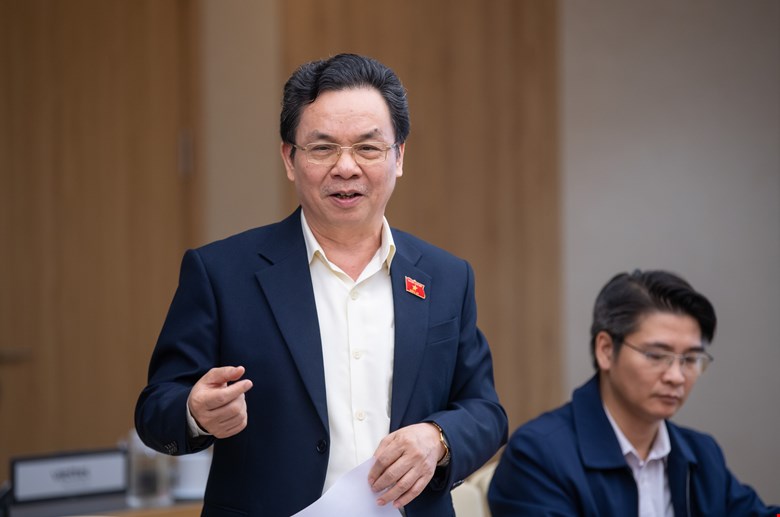
National Assembly Delegate Hoang Van Cuong
During the Hanoi group discussion, Delegate Hoang Van Cuong focused on Article 10 of the draft resolution, which addresses exemptions and reductions in land use fees and land rent payments when changing land use purposes.
Notably, the provision regarding land use fees when converting garden land to residential land drew attention. According to the draft, for garden, pond, or agricultural land within the same plot recognized during land use rights certification, the land use fee upon conversion to residential land is calculated as follows: 30% of the difference between the land use fee based on residential land prices and that based on agricultural land prices for the area within the local residential land allocation limit; 50% of the difference for the area exceeding the limit but not more than twice the limit; and 100% of the difference for the area exceeding twice the limit. This fee is applied once per household or individual per plot.
Delegate Hoang Van Cuong strongly supported the drafting agency’s proposals. He noted that in recent years, citizens have had to pay land use fees amounting to billions of dong when converting garden, pond, or adjacent agricultural land to residential land.
According to the delegate, the need for residential land is legitimate, but the requirement to pay 100% of the difference between land use fees based on residential and agricultural land prices significantly increases the financial burden on citizens.
Therefore, Delegate Cuong deemed the 30% fee for conversions within the residential land limit appropriate. He also agreed that the percentage should increase for conversions exceeding the limit set by provincial authorities.
Contributing to the discussion, Delegate Do Duc Hong Ha (Hanoi delegation) suggested reconsidering the 30%, 50%, and 100% differential rates based on the land conversion limit.
He argued that the complex percentage system could lead to significant fee disparities between localities. For example, 30% in urban areas, especially major cities, might be higher than 100% in rural areas.
Additionally, Delegate Ha pointed out that this provision might conflict with Article 121 of the Land Law. He proposed a uniform rate to address practical challenges, ensuring it is reasonable, easy to implement, and fair across localities.
Navigating Land Use Purpose Conversion: Key Considerations and Solutions
Delegates proposed that residential land conversion fees for households should be calculated based on the state-regulated price framework, rather than market rates.
Navigating Land Use Purpose Conversion: Key Considerations and Solutions
Delegates proposed that the conversion fee for residential land should be calculated based on the state-regulated price framework, rather than market rates.
Delegate: ‘Land Revoked at $45/m², Citizens Forced to Buy Back at $4,500/m² – A Reality Disconnect’

Representatives argue that the discrepancy between land reclamation and the actual land prices paid by citizens creates a mismatch with reality, leading to inconsistencies.
Supreme Court Chief Justice: Land Prices Must Align with Market Trends, Only Rising, Not Falling

Chief Justice of the Supreme People’s Court, Nguyen Van Quang, expressed concern that aligning land prices with market rates would inevitably lead to price increases, stating, “There’s no way to maintain or reduce them.”
Crafting Hyper-Localized Land Valuation Tables: A Thua-Level Approach
The draft resolution by the National Assembly outlines that land price tables will be structured based on land type, area, and location. For regions with digital cadastral maps and land price databases, pricing will be detailed down to individual land plots. Provincial People’s Councils will determine, publish, and implement these land price tables starting January 1, 2026, with provisions for amendments and updates as necessary.