Untapped Potential in Vietnam’s Supporting Industries
According to the Ministry of Industry and Trade, Vietnam currently has over 6,000 supporting industry enterprises, primarily operating in sectors such as mechanics, electronics, textiles, and footwear. However, nearly 88% of these are small and medium-sized enterprises, mostly using outdated equipment and lacking quality standards. Only about 10% have adopted automation, and less than 20% hold ISO certifications or implement modern management models like 5S, Lean, or TQM.
Leaders of the Ho Chi Minh City Supporting Industries Association note that most domestic enterprises only participate in low-value-added processing stages, making it difficult to access large-scale, high-standard orders from leading corporations.
The localization rate in many key industries remains low. Specifically, textiles and footwear achieve 45–50%, mechanical engineering 15–20%, and automobile assembly 5–20%, falling short of the 40% localization target. Despite the presence of major electronics corporations, the proportion of components produced in Vietnam is limited. This highlights a significant gap in the industrial ecosystem, emphasizing the urgent need for deeper investment to enhance domestic production value.
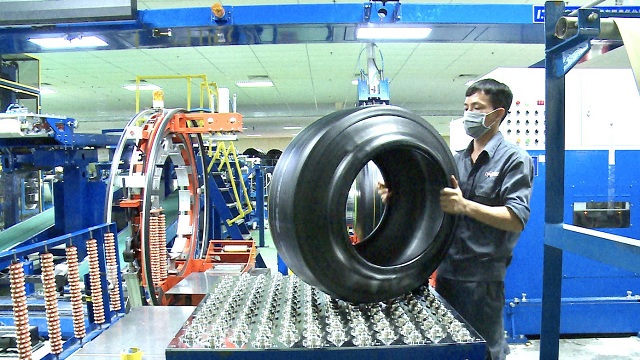
Workers in Kumho’s factory. Photo: Huong Chi
|
Mr. Haruhiko Ozasa, Chief Representative of the Japan External Trade Organization (JETRO), stated that the localization rate of Japanese enterprises in Vietnam (including both Japanese supporting industry enterprises in Vietnam and Vietnamese domestic enterprises) is 36.6%, comparable to Malaysia and the Philippines. According to Mr. Ozasa, in 2024, the weakening yen increased supply from Japan by 2.7 points compared to the previous year, reducing the localization rate in Vietnam.
Mr. Ozasa noted that, when considering Vietnamese enterprises separately, their supply to Japanese companies accounts for only 15.7% of the total supply (a 1.5-point decrease from the previous year), which is very low. Compared to Indonesia, Thailand, and Malaysia, Vietnamese enterprises still face significant limitations.
According to JETRO’s Chief Representative, 56.1% of Japanese enterprises operating in Vietnam plan to expand their investments, far exceeding ASEAN’s average of 37.7%. Notably, 50.9% of these companies intend to increase procurement in Vietnam, the highest rate among ASEAN countries. Sectors such as electrical equipment, electronics, textiles, and machinery show a strong demand for expanding local supply.
Mr. Hashimoto, Chairman of Sharp Corporation (Japan), announced that the company is exploring investment opportunities in southern Vietnam to shift its supply chain. He praised Ho Chi Minh City and Binh Duong Province for their attractive investment environments, aligning with Sharp’s criteria. The corporation already operates two factories in the Vietnam-Singapore Industrial Park (VSIP).
According to Mr. Vo Son Dien, Chairman of the Ho Chi Minh City Supporting Industries Association, the city excels in information technology with a vast workforce. Integrating information technology into manufacturing will create new advantages, strengths, and competitive capabilities for supporting industry enterprises.
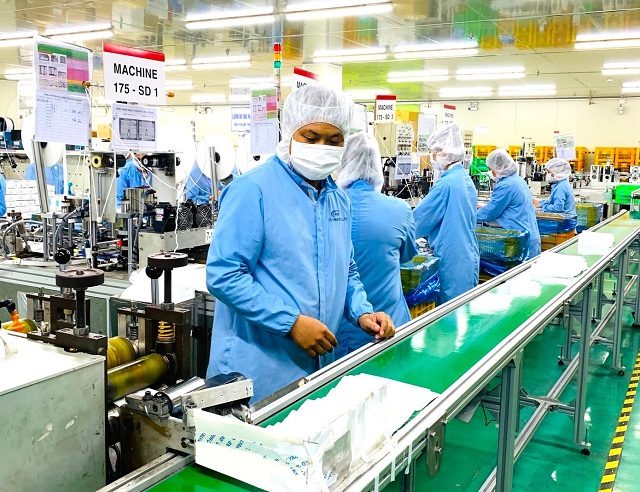
Workers in a factory in Ho Chi Minh City. Photo: Huong Chi
|
Key Policies Needed
Leaders of the Ho Chi Minh City Supporting Industries Association identify five key sectors within the industry: mining, processing, manufacturing, assembly, and maintenance. Among these, manufacturing (also known as supporting industries) encompasses four major groups—electronic components, mechanics, plastics, rubber, and accessories—forming a massive industry.
Experts highlight the industry’s vast potential, but it remains underutilized. Vietnam’s industrial development contrasts with that of developed nations. While they focus on manufacturing before assembly, Vietnam primarily engages in assembly without manufacturing, leading to dependency.
A leader from a supporting industry enterprise shared with reporters that, in addition to existing policies, a special mechanism is required. This includes dedicated land for supporting industries, initially free of charge until enterprises become profitable. A specialized agency for supporting industries should serve as the central management body, with a distinct “law” governing the sector’s development. Only then can the industry meet expectations.
Echoing this view, Mr. Nguyen Tu Quang, CEO of BKAV, suggested tailoring policies to local characteristics to determine suitable industries and attract relevant enterprises. A national materials program should focus on domestically produced materials currently imported in large quantities, enhancing Vietnam’s self-reliance and reducing dependence on foreign suppliers.
Huong Chi
– 09:49 24/11/2025
Record-High FDI Disbursement Achieved in the First 10 Months Over the Past 5 Years
According to data from the General Statistics Office and the Ministry of Finance, Vietnam’s realized foreign direct investment (FDI) in the first 10 months of 2025 reached an estimated $21.3 billion, marking an 8.8% increase compared to the same period last year. This represents the highest FDI disbursement for the 10-month period in the past five years, underscoring foreign businesses’ confidence in Vietnam’s investment policies and business environment.
Who is the Largest ‘Eagle’ Investor in Vietnam Today?
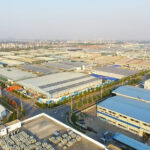
Vietnam has attracted over $31.5 billion in foreign direct investment (FDI) in the first 10 months, according to data from the General Statistics Office and the Ministry of Finance. Singapore emerged as the largest investor, contributing $3.76 billion, which accounts for 26.7% of the total newly registered capital.
Unveiling the Top Regions Surpassing $1 Billion in New FDI Capital Attraction in the First 10 Months of 2025

The latest report from the General Statistics Office (Ministry of Finance) reveals that as of October 31, 2025, Vietnam’s total registered foreign direct investment (FDI) reached $31.52 billion. This figure includes newly registered capital, adjusted capital, and the value of capital contributions and share purchases by foreign investors, marking a 15.6% increase compared to the same period last year.
Accelerating the Attraction of High-Quality FDI in Manufacturing and Processing

Vietnam has witnessed a significant surge in foreign direct investment (FDI), reaching an impressive $28.54 billion in the first nine months. The manufacturing sector remains at the forefront, attracting a substantial number of high-tech investors from Japan. This robust growth underscores Vietnam’s appeal as a prime destination for global investment.
Singapore vs. Vietnam: Q3 2025 GDP Growth Comparison in ASEAN

Singapore’s economy experienced a slowdown in the third quarter of 2025, according to data released by the Ministry of Trade and Industry (MTI) on October 14th.