







In the Kera candy case, the Ho Chi Minh City People’s Court (HCMCPC) stated that all actions by Asia Life Company in producing and trading counterfeit Kera supplements, along with other offenses by the defendants, have been separated for further investigation by the Ministry of Public Security’s Police Investigation Agency.
According to the case file, the Police Investigation Agency issued Decision No. 3109 on August 29, 2025, to separate the criminal case, focusing on the production of counterfeit Kera products.
Additionally, signs of legal violations in the production of similar products and tax-related offenses, as outlined in Decision No. 18 dated April 3, 2025, are still under investigation.
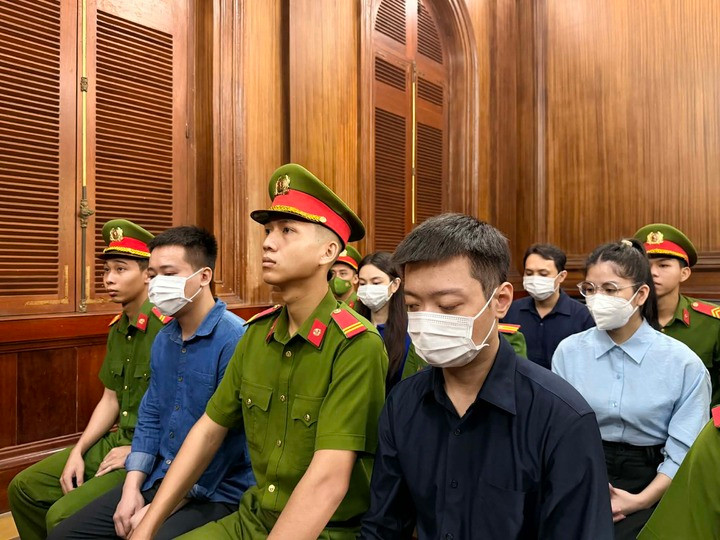
Defendants at the trial on November 19.
The Supreme People’s Procuracy did not prosecute these acts, so under Article 298 of the Criminal Procedure Code, the court did not consider them in this trial.
Based on the investigation and trial proceedings, the Police Investigation Agency highlighted several loopholes and shortcomings in management.
The court urged relevant agencies to urgently address these gaps in the legal system and state management of production and trade. The promotion and operation of products online have become avenues for fraudulent activities.
The court noted that the 2010 Food Safety Law and Decree 15/2018 allow businesses to self-declare product quality, ingredients, and functions, aiming to streamline procedures. However, this lacks pre-screening and clear accountability for authorities.
Upon receiving documents, authorities primarily check procedural validity, while post-checks are random, allowing companies to alter ingredients for profit.
Currently, dietary supplements are regulated like regular food, not as high-risk health products. Many products claim therapeutic effects but are registered as supplements to avoid pharmaceutical regulations.
Market approval does not require quality or efficacy assessments. Authorities mainly verify documents without technical scrutiny, leaving loopholes for fraudulent declarations.
The court emphasized that formal inspections and inadequate record management hinder fraud detection. It recommended legal revisions, stricter pre- and post-checks, and transparent declaration mechanisms.
On November 19, the HCMCPC sentenced individuals from Chi Em Rot Group and Asia Life for consumer fraud. Defendants received prison terms ranging from 2 to 3 years and fines of VND 50 million each.
In July 2024, Le Tuan Linh, Hang Du Muc, Quang Linh, and Tran Chi Tam formed a company for online sales, leveraging KOLs for market penetration. They recruited Le Thanh Cong and Miss Thuy Tien, offering her a 30% stake and a brand ambassador role.
The group produced “SuperGreens Gummies” (Kera) with Asia Life, claiming 22 ingredients, including 10 vegetable powders (28.13%). The product was marketed as “Natural Health from Fiber.”
However, Asia Life lacked certified raw materials, and internal tests showed only 0.935% fiber, far below claims. Despite this, they promoted it with false ads, attracting over 56,000 customers and earning VND 17.5 billion.
Consumers later found the fiber content was only 1.01gr/100gr, leading to the product being classified as counterfeit under Decree 98/2020/NĐ-CP.
Asia Life issued 30 invoices for 160,000 boxes to Chi Em Rot, valued at VND 5.6 billion. The group profited VND 12.4 billion from selling 129,000 boxes.