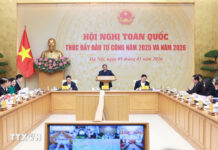










During the 28th session of the Hanoi People’s Council held on the morning of November 26, the Hanoi People’s Committee reported on the implementation of the city’s socio-economic development plan for 2025 and key tasks for 2026.
State Budget Revenue Surpasses 600 Trillion VND
Mr. Nguyen Xuan Luu, Vice Chairman of the Hanoi People’s Committee, stated that the city’s socio-economic performance in 2025 continued to grow, achieving 23 out of 24 planned targets. Notably, the Gross Regional Domestic Product (GRDP) recorded growth in each subsequent quarter, with an estimated growth rate of 8.5% for 2025. The GRDP scale reached 63.5 billion USD, accounting for approximately 12.5% of the national GDP.
State budget revenue for the year is projected to exceed 640 trillion VND (124.9% of the estimate), marking the first time it has surpassed the 600 trillion VND threshold. Land use fees alone contributed 89 trillion VND, a 167% increase.
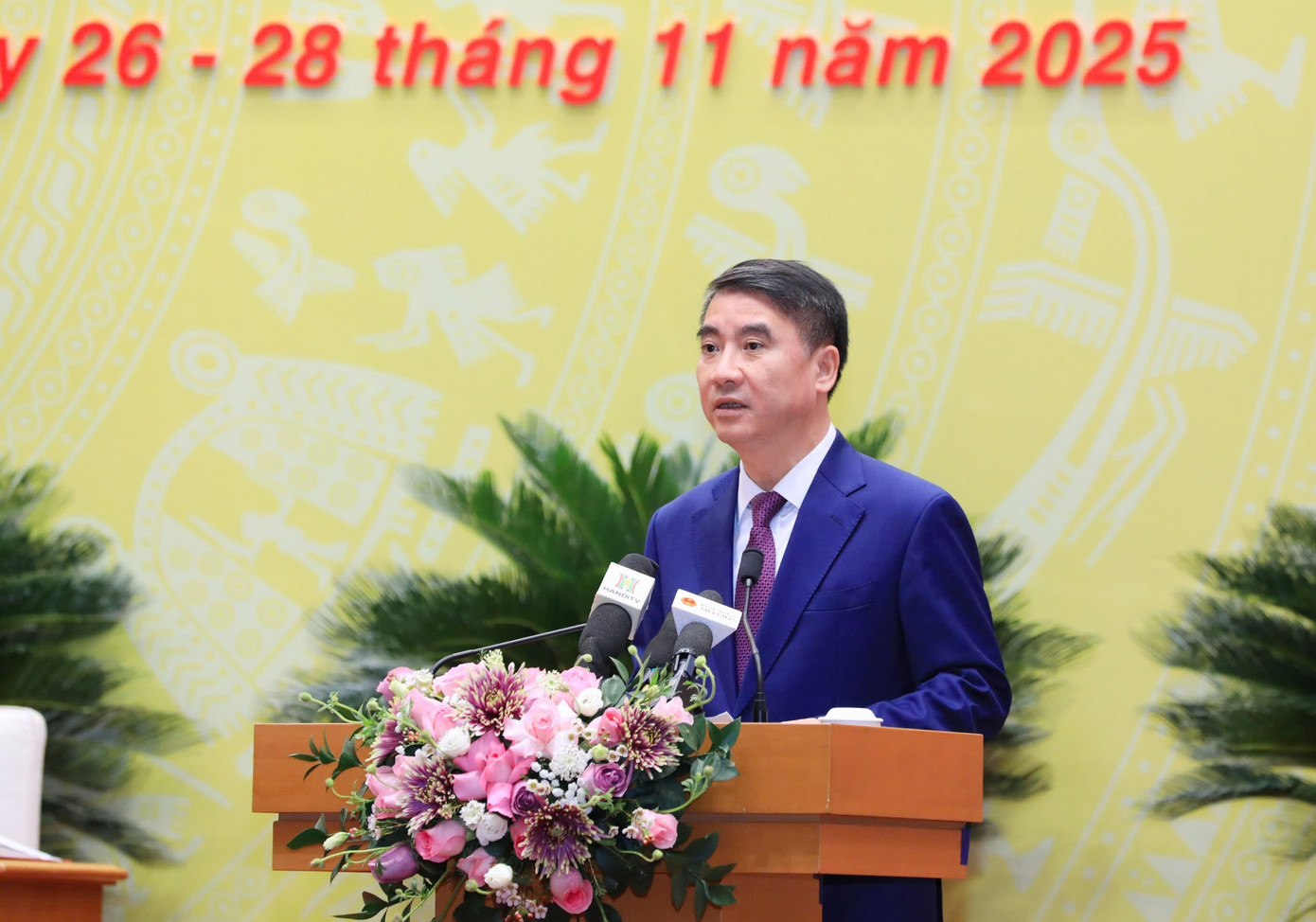
Mr. Nguyen Xuan Luu, Vice Chairman of the Hanoi People’s Committee, addressing the session.
Export turnover for the year is estimated at 20.65 billion USD, a 7.8% increase compared to 2024. Domestic economic sector exports reached 11.34 billion USD, while foreign-invested enterprises contributed 9.3 billion USD. Foreign direct investment (FDI) attracted 4.1 billion USD, a 52% increase over 2024.
Vice Chairman Nguyen Xuan Luu also noted that the public investment plan for the year was initially set at 87.13 trillion VND. After adjustments following the implementation of the two-tier local government system, the updated plan now stands at 107.135 trillion VND. As of November 26, disbursement reached 64.4% of the plan assigned by the Prime Minister.
Throughout the year, the city accelerated key projects, including the inauguration and groundbreaking of 10 major projects to commemorate the 80th anniversary of the August Revolution and National Day on September 2. Additionally, 8 projects were inaugurated to mark the 71st anniversary of the Capital Liberation Day on October 10. Preparations are underway to commence 8 key projects on December 19, 2025.
2026 Target: Double-Digit Growth
For 2026, Hanoi aims for an 11% GRDP growth. This includes 11.1% growth in services, 9.5% in industry, and 12.8% in construction.
Key growth drivers for 2026 include major infrastructure projects such as the Olympic Urban Area (350 trillion VND over 5 years), the Red River Landscape Axis (338 trillion VND over 5 years), Tran Hung Dao Bridge (8 trillion VND), and the Gia Binh Airport Connector Road (32 trillion VND).
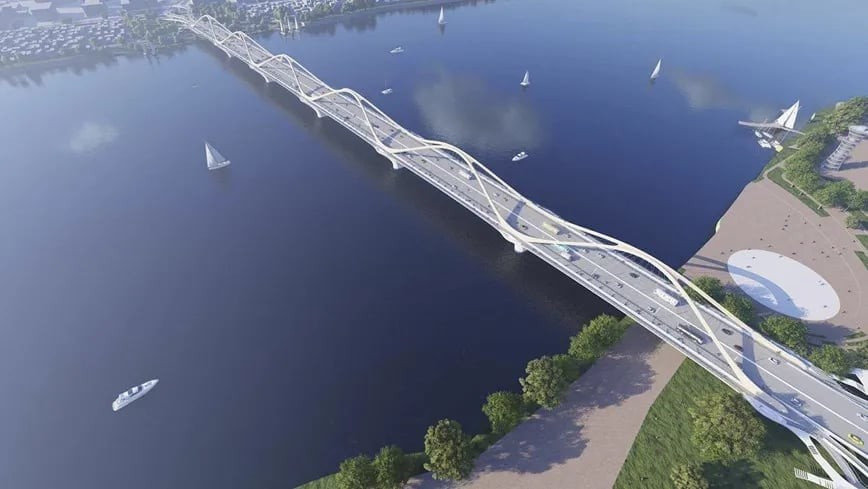
Hanoi is implementing numerous key projects to drive socio-economic development.
The city will also focus on developing services, enhancing trade, tourism, and finance; accelerating infrastructure development; and expanding the capital’s growth space along five axes.
To achieve the 2026 development goals, Hanoi will refine its organizational structure and policies for capital development. This includes enhancing the proactiveness, autonomy, and creativity of the two-tier local government system; preparing content for the Politburo to amend Resolution No. 15-NQ/TW, the Capital Law, and two development plans in line with new circumstances.
Hanoi will also adjust the urban railway network planning to ensure synchronization; maintain progress on urban railway projects (Lines 2.1 and 5); and advance the Ring Road 4 project in the Capital Region, along with bridges across the Red River (Tu Lien, Thuong Cat, and Tran Hung Dao bridges).
Additionally, the city will complete the land database and land records; implement a plan to leverage land resources, particularly in the Ring Road 4 area and TOD projects.
Hanoi aims to address five critical issues: traffic congestion, flooding, environmental pollution, food safety, and urban order. Efforts will be made to restore the water quality of the four inner-city rivers (To Lich, Kim Nguu, Lu, and Set).
Prime Relocation Spots: Mapping Companies Moving Out of Hanoi’s City Center, Anticipated Land Use Beyond Residential High-Rises
According to the proposal, the first phase will involve the relocation of 66 manufacturing facilities, agency headquarters, units, and hospitals. This includes 51 industrial production facilities (comprising 9 facilities listed in Resolution 17/NQ-HĐND dated July 8, 2022, by the City People’s Council and 42 new facilities) and 15 agency and unit headquarters.
The Transformation of the Depot Area on the Nam Thang Long – Tran Hung Dao Metro Line After One Month of Construction
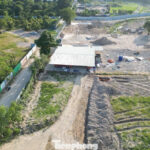
In recent days, the Xuân Đỉnh depot area, part of the Nam Thăng Long – Trần Hưng Đạo metro line project in Hanoi, has seen vibrant development. The entire 11.3-hectare construction site for the depot in Xuân Đỉnh ward has been fully prepared. This marks Hanoi’s first depot built under the Transit-Oriented Development (TOD) model, integrating smart transportation solutions.
Motorcycle Ban in Hanoi: Detailed Map and Timings for Gasoline-Powered Vehicles
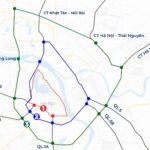
Hanoi proposes banning gasoline-powered motorbikes from entering low-emission zones based on specific timeframes or areas, as outlined in the detailed low-emission zone plan.
Critical Proposal for All Gasoline Motorcycle Riders in Hanoi
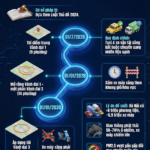
This initiative marks a significant step in Hanoi’s ambitious green transformation roadmap, which the city is vigorously advancing.
Hanoi to Pilot Ban on Gasoline Motorcycles in 9 Inner-City Wards Starting July 1, 2026
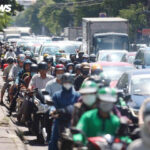
Hanoi plans to implement a low-emission zone in three phases, with the first phase piloting a ban on gasoline motorbikes during specific hours or in designated areas across nine central wards.