A recent survey by PropertyGuru Vietnam reveals that, since early November, apartment prices in Hanoi have ceased their daily, weekly, and monthly fluctuations. The market has seen a price plateau over the past month.
For instance, the Central Field project in Yen Hoa ward maintains its 2-bedroom, 2-bathroom units at 7.7 to 8 billion VND per unit.
At My Dinh Plaza 2, prices remain stable, with 2-bedroom, 2-bathroom units ranging from 6.5 to 7 billion VND, unchanged since mid-October. While some sellers have listed units at nearly 8 billion VND, no transactions have occurred at this price point.
In A14 Nam Trung Yen, 2-bedroom, 1-bathroom apartments hold steady at 4.8 to 5.2 billion VND since late October, while 2-bedroom, 2-bathroom units remain at 5.8 to 6 billion VND.
At Thong Nhat Complex, 3-bedroom units of approximately 90 sqm are priced around 10 billion VND. My Dinh Pearl’s 1-bedroom, 1-bathroom units continue to be listed at 5.2 to 5.4 billion VND, consistent with late October prices.
Home City’s 70 sqm, 2-bedroom, 2-bathroom apartments are priced between 7.8 and 8.2 billion VND, showing no recent changes.
Along Hoang Dao Thuy Street in Trung Hoa – Nhan Chinh, 3-bedroom units start at 10 billion VND, while 2-bedroom units range from 7 to 8 billion VND, unchanged over the past month.

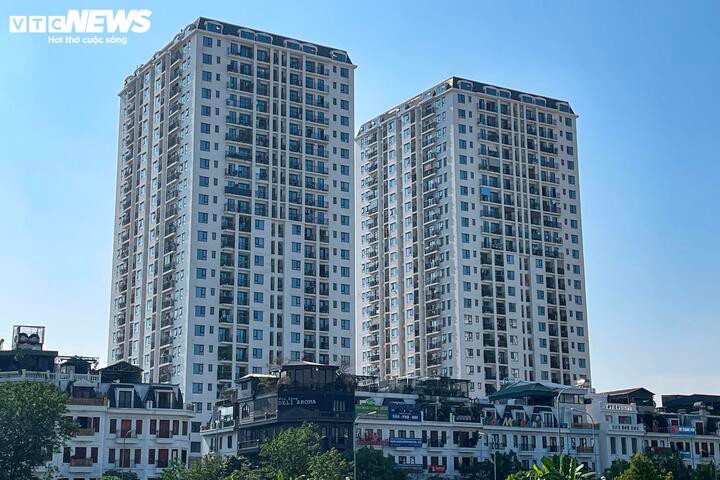
Hanoi apartment prices show signs of stabilization. (Photo: Minh Duc)
Despite stable prices, Hanoi’s apartment market liquidity has significantly declined.
Ms. Nguyen Thu Hoa, a real estate agent in Cau Giay district, reported an average of 4-5 transactions per month in September and October. However, since late October, she has only closed one deal. Many agents in her company have experienced a similar drop in transactions, coinciding with interest rate fluctuations.
“Many banks have discontinued loan packages for individuals under 35. Rising interest rates have made both investors and genuine buyers hesitant to purchase,” Ms. Hoa noted.
However, agents emphasize that market stabilization does not equate to decline. There is no widespread panic selling or price slashing. Prices remain high, and genuine demand persists, especially in central and near-central areas where land is scarce. Well-located projects with clear legal status and full amenities continue to attract steady interest.
Mr. Nguyen Quang Huy, CEO of the Department of Finance and Banking at Nguyen Trai University, observes that recent market research indicates a plateau in Hanoi apartment prices. Some projects have seen reduced liquidity, and secondary market sellers have accepted 100-200 million VND reductions to expedite sales.
However, these price reductions are localized, affecting units with poor locations, undesirable floors, suboptimal designs, or sellers facing urgent financial needs. This does not signal a market-wide price decline but reflects secondary market dynamics, where prices vary by unit rather than market-wide trends.
Mr. Huy notes that the market has reached a localized peak, particularly for newly launched projects and high-end segments. However, declaring an absolute peak lacks sufficient evidence. Sustained supply shortages, strong genuine demand, migration to Hanoi, urbanization, and infrastructure expansion continue to support prices. Long-term price adjustments are unlikely as development costs rise.
“In the near future, Hanoi’s apartment market is expected to polarize. Projects with prime locations, transparent legal status, full amenities, modern designs, and efficient management will maintain or slightly increase prices.
Conversely, projects in outlying areas with limited amenities, high density, or outdated designs will face liquidity challenges and may need to reduce prices or offer discounts to compete. Increased social housing supply will support low-income buyers and partially ease demand pressure but won’t significantly lower overall prices,” Mr. Huy predicts.
Apartment Prices Unlikely to Cool This Year
Market cooling expected in 1-2 years. (Photo: Minh Duc)
Experts predict that apartment prices will take 1-2 years to cool. Mr. Pham Duc Toan, CEO of EZ Property, attributes the recent price surge to limited supply, concentrated in high-end segments.
Recently, Hanoi resolved bottlenecks for 298 commercial housing projects, with many set to break ground soon. Additionally, the government is accelerating social housing development. This will significantly increase supply by 2026-2027.
“Increasing supply is key to addressing high prices. By 2026-2027, as supply surges, apartment prices will decrease. With more developers entering the market, competition will drive prices down, benefiting genuine buyers,” Mr. Toan stated.
Ms. Do Thu Hang, Senior Director of Research and Consulting at Savills Hanoi, forecasts 8,900 new units in Q4/2025, primarily mid-tier. From 2026 onward, supply is expected to be more abundant.
She identifies three factors cooling apartment prices: increased supply, with Hanoi approving 148 projects covering over 840 ha for commercial housing; accelerated renovation of old apartments, boosted by new regulations allowing additional floors; and expedited social housing projects with improved investor policies.
Skyrocketing Apartment Prices Leave Investors Barely Breaking Even

Many investors report holding their apartments for 4–5 years, so despite prices surging by over a billion dong in the past year, they’ve only broken even and haven’t turned a profit yet.
Does Ba Huan’s Tax Debt Impact the Stabilized Egg Program?

Amidst the controversy surrounding Ba Huan eggs, including tax debts and ownership changes, the Department of Industry and Trade of Ho Chi Minh City has confirmed that the company remains an active participant in the city’s price stabilization program.
2026 Condo Price Predictions: Expert Insights Revealed
Real estate experts predict that current condominium prices are excessively high and may have already peaked. As a result, the market is expected to undergo a new correction phase starting in 2026.
Hanoi Apartment Market Anomaly: Are Featured Projects Truly Slashing Prices?
Data from the Institute of Construction Economics (Ministry of Construction) reveals that in Q3/2025, alongside projects with rising prices, several developments saw price reductions, including Hanhomes Blue Star, N04A Ngoai Giao Doan, and AZ Lam Vien Complex.
₫6 Billion Still Falls Short for Buying an Apartment in Hanoi

Owning a 2-bedroom apartment in the city center for just 6 billion VND seems like a dream come true, but the reality is far more challenging than it appears.