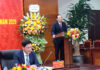
Mr. Nguyen Van Duoc, CEO of Trong Tin Accounting and Tax Consulting LLC
On the morning of November 28, the Corporate Finance Magazine, Vietnam Tax Consultants Association, in collaboration with the Hanoi Tax Department and related units, organized a seminar titled “Supporting Business Households in Transitioning from Lump-sum Tax to Declaration, Aiming Towards Enterprise Status.”
During the seminar, a business household raised a question: For revenues exceeding 1 billion VND, electronic invoices must be issued, but for revenues between 200 million and 1 billion VND, it’s not mandatory. What constitutes a valid invoice for this revenue range? Obtaining electronic invoices from small individual buyers is challenging. What steps should be taken to ensure legitimate input invoices for declaration?
Addressing this concern, Mr. Nguyen Van Duoc, CEO of Trong Tin Accounting and Tax Consulting LLC, stated that according to Decree 70, by December 31, 2025—just over a month away—three groups of business households must adopt electronic invoices.
Under Article 4 of Decree 123, amended by Decree 70, the general principle is that all business activities, sales, and service provisions must issue invoices to buyers. This principle remains unchanged.
However, exceptions exist. Business households under the lump-sum tax regime or those not yet required to pay tax are not obligated to use invoices. Decree 70 stipulates that business households with revenues between 100 million and 1 billion VND must use electronic invoices through cash registers connected to tax authorities.
The second case applies to households already equipped with cash registers, which must connect these devices to tax authorities.
The third case involves large-scale business households operating under the declaration method, which must also comply with electronic invoicing via cash registers as per current regulations.
For households under the lump-sum tax regime with revenues below 1 billion VND, electronic invoicing via cash registers is not mandatory until the end of 2025. However, declaring households or those opting in voluntarily must still issue invoices.
From 2026, regulations will change as the lump-sum tax regime is phased out. According to Scheme 3389, all businesses selling goods or services must issue invoices to buyers, except in cases below the taxable revenue threshold or with specific exemptions.

Regarding input invoices, Mr. Duoc explained that under current regulations, Circular 40 and the declaration method require maintaining seven accounting books per Circular 88. Tax calculation remains based on revenue multiplied by a rate, similar to the lump-sum method, but with full revenue declaration and mandatory invoicing for all sales.
For input invoices, Mr. Duoc noted that tax laws do not heavily penalize the absence of input invoices in determining tax obligations. Until 2025, tax management focuses on output revenue. For example, a 10 billion VND revenue, even without input invoices, is taxed based on the full amount multiplied by the rate. Input invoices are not yet decisive for tax liabilities.
However, businesses are legally entitled and obligated to obtain invoices for purchases. Failure to do so may violate other laws. For instance, unverifiable origins during market management inspections can lead to seizures. Similarly, failure to produce transport documents within 24 hours during police checks can result in goods confiscation.
Thus, securing input invoices before 2025 is crucial for proving ownership and legal compliance. Tax authorities recommend obtaining invoices for transparency. From 2026, policies will shift: all businesses must have input invoices to prove ownership and fulfill tax obligations, especially under the “revenue minus expenses” method with 17% or 15% tax rates.
Without input invoices, future business operations will be severely hindered, except in specific cases like unprocessed agricultural/aquatic products, raw materials, or personal assets. For example, purchasing a used phone from an individual is acceptable, but claiming to buy commercial vehicles or motorcycles without invoices is not. Except for special cases, businesses must obtain input invoices.
“Hanoi Tax Deputy Director: Gold Shops Must Record Citizen ID or Tax Code of Buyers and Maintain Detailed Seller Information Logs”

At the “Vietnam Gold Market: Opportunities and Challenges in the New Phase” forum, Mr. Nguyen Tien Minh, Deputy Director of Hanoi Tax Department, revealed insightful information regarding the current state and future prospects of the gold market in Vietnam.
“Hanoi Tax Deputy Director: Gold Shops Must Record Citizen ID or Tax Code of Buyers and Maintain Detailed Seller Information Logs”

Mr. Nguyen Tien Minh, Deputy Director of the Hanoi Tax Department, shared this information at the forum titled “Vietnam’s Gold Market: Opportunities and Challenges in the New Phase.”
Revised Title:
Finance Ministry to Recalculate Taxable Revenue Thresholds for Households and Individual Businesses

On November 19th, during a legislative discussion in the assembly hall, Minister of Finance Nguyen Van Thang announced that the Ministry of Finance will thoroughly research and calculate an appropriate tax rate for business households.
Must-Know Benefits and Considerations for Household Businesses Earning Over 200 Million VND/Year When Switching from Lump-Sum Tax to Declaration Model

As of January 1, 2026, new tax regulations for businesses will be implemented in accordance with Resolution 198/2025/QH15 and Decision 3389/QD-BTC. Business owners with annual revenues ranging from 200 million to 3 billion VND should take note of the following key points.
Finance Minister Confirms More Favorable Tax Policy for Household Businesses: Threshold Increased from 100 Million VND to 200 Million VND Annual Revenue

Minister of Finance Nguyen Van Thang stated that the fundamental tax calculation method remains unchanged. Previously, it was based on a fixed tax system (where business owners self-declared revenue), whereas now it relies on revenue declaration. Transitioning to this declaration system significantly reduces losses, particularly in economically developed areas.