Japanese retailer Muji has launched two flagship stores in Thailand and Vietnam on November 28th, while expanding its range of locally tailored products, from apparel to snacks.
A new store in Bangkok – the largest in Southeast Asia by floor area – and one in Ho Chi Minh City are reopening after expansions aimed at solidifying Muji’s position in what it calls its “next profit driver” region, where it already operates around 100 stores across five countries.
“Localization” in Vietnam and Thailand
Central to their strategy is a focus on “localization,” which includes offering items like Thailand’s popular coconut rolls or motorcycle helmets in Vietnam, where scooters dominate the bustling streets.
“Food will positively impact customer traffic, which has been a challenge, so we want to focus on and strengthen it as a core category,” said Akihiro Kamogari, CEO of the Thai subsidiary, in an interview with Nikkei Asia on November 21st.
In Thailand, the number of food items – including locally produced products like coconut spring rolls and shrimp snacks – has doubled to around 200 to coincide with the opening of the CentralWorld (Bangkok) flagship store.
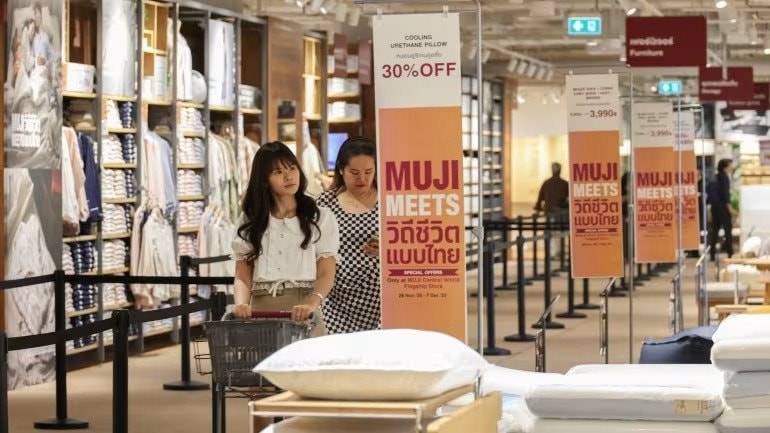
Muji’s Bangkok flagship store spans nearly 3,300 square meters.
According to Kamogari, the ultimate goal is to expand to 300 to 350 products. A food development team was established about a year ago, with experienced staff brought in from Japan to collaborate with local employees and suppliers.
Food currently accounts for about 4% of the company’s sales in Thailand, but Kamogari said he expects “to enhance development with a target of increasing this figure to 7% by 2028 and 10% by 2030.”
In Vietnam, Muji noted that motorcycle helmets and raincoats are particularly popular, while a long pillow made from recycled polyester launched in Vietnam has also been introduced in other ASEAN markets.
“It’s crucial to provide essential items for local life and customs,” said Tetsuya Nagaiwa, General Director of the Vietnamese subsidiary.
Muji is also developing snacks and chocolates designed to appeal to Vietnamese customers. “We hope these items will encourage people to visit the store and experience Muji,” Nagaiwa added.
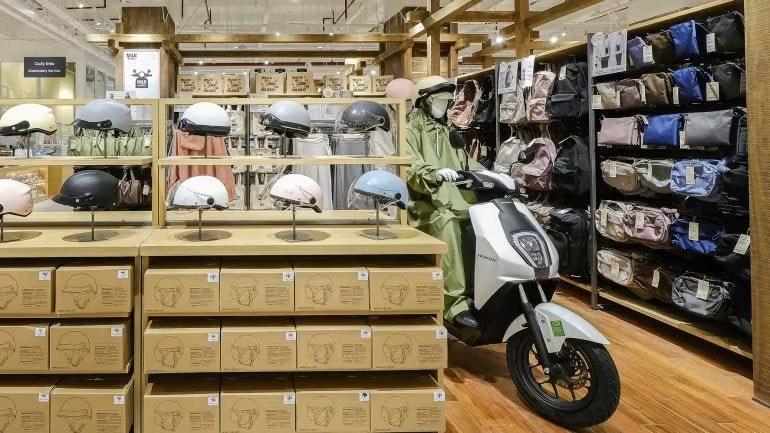
The Vietnam store features products like helmets and raincoats.
Additionally, the brand is increasing local production of some globally distributed products, allowing them to be offered at lower prices. For example, in Vietnam, the recent development of freeze-dried strawberries coated in chocolate has enabled the product to be sold at approximately 60% of the price required when imported.
This local production also helps products comply with specific country regulations and shortens delivery times.
Southeast Asia as the “Next Golden Goose”
In its medium-term growth plan announced last month, Ryohin Keikaku set a target of 1 trillion yen ($6.4 billion) in revenue and 100 billion yen in operating profit for the fiscal year ending August 2028.
The company stated that its Southeast Asia and Oceania business, with revenue increasing 28% to 50.1 billion yen in the fiscal year ending August 2025, is expected to play a significant role in achieving this three-year goal.
The company’s footprint in Southeast Asia remains small compared to Japan and mainland China, where it operates 683 and 422 Muji stores, respectively, as of the end of August, not including cafes. However, during a press conference on the three-year plan, Chairman Satoshi Shimizu stated that he aims to develop the region into the “next profit driver by 2028.”
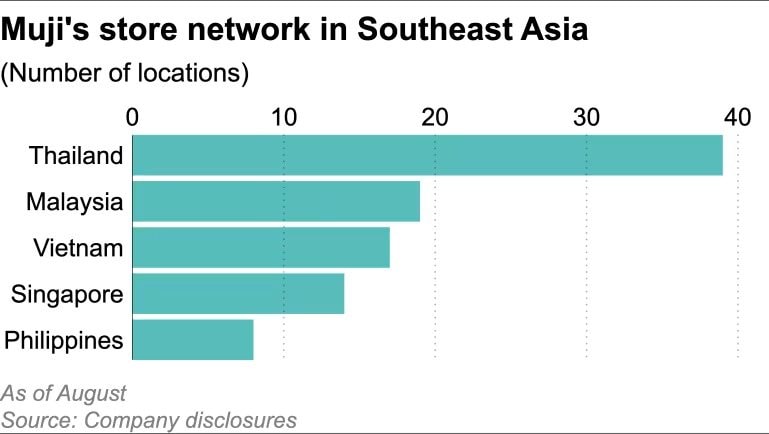
Muji’s store network across five Southeast Asian countries.
However, Muji faces increasing competition in Southeast Asia as more retailers from Japan, China, and elsewhere seek to expand in the region. Early this month, real estate services group CBRE reported an increase in total retail supply in Bangkok, noting that “the wave of Chinese brands entering and expanding remains a highlight” in Ho Chi Minh City’s market.
Muji plans to use its new flagship stores in these two cities, which attract many domestic and international visitors, as information hubs for the entire Southeast Asian region.
“We aim to strengthen Muji’s presence not only domestically but across the ASEAN region,” Nagaiwa said. “We want the flagship stores to serve as information dissemination centers.”
The new Bangkok location will house Atelier Muji, a workshop space hosting lifestyle events to promote the Muji brand, marking its first deployment outside Japan. Additionally, a dedicated corner will showcase food products typically sold in Muji stores across other countries like Vietnam, Malaysia, and Taiwan.
“Without the success of this [flagship store], I don’t believe the entire ASEAN business will succeed,” Kamogari said. “We’ve prepared for a strong start, and after the opening, we’ll continue to focus on initiatives like product categorization and marketing.”
Vietnam Poised for Stunning Surge, Projected to Hit $39 Billion by 2025: Doubling Southeast Asia’s Benchmark
Achieving the $39 billion target by 2025 is not merely a milestone in economic growth but a testament to the adaptability and technological embrace of the Vietnamese people.
Seizing Opportunities Amid Regulatory Scrutiny: MWG CEO on Tax, Counterfeit, and Substandard Goods Crackdown
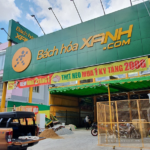
The MWG Group’s mini-supermarket chain is set to launch its first store in Ninh Binh this November. According to MWG’s CEO, Mr. Vu Dang Linh, this food retail system has the potential to open over 1,000 stores annually in the upcoming period.
Vietnam’s Leading Index Tops Southeast Asia for Three Consecutive Years

Experience exponential growth with a remarkable 20% annual development rate—three times faster than the GDP growth rate.
$20 Million Shopping Mall Officially Opens in Vietnam’s Most Livable City

This marks MM Mega Market’s inaugural shopping center project, signifying a pivotal strategic expansion in the Vietnamese market.
Vietnamese Index Surges as Fastest in Southeast Asia, Unveiling “Unprecedented Historical Goal” – Russian Media Reports

Vietnam’s index surpasses that of regional powerhouses like Singapore, Thailand, Indonesia, and Malaysia, solidifying its position as a formidable contender in the area.