According to VASEP, Vietnam’s seafood exports in the first 10 months of the year marked a significant milestone, surpassing $9.5 billion, a 15% increase compared to the same period last year.
China and Hong Kong (China) remain pivotal markets for Vietnam’s seafood industry this year. By the end of October, exports to these markets exceeded $2 billion, with a remarkable 32% growth, particularly in lobsters, sea fish, and live crabs. The rising demand for fresh seafood during the year-end period presents substantial growth opportunities for Vietnamese businesses.
Exports to Japan continued their steady recovery, reaching nearly $1.4 billion in the first 10 months, driven by strong consumption of shrimp, squid, sea fish, and sterilized crabs.
Europe also showed robust growth, with exports totaling $985 million in 10 months, benefiting from the relaxation of certain technical barriers on Vietnam’s farmed seafood. Meanwhile, exports to South Korea maintained double-digit growth, reaching $725 million, fueled by high demand for octopus and surimi.
Markets within the Comprehensive and Progressive Agreement for Trans-Pacific Partnership (CPTPP), notably Canada, Australia, and Japan, remain the fastest-growing regions, highlighting Vietnam’s advantage in leveraging tariff preferences.
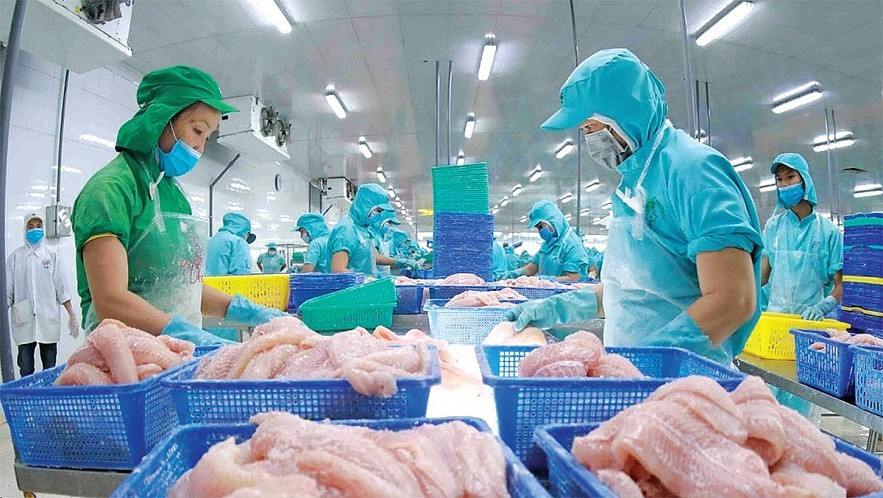
Seafood exports to the U.S. have entered a period of volatility in recent months.
In contrast, the U.S. market has entered a phase of significant volatility. While overall 10-month exports to the U.S. still increased year-on-year to approximately $1.6 billion, a downward trend became evident from Q3 due to the 20% retaliatory tariff imposed in August. Key products like shrimp and pangasius, which hold substantial market share, saw declines in September and October as businesses adjusted volumes to mitigate potential losses.
Additionally, challenges such as anti-dumping duties on shrimp and the Marine Mammal Protection Act (MMPA), expected to impact harvested seafood from 2026, have made the U.S. market a high-risk area for the industry.
The decline in the U.S. market is no longer a forecast but a reality reflected in corporate financial reports. The lag in tax policy is gradually eroding profit margins, forcing businesses to rethink their market strategies.
Sao Ta Food JSC (FMC) exemplifies the impact on businesses. In the first 9 months, FMC reported an after-tax profit of VND 251.2 billion, up 6.7%, but this required absorbing nearly VND 193 billion in retaliatory taxes this year, compared to zero in the same period last year. Selling expenses doubled, and anti-dumping and countervailing duties surged compared to the previous year.
Vinh Hoan (VHC) clearly illustrates the trend of reducing U.S. orders to avoid losses. Revenue from the U.S. market in recent months dropped by 36%, with the domestic market surpassing the U.S. as the company’s largest revenue source for the first time.
VASEP anticipates that 2026 will bring numerous challenges, including the prolonged U.S. retaliatory tariffs, potential MMPA impacts, the EU’s possible continuation of the IUU yellow card, and increasing competition from India, Ecuador, and Indonesia. This necessitates Vietnamese businesses to proactively restructure markets, develop value-added products, invest in processing technology, and enhance sustainability standards to sustain long-term growth.
Europe Tightens Seafood Traceability Regulations

As of January 10, 2026, the European Union (EU) will implement new regulations for controlling imported seafood. Being one of the top three seafood suppliers to this market, Vietnamese businesses are expected to face significant impacts from these updated rules.
Vietnam’s Seafood Exports Projected to Hit $10.5 Billion in 2023
The Vietnam Association of Seafood Exporters and Producers (VASEP) forecasts that the country’s seafood export turnover will reach a record-breaking $10.5 billion this year.
Vietnam’s Underwater ‘Treasure’ Outshines Catfish and Tuna: Exports Surge Over 300% as Competitors Face U.S. Tariffs Exceeding 50%
This product has generated over $57 million in revenue since the beginning of the year.
Vietnam’s Affordable Superfood Sweeps Asia and Europe: Surging Past $200 Million in Sales as Thailand and South Korea Race to Secure Supplies

Thailand and South Korea have emerged as the two largest consumers of this product, solidifying their position as key markets in the industry.
Vietnam’s ‘Catfish King’ Seizes $42 Million Opportunity as China’s Tilapia Exports to the U.S. Stall

Amidst the challenges facing tra fish exports, Nam Viet Joint Stock Company (ANV) is emerging as a trailblazer, strategically pivoting to tilapia production. This shift capitalizes on the market gap in the U.S., where Chinese supply has dwindled due to elevated tariffs.