This milestone officially places Vietnam among the top 15 countries with the largest trade volumes globally, a strategic achievement that experts believe will significantly impact the nation’s economy. Mr. Nguyễn Tuấn Việt, CEO of VIETGO Export Promotion Company, offers an in-depth analysis of this landmark and its long-term implications for Vietnam’s trade position.
According to Mr. Việt, the remarkable aspect is not merely the figure of 801 billion USD but the unprecedented growth rate and the sustained expansion of trade. “Reaching the 800 billion USD mark by mid-November highlights that Vietnam’s trade momentum far exceeds typical commercial cycles. This underscores a new pinnacle in production capacity, adaptability, and economic openness,” he stated.
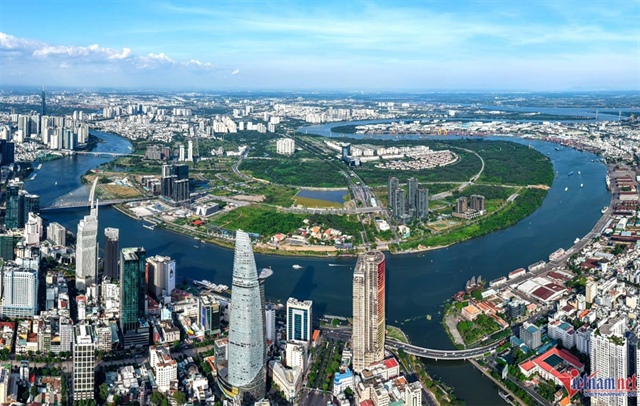 Vietnam enters the top 15 countries with the largest trade volumes globally. Photo: Nguyễn Huế |
Compared to other leading nations, Vietnam’s entry into the Top 15 is notable as this list has remained largely unchanged for years, dominated by traditional powerhouses like the U.S., China, Japan, Germany, South Korea, and Singapore. “Joining the Top 15 reflects not only scale but also maturity in trade practices, production standards, technological advancement, and supply chain management,” Mr. Việt observed.
He emphasized that a nation’s trade position hinges on its ability to generate foreign currency and maintain a stable trade surplus. Vietnam has consistently recorded trade surpluses, currently around 30 billion USD, bolstering foreign exchange reserves, stabilizing exchange rates, and providing macroeconomic flexibility.
“To become an economic powerhouse, a country must rely on exports. Without foreign currency, accumulation, and enhanced status, progress is impossible,” he added.
A key development is Vietnam’s progress driven by both foreign-invested (FDI) and domestic enterprises. In recent years, the export values of these sectors have converged, indicating significant upgrades in technology, product quality, export standards, and market access among Vietnamese firms.
“Vietnamese companies are no longer limited to OEM or processing roles. Many agricultural, processed food, wooden, consumer, and even construction products now meet high export standards and have established brands. This shift is crucial for Vietnam to enhance both the quantity and quality of its exports,” Mr. Việt explained. This forms the basis for Vietnam’s deeper economic growth and reduced reliance on low-cost industries.
In this context, comparisons with India, the nation immediately above Vietnam, are particularly insightful. Despite India’s population being 14 times larger and its strengths in software and agriculture, its total trade volume only slightly exceeds Vietnam’s. “The gap between Vietnam and India is narrowing rapidly. If this trend continues, Vietnam could surpass India within 1-2 years, fundamentally altering its position in global supply chains,” Mr. Việt predicted.
Another critical point Mr. Việt highlighted is Vietnam’s export capacity, which has reached or surpassed its 2024 GDP. In 2024, total exports hit 400 billion USD, with projections of 450-500 billion USD in 2025. “Few countries achieve this ratio, demonstrating Vietnam’s expanding production, supply chain integration, and rising competitiveness,” he clarified.
Mr. Việt views 2025 as not just a record-breaking year but a pivotal one in Vietnam’s journey toward becoming a major global trade economy. “We possess rare advantages: the most extensive FTA network, political stability, a strategic location, competitive logistics costs, and a young workforce. These are precisely what multinational corporations seek amid global supply chain restructuring,” he noted.
The focus now is not on maintaining position but on accelerating growth
Within the broader context, Mr. Việt sees substantial growth potential in various Vietnamese sectors: agriculture (with coffee potentially reaching 10 billion USD for the first time), wood products, processed seafood, consumer goods, and construction materials. Additionally, the industrial-electronics sector is experiencing a significant shift toward Vietnam. “When both industrial and processed agricultural sectors grow simultaneously, the trade momentum will be far greater,” he analyzed.
Mr. Việt stressed that the 801 billion USD milestone in November 2025 is not just a one-year achievement but the result of years of accumulation and growth strategy transformation. “This reflects a qualitative shift, not merely quantitative. Vietnam is on the cusp of reaching 1 trillion USD in trade, once considered unattainable. Vietnam’s economic position on the global trade map is increasingly prominent.”
He concluded: “Vietnam has entered the Top 15. The priority now is not to maintain this position but to accelerate. With sustained momentum, Vietnam could become one of Asia’s leading production and trade hubs within 5-7 years. This directly supports the government’s 2025 GDP growth target.”
Historically, each percentage point of export growth has significantly contributed to GDP through foreign exchange accumulation, production expansion, and trade surpluses that stabilize exchange rates and control inflation. Vietnam’s current 30 billion USD trade surplus provides a buffer for flexible government management amid global economic volatility.
Being in the Top 15 also signals continued high-quality FDI inflows into Vietnam, essential for boosting productivity, expanding manufacturing, and increasing value addition, thereby directly contributing to GDP.
In essence, the Top 15 milestone not only reflects Vietnam’s trade status but also indicates that the government’s GDP targets for 2025 are more achievable than ever.
Đức Thuận
– 11:27 30/11/2025
Unmet Demand: The Vast Opportunity in Vietnam’s Senior Care Real Estate Market
The current elderly care system is still in its infancy, with fewer than 30% of communes and wards offering support models for seniors. Nationwide, the number of specialized care centers remains under 100, highlighting significant gaps in meeting the growing needs of the aging population.
Luxury Condos in Ho Chi Minh City Hit Staggering 450 Million VND/m² Mark

Despite luxury and high-end apartment projects in Ho Chi Minh City reaching staggering prices of 120-200 million VND per square meter, with some even hitting 450 million VND, interest has surged by 168% in the past quarter.
High-Speed Rail Project: Company Urges Immediate Action with $100 Billion Funding Pledge

Mr. Truong stated that he has submitted an urgent petition regarding his exclusion from the North-South High-Speed Railway project meeting. He has requested a direct meeting to present and clarify his investment proposal and capital plan.
Vietnam Joins Top 15 Global Trade Powerhouses with $801 Billion in Total Trade, Poised to Surpass India
“At the current growth rate, Vietnam could very well surpass India in just one to two years,” stated Mr. Nguyễn Tuấn Việt, CEO of VIETGO Export Promotion Company.
Toyota Innova Cross Budget Variant Leaked: Priced Under $32,000, Smaller Wheels, Compact Display, No ADAS, But Includes Auto Cruise, 6 Airbags, and 8 Sensors

Introducing the Toyota Innova Cross 2.0G, an affordable variant designed to offer exceptional value. Compared to the premium 2.0V model, the 2.0G trims down select features while maintaining the Innova’s signature reliability and performance. With a potential price tag under 755 million VND, this version is perfect for those seeking a balance between cost and functionality.